Musings
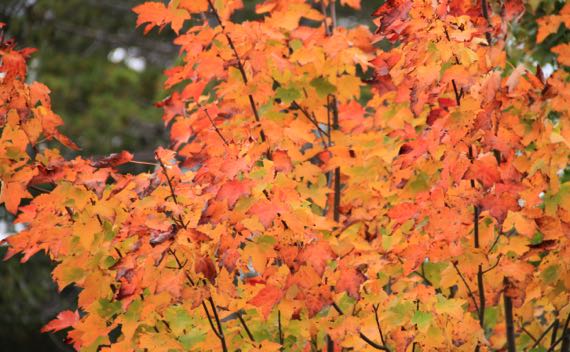
We ventured over to the wildlife refuge to check on critters and color.
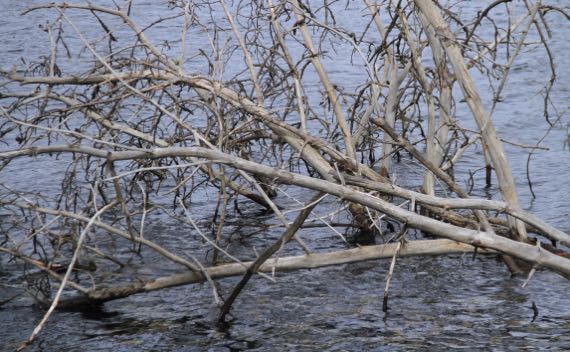
I got distracted by a tree skeleton…
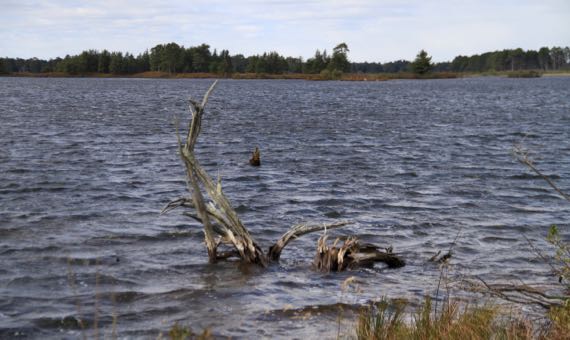
…and a stump skeleton…
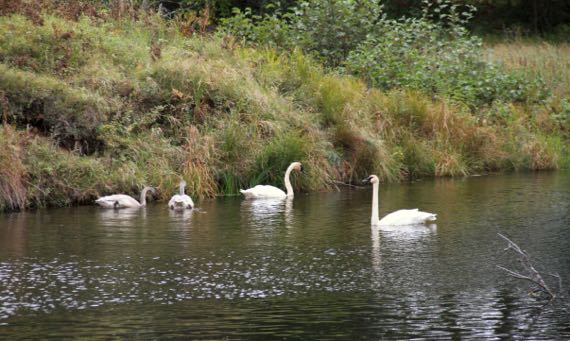
…as the bird count was low, and most we saw were far away. We did see a loon (near the loon overlook, of all places), a very few Canada geese and mallards, a wood duck, and this family of swans. The mostly-grown goslings cygnets, to the left, still have slightly brownish-grey feathers; I do not know when they become white.
Posted at 5:41 PM |
1 Comment »
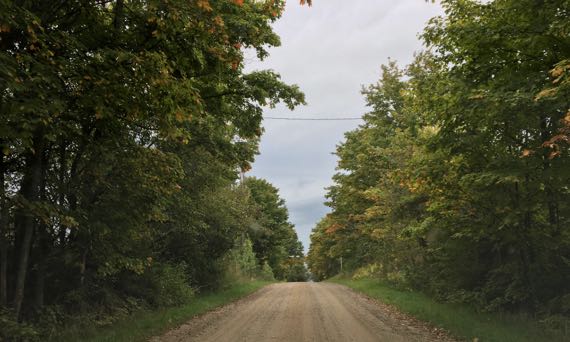
I made a grocery run, very local. Bread and milk. I know that’s a standard joke, but true today. Over off the northeast side of the lake, the leaves are well within the golden orange/brown bronze continuum, with considerable green remaining, and bits of red. This is our road, same latitude, but far more green—and many of these are maples. A Ma-Nachur mystery.
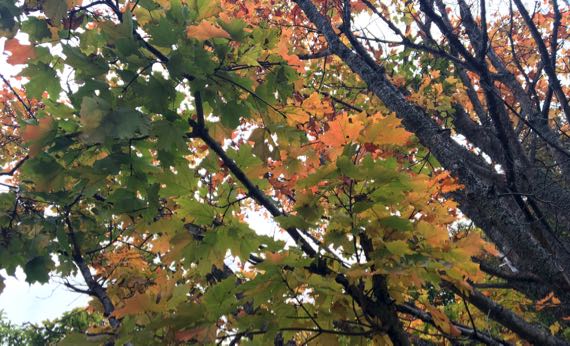
This maple, right next to the cottage, has far more colorful leaves, and many are already falling. This tree runs ahead of its neighbors every autumn, in my observation.
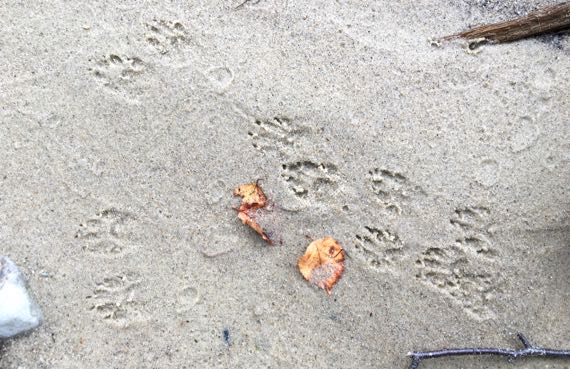
Down at the beach, the water was quiet, revealing a narrow sand strip. I think these are raccoon tracks.
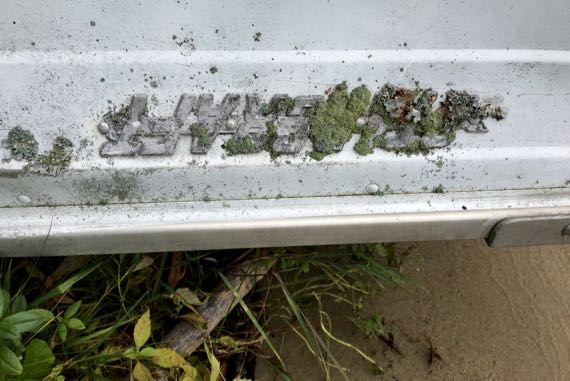
And this rowboat…it showed up early in my childhood, making it about a half-century old. If I remember correctly. The moss and lichen are creatively obscuring the STAGECRAFT logo….
Here’s another “track” (broadly defined)…about a half-mile north of us is a swamp, maybe a quarter-mile along the road. The road bumps along only about a foot above typical water level. Sometimes, there’s a weather change at the swamp; this may sound unlikely, but I’ve noted it over and over. It happened today. As I passed north, headed for my shopping, the asphalt was wet, just damp, in the swamp, and beyond. At our end of the road, nope, dry—the air was humid, but no rain. It is expected broadly across the area before dark, however.
Posted at 5:21 PM |
Comments Off on Tracks
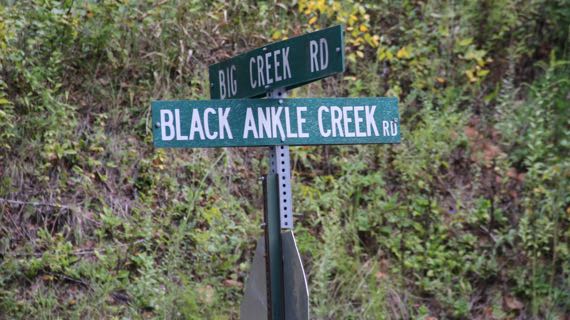
We took a wilderness wander today, a long loop on our way to Little A-town. We took Big Creek Road for quite a distance, and at this corner could go either way, and we stayed with BCR (in order to go through Aska, which turned out to be a few remaining buildings and fields, no commercial structures and no town center). Note that Big Creek didn’t really flow through a Big Valley, and that there was indeed a Little Creek near the far end of our route.
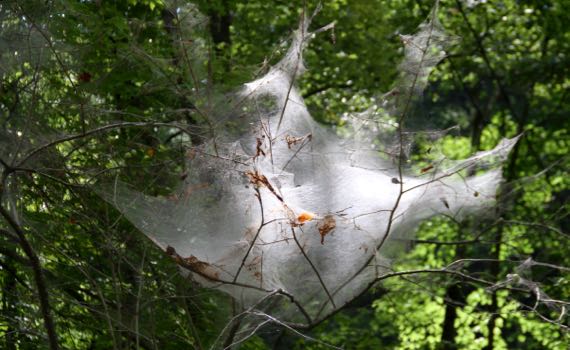
We saw lots of outsized caterpillar tents like this in the mountains, and the grass was darned green for this time of year. I don’t know if the two reflect the same summer weather trends. Still—GIANT caterpillar tents.
Posted at 9:47 PM |
Comments Off on Corner of BCR and BACR

This cat duo, Sebastian and Eloise, are taking advantage of the thermal mass of their front step to gain some cool in the early morning. Temperature cool, that is.
Later Sebastian moved to our thermal mass porch, and the Guru got worried that he was parched-limp, not merely, cat-napping, and put out a bowl of water. Sweet man.
Title borrowed from Eric Gurney’s “How To Live With A Calculating Cat” (1962).
Posted at 9:49 PM |
Comments Off on Calculating cats

This is the kind of plant I’d look up starting with sedges. I think of sedges as funky marshy-land grass-like denizens. Maybe these cotton-top, stiff-stemmed plants?
I found out the other day that there are kinds of insects known as sedges—a new one on me. I got this from a fly-tying book on what the insects and the fishing-flies that imitate them look like—not actually how to tie them.
Later, I checked the big world of the internet, and found out that bug-sedges are what I have heard called caddis flies. Their wings fold into an inverted V making a lengthwise ridge above their backs.
Posted at 10:22 PM |
Comments Off on More vocab

Over at the Refuge, where we went to dodge chores in the damp of the morning, we saw nesting swans…also flying and floating and feeding swans. Not many Canada geese. A beaver.
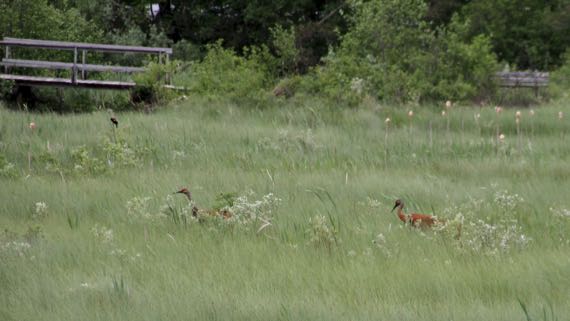
Several sandhill cranes. And a red-wing blackbird to the left.
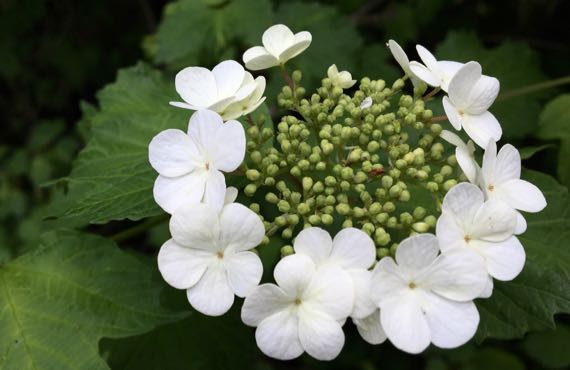
Some kind of viburnum. I thought it was a hobblebush (there’s a name), but if these are the leaves, they don’t match those in my ID book….
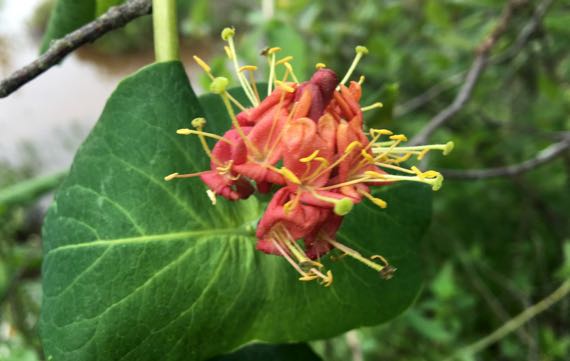
I saw just one specimen of this vine, with leaves that wrapped around the stem almost completely, and this showy bloom. I cannot find it in my book…. I call it the mystery vine.
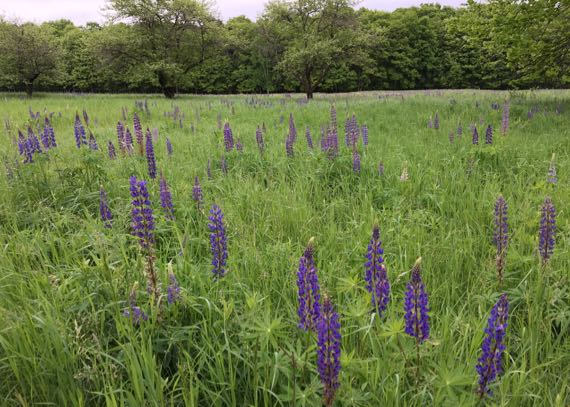
Across our orchard and field, the deep blue lupine are variable, but most are dark across the entire bloom part. Of course, there are also some in pink and white, and some…blended versions, too.

So, for our collection, this is an unusual coloration, this bicolor presentation. Pretty though, especially with the dark lines. Interestingly, this is the version in my wildflower guide.
This is sure the lupine-time. They are taller than the orchard grasses that will eclipse them within weeks, and their delightful colors sure make them pop against the green-green background.
Posted at 6:58 PM |
Comments Off on Natural history moments
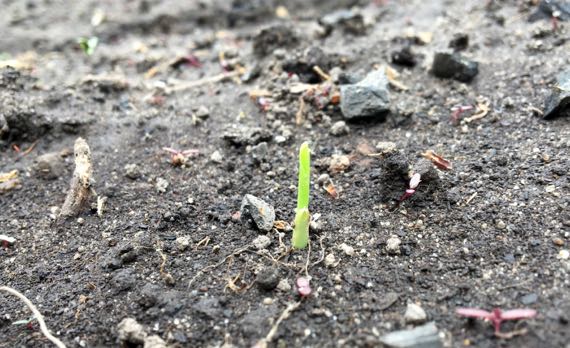
How does it get to be JUNE so quickly? This is a tiny, emerging maize plant, less than an inch tall. Very early for sweet corn here…relatively warm plus enough moisture equals stimulated seeds.
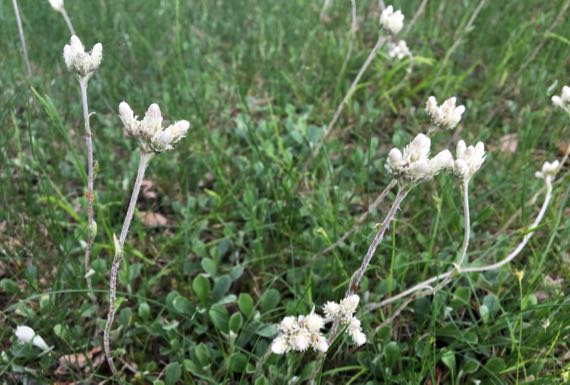
I learned this as pussytoes, but it looks slightly different from the one in my wildflower book. A different species, I suppose. Tried to photo them the other day and failed as the wind kept wobbling the stems.
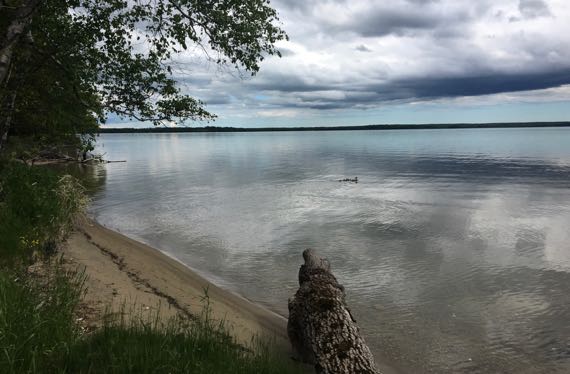
I love the lake when it’s glassy like this, such a mirror for the sky. Later I could count the mallard’s ducklings: seven; that’s quite a brood.
Posted at 10:22 PM |
1 Comment »
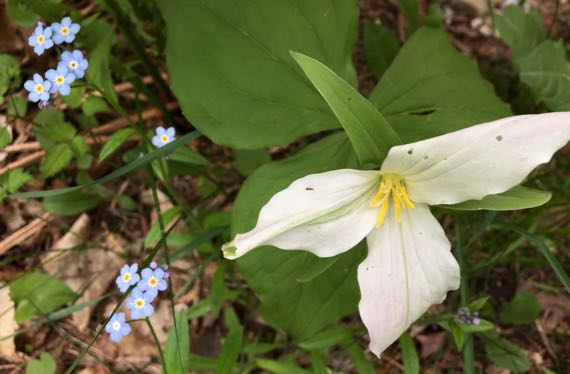
Right out my back door: forget-me-nots (knots? haha) and a trillium. Plus bracken ferns (not in photo). Lovely.
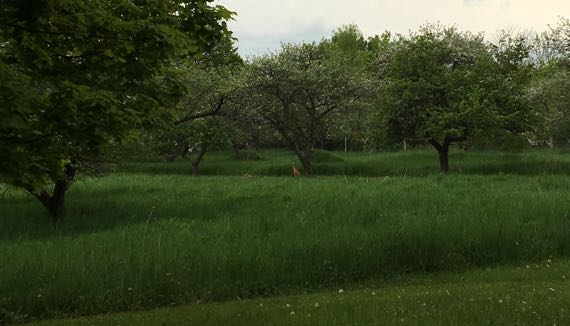
And in the orchard: a strolling sandhill crane (brown object in photo center).
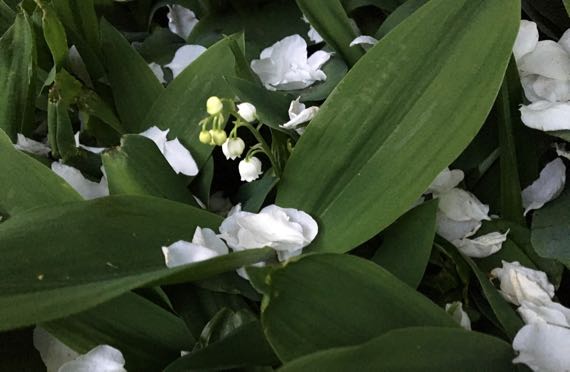
Just out the neighbors’ back door: giant apple petals scattered on the lilies-of-the-valley.
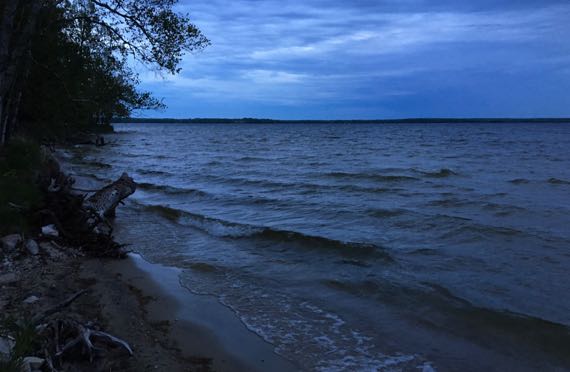
Short version: whatta special place, here where the road ends at the lake.
Posted at 9:39 PM |
Comments Off on What a neighborhood!

Whatever you think you know about Tintagel Castle, it’s probably wrong. The King Arthur association, no chance. The rocky almost-island has plenty of ruins, mostly dating to three periods, the Dark Ages (here AD 500–600s, roughly), the 1200s, and to Victorian times. The DA ruins are pretty humble and meager. While the landform is defensible, there’s little else to recommend it—not much area to grow food and everything’s rocky, although the harbor situation for small watercraft is workable if the seas are relatively calm (says this landlubber). The “castle” dates to about 1230, including the ruins of a Great Hall and Chapel (the most recognizable architecture). The Great Hall had to be modified as part of it slid into the sea not long after it was constructed. The rest of what commonly constitutes a castle—not here or only small bits. The Victorian modifications look like versions of a folly to me….

Here’s the Great Hall…. Both these pictures show Tintagel’s most salient feature: elevation changes. This is rough terrain. Note that the bridge below (far below) my shadow is steps—not flat. See: terrain!
We were glad it was only breezy (and not windy) and not rainy (and slick underfoot) during our Tintagel visit. BTW, that big, chunky, rectangular building on the far hill is a hotel. Great location for them; bit of an eyesore from Tintagel.
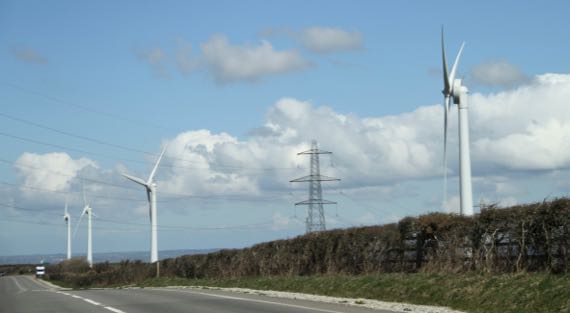
Wind generators…all busy generating—none still.
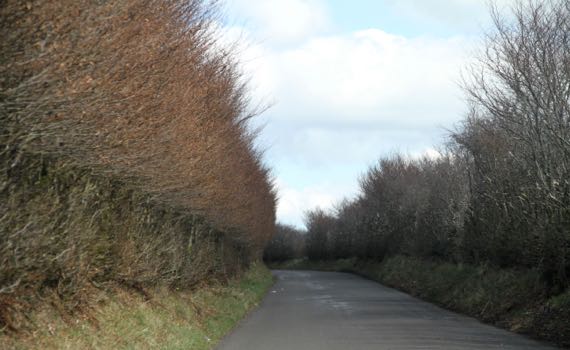
And on Exmoor (our last moor, I think), elaborate hedging…and the secret of how they’re made was revealed to us along this stretch—no photos; too fascinating to snap, just looked. So, here’s the secret to that dense vegetation. About 10cm very upright trees in the existing hedge are cut in a not-quite-vertical slice, so that the top is still attached to the root. Then, the branches are sliced off the tops, which are laid down along the top of the existing hedgerow (two parallel rows), and tied together to keep them from springing back up or shifting out of alignment. They must subsequently send up new verticals, making the dense hedgerows we see, along with the horizontals below the verticals.
The hedging on the left has been trimmed mostly I think to give drivers better line of sight, although also to keep branches from brushing vehicles.
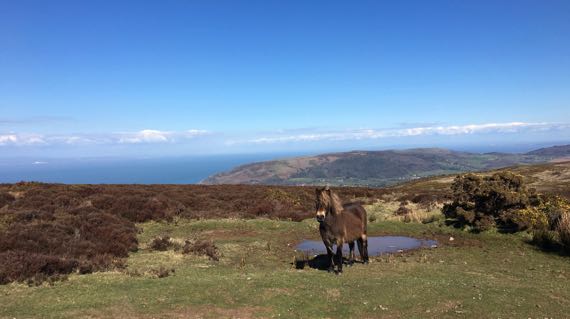
Exmoor pony. That’s Wales on the other side of Bristol Channel, below the line of clouds. We go there tomorrow.
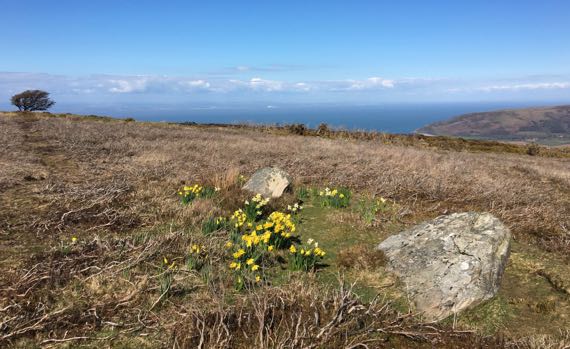
Since it’s a moor, standing stones, right? These two are leaners at this point. And someone’s planted daffodils. We have been enjoying daffodil and primrose season in southern England. We are so lucky with the weather (fingers crossed for the coming days).
Posted at 4:52 PM |
1 Comment »
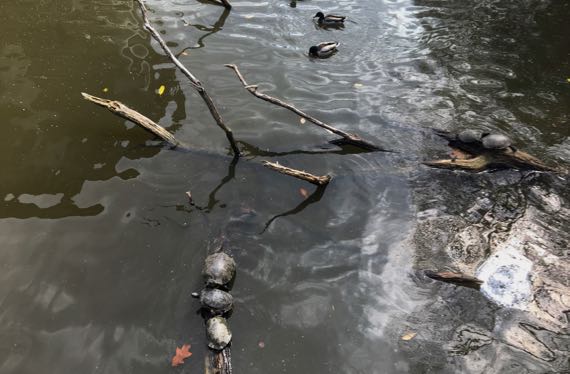
Over at PiedPk, I found many good-sized log-turtles. They do a great job of balancing their nearly-planar shell-bottoms on the rounded logs.
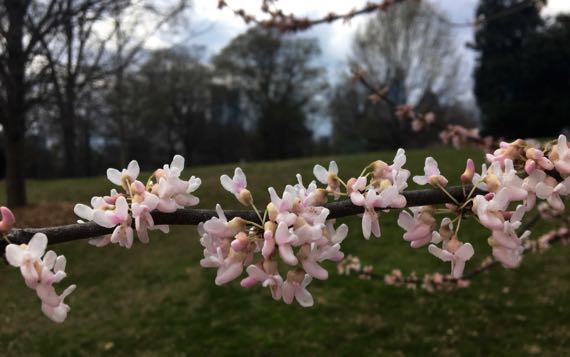
I also found this pale pink redbud. Pretty sure it’s a redbud, anyway.
* Lake Clara Meer.
Posted at 8:24 PM |
Comments Off on LCM* report