Musings
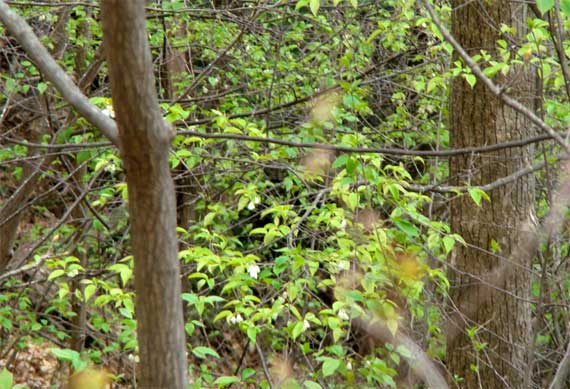
Not that YOU can tell, but the black spot in the background in the middle of the frame, rushing down the slope away from the hikers on the trail above, is a bear, about 1/3 grown. S/he was with Mom and sibling (not pictured). This was up above Dockery Lake, mid-afternoon, in off-and-on light drizzle.
Nice early spring wildflowers, especially violets or species that look like violets.
Posted at 10:22 PM |
Comments Off on Bearly visible
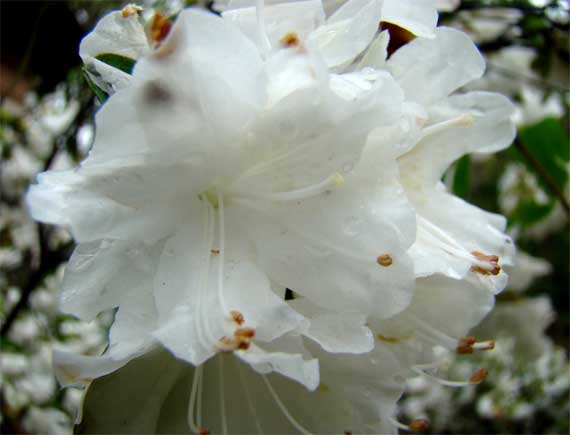
It rained last night, pretty heavily at times. This morning, the winds came with the rain, whoosh for quite a while. Small branches fell and we heard some ominous sounds from afar—thankfully for the afar part. I went out to photography the white azalea that’s in full bloom and found the branches droopy under a heavy load of precip.
To get away from the roof and diminish the scary wind noises, I did some reading downstairs during the w-o-r-s-t of it, and came across the following in Barbara Kingsolver’s Animal, Vegetable Miracle: A Year of Food Life (2007). Here’s the setup. Spring is coming, and the turkeys that weren’t sacrificed for Thanksgiving and other feasts—meaning the hens—begin to experience the springtime tide of rising hormones, but BK doesn’t understand that that’s what’s going on with the hen with droopy wings. She finally figures it out and hies off to the internet and the library for the animal husbandry information she needs, and which didn’t arrive with her two-day-old chicks the spring before. Since most modern US turkeys come into the world via artificial means, hatch under heat lamps, and are sacrificed before they reach their own springtimes, appropriate council, she discovered, is…rare. She finally digs up a fifty-year old agricultural self-help book and gets some advice (p. 322):
I had more than just sentimental reasons for wanting to see my turkey hens brood and hatch their own babies, however unlikely that might be. I plowed on through my antique reference for more details on nesting and brooding, and what I might do to be a helpful midwife, other than boiling water or putting a knife under the bed. My new turkey-sex manual got better and better. “Male turkeys,” I read, “can be forced to broodiness by first being made drowsy, e.g., by an ample dose of brandy, and then being put on a nest with eggs. After recovery from the hangover, broodiness is established. This method was used extensively by farmers in Europe before incubators were available.”
Got it?
Posted at 1:43 PM |
1 Comment »
Our President bids us to look at our (national) finances with honesty and openness—i.e., to use critical thinking and to not exercise denial.
I heartily applaud that. Even though it’s painful.
I look at our household finances, and, um, it’s no fun to do that. Also painful. Actually: painful squared.
I suppose there’s another element in play here. Unlike our government, we’re cheapskates*.
Science comment: while species distribution has long been linked to climate, tada!, it’s not that simple. Instead, more complex issues may constitute the determining factor, as shown by this study of western hemlock distributions in western North America. Climatically similar areas may offer different competitive situations, as with more frequent fires and more disturbance-adapted species keeping the western hemlocks from proliferating in the Rocky Mountain region, as compared to the Pacific Coast region.
* Interesting word: cheapskate. The “cheap” part is from an Old English word referring to bargaining or trade, from the Latin caupo, or small trader/innkeeper. The “skate” part is from a term for a worn-out horse, or for a mean, contemptible, or dishonest person. According to the Mac dictionary….
Posted at 5:38 PM |
2 Comments »

The hyacinths are coming! The hyacinths are coming!
In my dreams I really write well—like Colin Thubron describing an ancient vehicle, still in service: “Already its body was disintegrating, half its dashboard had gone, its radio mercifully dead, and styrofoam belched from its seats.” That’s from pg. 62 of his Shadow of the Silk Road (2006). Here’s a longer passage from that volume (pg. 124–25):
The only purpose in the silk moth’s life is to reproduce itself. During its two-week existence it never eats and cannot fly. Instead this beautiful Bombyx mori lays eggs from which larvae as thin as hairs are born: offspring so light that an ounce of eggs yields forty thousand caterpillars.
At once they start to gorge ravenously. Their only food is the white mulberry, whose pollarded skeletons line the fields of Khotan*. Peasant families exhaust days and nights feeding them, with an ancient care which no machinery can match. Sightless, almost immobile, the silkworm has been reduced by millennnia of cultivation to a helpless dependence on humans. The caterpillars are like neurotic babies. They thrive only on fresh leaves, gathered after the dew has evaporated, and served to them, at best, every half-hour. Ideally the age of the mulberry shoots should coincide with their own.
In five weeks of frenzied feasting they consume thirty thousand times their weight at birth. The munching of their jaws makes a noise like rain falling. Centuries ago the Chinese noted that the colour of their forelegs anticipated the tint ofthe silk they would sping. Abrupt changes of temperature or lapses in hygiene, any sudden noise or smell wreaks havoc with their nerves, and they may die. But after a month each silkworm has multiplied its initial weight four thousandfold, and has swollen to a bloated grub, its skin tight as a drum, with a tiny head.
Then suddenly—when moulted to creamy transparency—the caterpillar stops eating. For three days the future silk flows from its salivary glands in two colourless threads which instantly unite, and it spins these about its body with quaint, figure-of-eight weavings of its head. Even after it has sealed itself from sight inside its shroud, it may sometimes be heard, faintly spinning.
Then comes the ‘great awakening,’ as the Chinese say. Within twelve days, locked in an inner chysalis, the wings and legs of the future moth like folded on its breast. Then it stirs and bursts with dreamy brilliance into the sun.
Here in Georgia we once had, locally-speaking, a large-scale silk industry. It was in New Ebenezer (founded 1736; the nearby original Ebenezer was founded in 1734), a settlement established by Protestant Salzburgers upstream from Savannah, ca. 1740. Read more here and here.
* Khotan, also spelled Hotan, is on the southwest edge of the Taklamakan Desert in far western China.
Posted at 8:18 AM |
1 Comment »
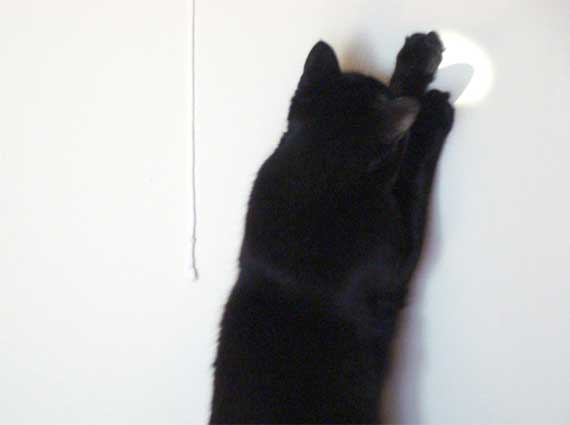
We spent quite a while this afternoon laughing at the antics of Salem the Cat as he chased the reflection off Dad’s watch (until he got tired and just watched it from a sprawl). Sunny day! Lovely!
* Ever a worthy occupation in the northern hemisphere in the dead of winter….
Posted at 10:22 PM |
Comments Off on Chasing light*
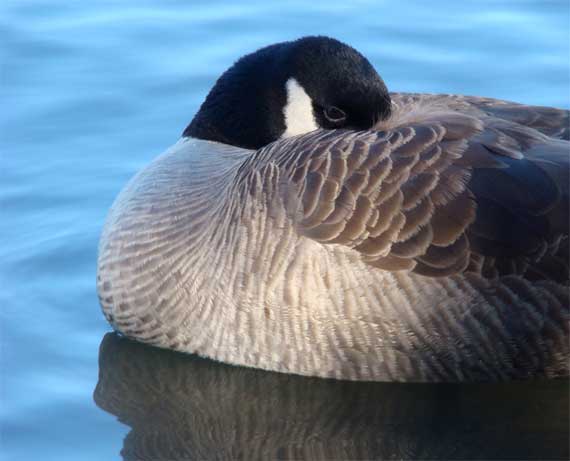
The waterfowl at the park are such beggars, at least this time of the year. Yet, in today’s cold, we tiptoed by and they just watched us. Upon reflection, I guess they were actually inspecting our pockets for bags of bread.
Posted at 3:34 PM |
Comments Off on Bury beak in feathers
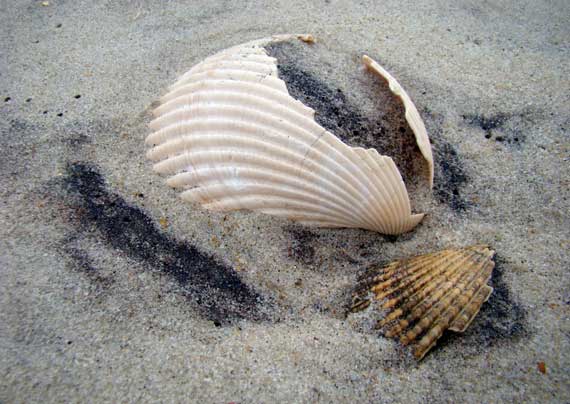
From the ferries to and from Okracoke last week, we saw flocks of birds on the Sound, but I’m not entirely sure what species. There were minorities of brown pelicans and some kind of gulls (big ones, it seemed), but most were anhingas or cormorants. Actually, after studying the closest bird book (Sibley’s Eastern North America Field Guide), I wonder if they both weren’t there. Most seem definitely like feeding anhingas, but a few seem to have cormorant shapes and colorations (most likely the double-crested species).
Elsewhere, we saw tundra swans glistening even in the grey, fogged muted daylight. I think there were snow geese, too….
Most of the beach shells on the Outer Banks have been hammered between the surf and sand, yet they still make patterns in the multi-colored sand after the tide goes out….
Posted at 7:50 PM |
Comments Off on Birds and shells

We went to NW Georgia for today’s big adventure. We parked at the Keown Falls picnic area—lovely, under the trees—and ascended to check the falls (dry), and ascended further, to the top of Johns Mountain. Then we followed the trail south along the spine of Johns Mountain, then, well, as Bill said, it’s all downhill from here.
We found the fall color glorious, brilliant in full sunshine, with few leaves fallen. Spellbinding in every direction….
We took advantage of the picnic area to down some calories, both solid (mmmm good salsa!) and liquid.
Part of our route followed the Pinhoti trail, which, I have now learned (courtesy of the internet—scroll down for map), apparently is the longest foot trail system in GA, and extends into AL for another 136 miles. It connects with other trails to make a walking trail from FL to Canada. So they say.
Georgia mountain woods, in my experience, lack many rodents, birds, and larger critters relative to other North American woods I’ve spent time in. Today was no exception. Our most exciting critter sighting: several busy dung beetles.*
* Get this: one of my recent birthday cards referred to dung beetles….
Posted at 7:51 PM |
6 Comments »
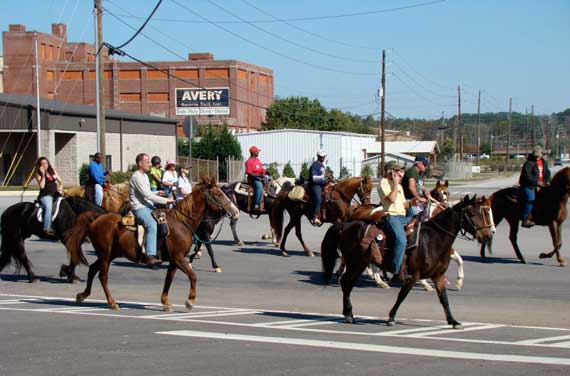
…you may have noticed that I’ve been on the road lately. Although yesterday we returned home (yeah!)—and it is MOSTLY our Home AGAIN (double yeah!)—today I was traveling again. To Rome. Not the Italian or even the New York one, but the one in northwest Georgia, where I attended Society for Georgia Archaeology semi-annual meeting events.
There, I got stuck in the parking lot of the Chieftains Museum (also the home of Major Ridge, a prosperous Cherokee who was forced to endure the Trail of Tears ethnic cleansing/removal to lands that became Oklahoma over the winter of 1838-39*), waiting for a parade of modern wagons drawn by pairs of mules escorted by myriad riders on horseback to pass by. I estimate there were perhaps two hundred non-human critters involved in that mini-migration….
* Ridge, whose name in Cherokee was Ca-nung-da-cla-geh, was murdered by other Indians in 1839 for having signed the Treaty of New Echota (then the Cherokee Capital, in Georgia) in 1835, along with a minority of other Cherokees and without the permission of the tribal government. The treaty was an agreement by the Cherokees to leave their southern Appalachian homeland in return for monetary compensation and lands to settle out west.
PS If you’re bored with the above, perhaps you’d be interested in this NYTimes piece on worm grunting aka worm charming? BTW, the full PLoS article by Kenneth C. Catania is here….
Posted at 6:06 PM |
2 Comments »
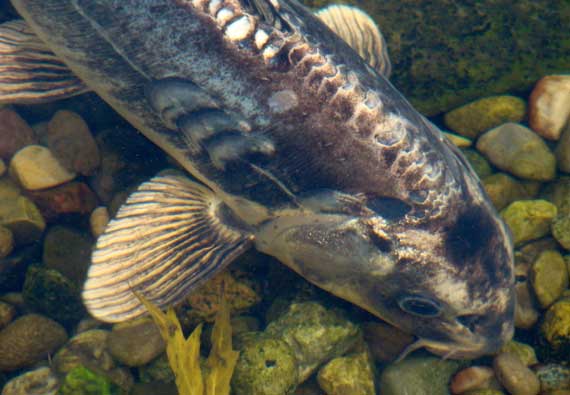
Back to the garden today, and we finally determined that the pond has nine fish. For some time we didn’t see the black one that often swims off by him/herself. This one was feeding aggressively amongst the rocks….
Posted at 10:22 PM |
Comments Off on Fish-garden