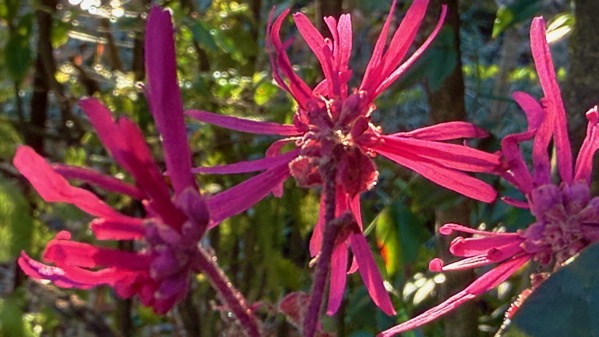
Precip on petals
Wednesday, 5 March 2025

During my post-rain walk, I discovered many dewy blooms, not all as elegant as this deciduous magnolia.
Wednesday, 5 March 2025

During my post-rain walk, I discovered many dewy blooms, not all as elegant as this deciduous magnolia.
Tuesday, 4 March 2025

We’re supposed to have a front come through overnight, so windy storms, perhaps (hopefully?) weaker than the other weekend that caused us to need four large trees removed. Whew. Still, before the winds, somehow a fading camellia blossom found its way to our front steps this afternoon.
Saturday, 1 March 2025

These plants, decorative in this area, mystified me (with my northern mental database) until I found them labelled somewhere. Now, I know them to be relatives of artichokes…sporting rather elegant dagger-leaves-of-green.
Monday, 24 February 2025

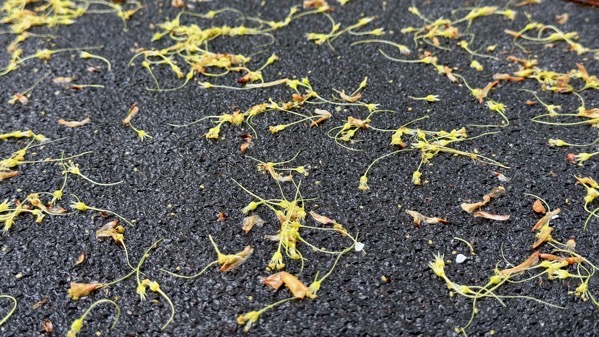
We’re coming out of a run of cold days, and we’re headed for some lovely warm days before cold rolls in again. The warmth is enough to get the pollen going, in a bit of an ironic twist.
Friday, 21 February 2025

At 9:30 this morning, the leaner was still rooted to the ground—ish.

By early afternoon, the top was removed and both the leaner and the one that fell away from our house were mostly removed.

Shortly before the guys closed down for the day, the leaner’s stump was removed, and the one that fell was merely a stub of a sump.
The elegance and carefulness of the work crew was something to behold (pardon the passive voice).
Thursday, 20 February 2025

Despite today’s gustiness…

…the tree guys climbed high, tied off this direction and that, fired up chainsaws, and took down two trees. I was surprised to see how much core rot one of them had…. Happily, they have a plan to remove the tricky, leaning, good-sized tree tomorrow
Thursday, 13 February 2025

The “possible five inches” of rain turned out to be about two-and-a-half, which is far less…dangerous. Even more exciting: the sun came out almost all afternoon.
Wednesday, 5 February 2025

Our departure…leaving from beneath the looming, snow-dusted Sierra de Ayllón, amid ice-crystals…mostly melted when we got going (lots of sun exposure).

We came upon these round structures in/near several towns, but I couldn’t figure them out. They seem clearly for storage, and the roof is vented, yet there’s only one door, and it’s small. My guess is they’re something to do with grain production…mystified.

Our first stop was Tiermes, which was a large CeltIberian fort that allied with Numancia (and others), and held out against the Romans for longer than other places (probably routed about 133 BC). The Romans remade the settlement, adding homes, a large aqueduct, a forum, temples, and more. The sandstone hill also had earlier Neolithic and Bronze Age occupations. Here’s the southeast gate; all the gates to Tiermes that I saw had a bend like this…I assume offering an additional level of security.

The southern face of the hill is mostly a wall of sandstone. The horizontal rows of holes held beams that made ceilings and floors of multi-story structures.

Here’s a look along the aquaduct from where it (presently) goes into the hill. This is just to the left and above the last photo.

This is the west gate, surely more eroded than when Romans and their CeltIberian predecessors used it…or maybe this was just a Roman gate.

The wheels of carts dug into the soft sandstone, and later eroded into deep trenches.

That vegetated (grassy?) area is the Roman forum. These photos do not do justice to the huge area of this settlement, and I mean huge in pre-Roman CeltIberian times especially. My walking track was almost two miles, and I missed some highlights. Of course, I have not seen the excavation reports, which may describe many unused (often trash-collecting) rooms, as often happens for Puebloan settlements in southwest North America.

Our last stop on the present Tiermes property was to step inside this Romanesque chapel/church, probably built in the late 12th C. I don’t know the date of the interior. There’s no longer any town nearby and I don’t know if there are scheduled services any longer.

Our next place of interest was the Cerros volcánicos de La Miñosa, a very small area that constitutes an unusual micro-environment.

One species typically mentioned is Erodium paularense, or the Paular geranium. This might be it. Interestingly, a few hundred meters away archaeologists have recorded six Paleolithic (meaning early) sites…perhaps because the ancients obtained something important to them from the volcanic zone. Dunno, just hypothesizing.

The pointy hill has a Castro atop, and the other is a Castillo. Off to the right on the slope below the Castillo is the Medieval (as in: most of the central buildings date to…) town of Atienza.
That’s enough for today. Tiermes remains among the most amazing pre-Roman/Roman sites I’ve yet seen.
Monday, 3 February 2025

This is maybe the third time we’ve seen a stand of these silver-barked trees. Dunno what they are…mystery arboles.

I’ve confirmed that this is Moncayo.

Wind turbine alignments. I’m trying to get my photographic fascination with them out of my system. Round hay bales can grab your eye this way, too.

We’ve seen plenty of large and small irrigation ditches, but rarely the valves. Here’s a split, where the flow is being directed two ways.

One of our goals today was to get a look at a large eroded area, or badlands, that is a park called Bardenas Reales.

We did find one place with a road we could safely try to get into (or towards) the heart of this sculpted landscape. You can see we didn’t get far, as farmed fields remain.

We partly circled Moncayo yesterday, and completed the loop today.

One more eroded landform.

I finally got a shot of the Ebro when we crossed it. I think this is normal spring elevated levels.

We cut through a “corner” of the lower slopes of the Moncayo massif, and found what must be a relatively warmer area, as many orchards flaunted blooming trees. My guess was peaches or apples, but I couldn’t parse the tree shapes and figure out the species.

We went through/by many little towns. Amazingly, most had parked cars and evidence of active residents. I cannot figure out the economic support for these scattered villages.

Later in the day, I became fascinated with the variations in soil color…this is rather brick red, and the trees are not yet blooming (February, remember…snow on elevations, remember?).

Castle ruins above larger small town…note the white lenses in the far distance behind the jagged walls…Moncayo massif, again.

I counted one man and one dog with this substantial sheep herd. As we continued up the road, it was evident that they’d come down it for at least a mile. Transhumance underway? Earlier in the day, we saw a smaller herd, controlled by a man with a loaded mule and four dogs. Spring is springing for shepherds.

This is the second fox we’ve spotted. Neither was much concerned with our presence.

I just encountered a description of wheeling clouds of birds as resembling the billowing robes of a genie. As shown….
Sunday, 2 February 2025

Wind turbines on horizon. Strange color balance (through windshield).

Frost patterns…one shady place we saw frost as late as 11:30am.

Flags, bell tower.

Storks, backlit.

Horses, also backlit, with frost, tracks.

Medieval rock graves, Revenga.

Medieval rock graves, Regumiel. They antedate the 12th C church built partially atop them.

Medieval rock graves with ice skim, Duruelo. Some sources say this trend in this area, the Upper Arlanza Basin, say these graves are 7th/8th C. Others say 8th–10th C.

Stand-alone snow-capped mountain, perhaps Moncayo.

Wind turbine array, with Pyrennees in far distance and Ebro basin between.

Rioja territory grapevines.

This is the part of the Roman city of Graccurris, founded 179 BC, that has been “reconstructed.” I could make little architectural sense of what seemed to me to be mostly a wasteland. Of course, there was significant Medieval occupation here, too….

Largest church in Alfaro, essentially modern Graccurris.

Smaller Alfaro church.

Fuzzy moon out our hotel window, a few minutes ago.