Musings
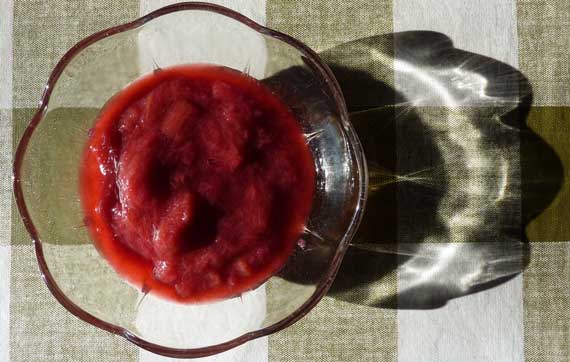
The Botanist found this exceptional rhubarb somewhere and planted it here in the Northland, and it is as tasty as it looks. I promise, there’s no food coloring in this sauce—just rhubarb, sugar, and a little water. The red continues through the heart of the stalk most of the way up to the leaf, instead of just at the base, as with other rhubarbs I’ve examined.
Posted at 11:16 AM |
Comments Off on Rhubarbing days
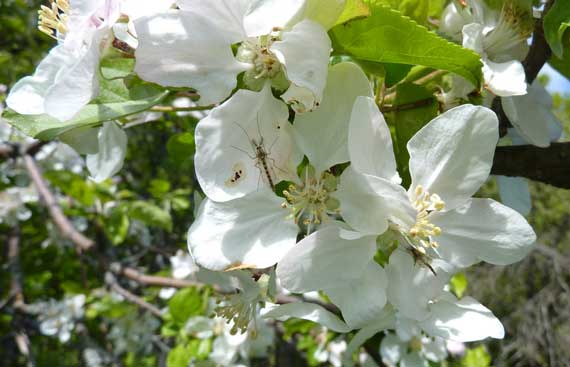
Our ancient apple orchard doesn’t have many trees, and they are of diverse types. These blooms are from one of three “early” trees, planted by the grove by Grandma’s brother Norton,* according to The Botanist. They’re already beginning to fade, and the rest of the trees are coming on strong. I am surprised there’s so much pink in the blossoms on many of the other trees.
More of the lupines are showing color, and the ones that earliest showed their blue “skirts” are opening nicely.
The forget-me-nots are gorgeous and dainty, and I can’t seem to take a focused, decent shot of them at all.
* But when? in the 30s? perhaps the early 40s? Dunno.
Posted at 10:22 PM |
2 Comments »
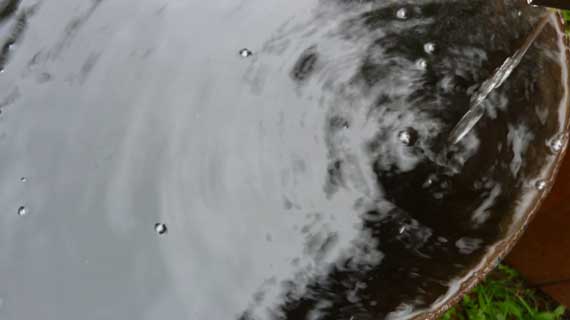
Day three of rain. But! Mid-afternoon the tide turned (as it were), and the sun shone and we basked in a new day, weatherwise. As you can see, the rainbarrel is overflowing….
Perhaps the other momentous news-of-the-day is that we spotted color in a few lupine buds during our post-rain walk—a gorgeous deep purple-blue. I haven’t spotted any of the pink ones….
Posted at 10:22 PM |
Comments Off on Day three
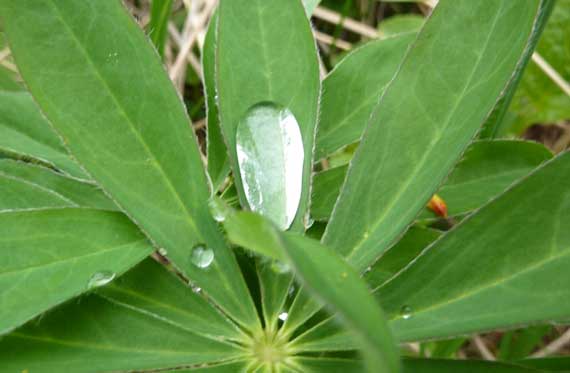
Today I photographed many youthful lupines, especially trying to capture the specialness of their leaves when decorated with raindrops. Gemstones have never looked prettier than some of these evanescent mini-marvels.
Posted at 10:22 PM |
Comments Off on Temporary gems

I’ve jumped back in time. Look at these cherry blossoms, boldly announcing the arrival of spring. And, yes, looking carefully in the orchard grass, we did find a very few asparagus shoots—oh, yum!
Posted at 10:22 PM |
Comments Off on Did I mention blackflies?

Cleverly, I have managed to find lilacs abloom—which they don’t readily do in ATL.
Posted at 10:22 PM |
Comments Off on Lilacs are abloomin’
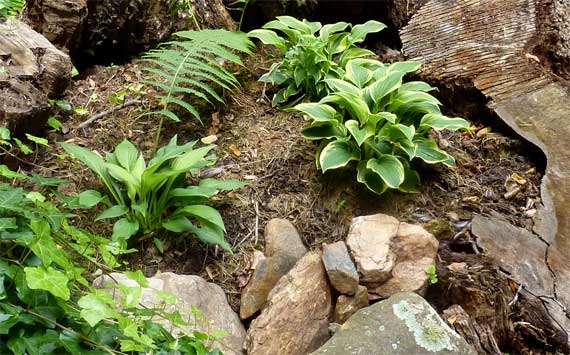
Our next-door neighbor is quite a gardener, and has given the stump socket new life. All the rain we’ve been having has helped the transition process. The hostas and ferns are watched over by a poke plant that’s shooting up and getting huge! I love keeping track of it through the kitchen windows. A chipmunk also hangs out in the stump garden….
The wheel of life….
BTW, with all this rain we’ve been having, Atlanta’s main drinking water reservoir, Lake Sidney Lanier, is within 6 feet of the desired summer levels. Seems like it should be a bit higher this time of the year, but this is so much better than it’s been….
Posted at 5:56 PM |
Comments Off on Stump garden

The mystery plant (which may be Arum maculatum) is aging—no surprise, and the spathe* is now drying and becoming less delicate. Compare to four days ago….
KW, over at ababsurdo, has a picture of an actual JITP (jack-in-the-pulpit).
* For enquiring minds, the spathe is the hood-like bract, which grows “around” the yellow spadix, the spiky inflorescence.
Comment: yesterday’s tomatoes…yup, visibly larger today.
Posted at 6:50 PM |
Comments Off on Aging vs maturing
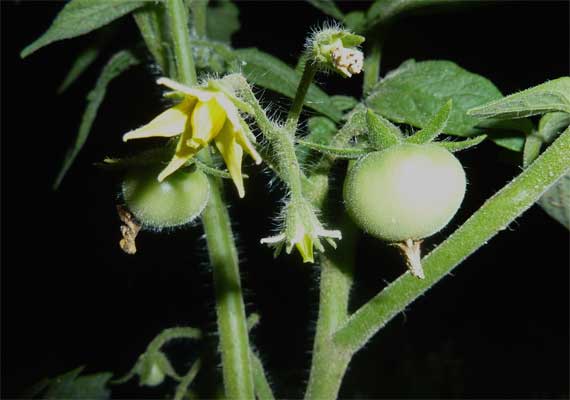
As the wheel of the seasons turns, lemme note that there are wee ’maters on the “patio tomato” plant. The Botanist mentioned in passing that some tomatoes like to have the blooms tapped a bit to be, I guess, pollenated. I’ve been tapping gently. I guess it works. (I can say that in the absence of a control sample. harhar)
Posted at 10:22 PM |
Comments Off on Look, potential produce!

Did I say a while back that the azaleas were finished blooming for the year?
I was wrong.
Did I say that the plant in yesterday’s picture might well be a jack-in-the-pulpit (despite Janet gently reminding me that they have trio-leaves—which our potential JITP doesn’t)?
I was wrong.
So, here’s the azalea proof (from today, via the new-cam). And the specimen from yesterday is far more similar to Arum maculatum. That plant is native to Asia (the kind with the yellow spadix), so the mystery thickens on how it got into our backyard.
Posted at 3:19 PM |
1 Comment »