Musings
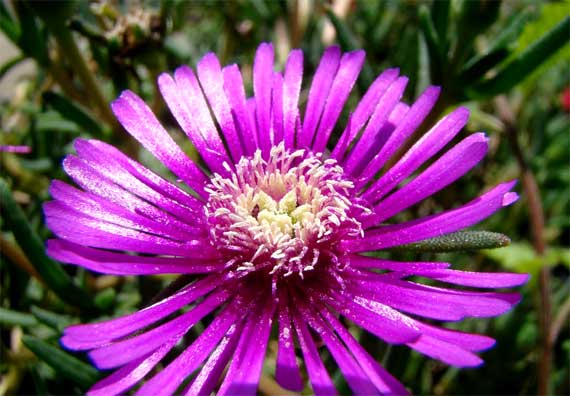
Today’s highlight was taking a long lunch and going to the State Farmers’ Market, a 150-acre installation south of town that’s also touted as the “World’s Largest Roadside Fruit and Vegetable Stand,” an excursion we shared with our neighbors.
We first lunched at the Oakwood Café on the premises. Once sated, we commenced our wander. Most of the stands (actually bigger than stands, if you ask me) that were open seemed to be attended by Mexican-American entrepreneurs, and I had great fun chatting with them. Two (guys) told me that I spoke very good Spanish! The only reponse is to say, “¡Usted, también!“*
I even saw guaje pods, which Wiki-Pee says are Leucaena leucocephala, “a mimosoid tropical tree.” These are not commonly seen on this side of the border; some people say that the name Oaxaca is derived from guaje (say gwah-hay). What fun!
Upon our return, we became immersed in a small financial morass, making this and that payment and deciding with the CPA to apply for an “automatic” extension of time to file (as we often do). Bleh.
BTW, no rhubarb. And no vendors who really knew what it is, either….
Extra points if you’ve read H. Allen Smith’s humor novel Rhubarb, about an orange-red cat who owned a baseball club (if I remember correctly)….
* It means “you, too!,” if you didn’t guess….
Posted at 6:23 PM |
2 Comments »
Loved basking in the design simplicity and aesthetic at the Apple Store during a short visit this afternoon.
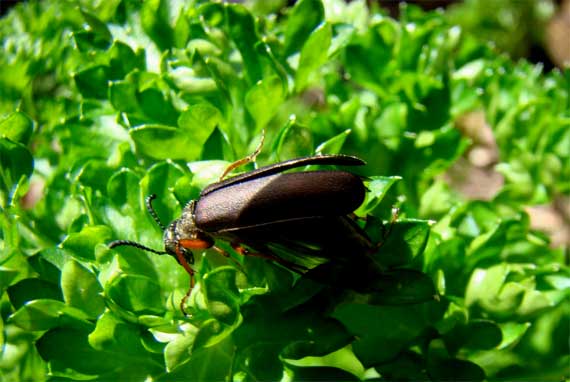
Really loved the brief tour of Bob’s garden—brief because it’s a small back garden. His parsley was playing host to this insect, which I inadvertently put in partial shadow with the camera lens—oops.
Posted at 7:25 PM |
2 Comments »
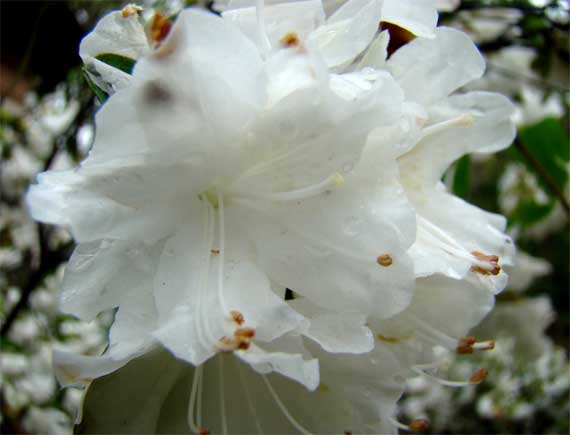
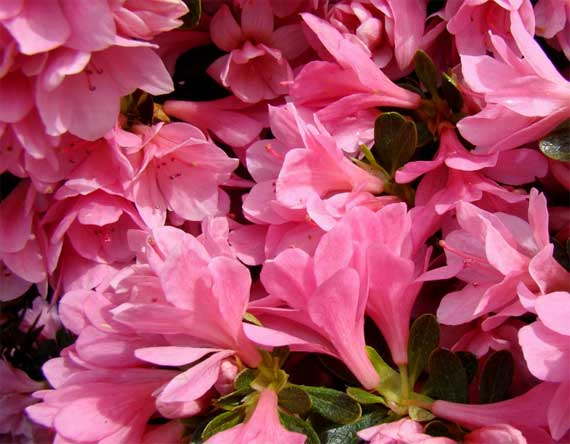
It rained last night, pretty heavily at times. This morning, the winds came with the rain, whoosh for quite a while. Small branches fell and we heard some ominous sounds from afar—thankfully for the afar part. I went out to photography the white azalea that’s in full bloom and found the branches droopy under a heavy load of precip.
To get away from the roof and diminish the scary wind noises, I did some reading downstairs during the w-o-r-s-t of it, and came across the following in Barbara Kingsolver’s Animal, Vegetable Miracle: A Year of Food Life (2007). Here’s the setup. Spring is coming, and the turkeys that weren’t sacrificed for Thanksgiving and other feasts—meaning the hens—begin to experience the springtime tide of rising hormones, but BK doesn’t understand that that’s what’s going on with the hen with droopy wings. She finally figures it out and hies off to the internet and the library for the animal husbandry information she needs, and which didn’t arrive with her two-day-old chicks the spring before. Since most modern US turkeys come into the world via artificial means, hatch under heat lamps, and are sacrificed before they reach their own springtimes, appropriate council, she discovered, is…rare. She finally digs up a fifty-year old agricultural self-help book and gets some advice (p. 322):
I had more than just sentimental reasons for wanting to see my turkey hens brood and hatch their own babies, however unlikely that might be. I plowed on through my antique reference for more details on nesting and brooding, and what I might do to be a helpful midwife, other than boiling water or putting a knife under the bed. My new turkey-sex manual got better and better. “Male turkeys,” I read, “can be forced to broodiness by first being made drowsy, e.g., by an ample dose of brandy, and then being put on a nest with eggs. After recovery from the hangover, broodiness is established. This method was used extensively by farmers in Europe before incubators were available.”
Got it?
Posted at 1:43 PM |
1 Comment »
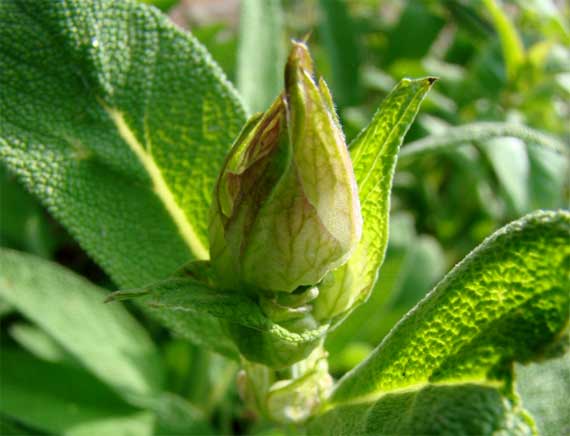
I haven’t been paying attention. The herbs that I rescued last year from under The Tree mostly survived the winter in fine fettle. The sage is so nourished from the spring rains and recent warmth that it’s blooming—well, almost!
Title does not refer to me….
Posted at 7:43 PM |
Comments Off on Budding sage
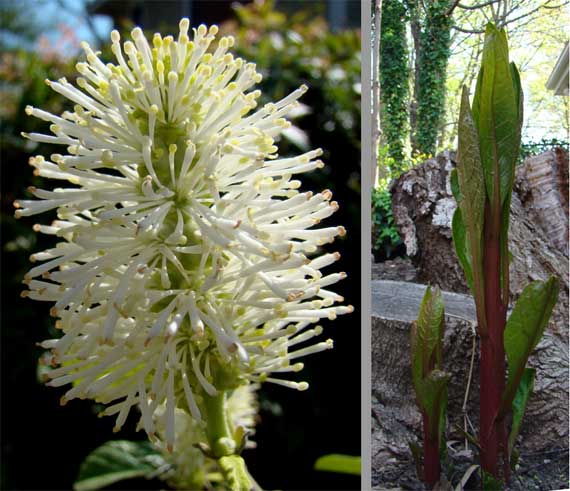
You can tell this is two photos clumsily stuck together, right? And that they’re at different scales? Right? The bloom on the left is maybe 2 cm tall. The poke salad on the right is about a foot high. Or it was two hours ago; most assuredly, it’s taller now.
I’m thinking the winter cold is now behind us (crossing fingers), and it’s time to get those tomato plants I bought last week into the ground.
BTW, that’s the stump from the tree that acted out last May in the right background of the picture on the right (ya follow that?). The little stumplet on the left is from a dogwood that got dragged down when the oak came down.
Posted at 6:50 PM |
Comments Off on Thinking about scale…
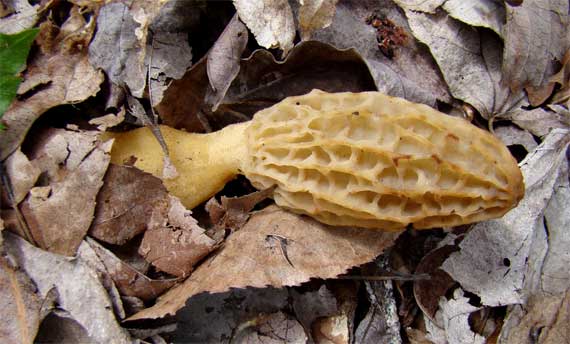
A fellow hiker spotted this lovely specimen on Sunday, not me. I seem to remember that “May is Morel Month in Michigan.” Here, the morel season is long over by May, I suspect….
Posted at 10:22 PM |
Comments Off on Shifted seasons
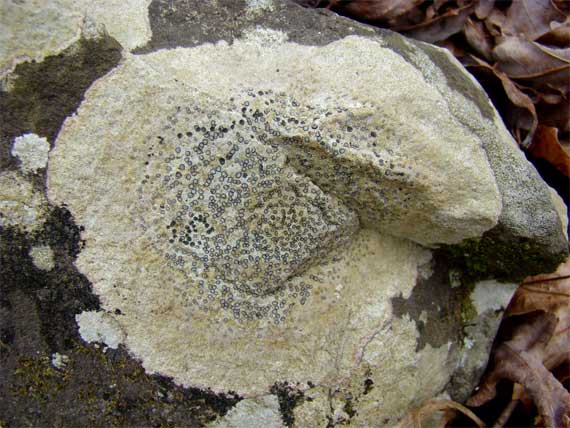
Here’s my ignorance: I thought lichens were a thing.
It turns out they’re a composite organism, that is, composed of two living things—a fungus and a fungus’ friend, according to the Wiki-P, “usually either a green alga…or cyanobacterium….” My sense is that they grow outward, so that bigger blobs are older than smaller ones (this is a larger older blob, although there’s nothing to give you scale—you had to be there…).
More Wiki-P wisdom: “Lichens are named based on the fungal component, which plays the primary role in determining the lichen’s form.”
Posted at 6:36 PM |
Comments Off on Lichen mysteries
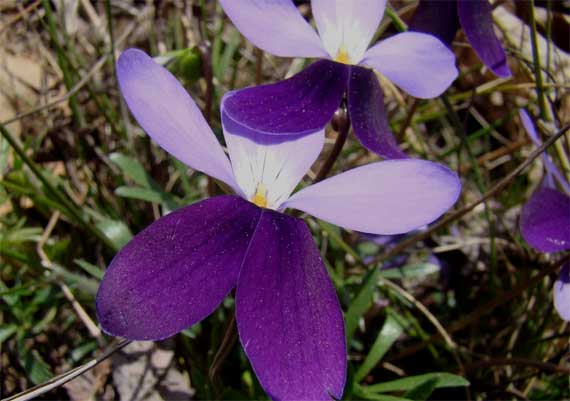
As I noted nearly a year ago, I don’t know exactly what this gorgeous wildflower is…. Love the dusting of pollen….
And, yeah, this came from the 2009 version of the hike reported here and here in 2008.
Posted at 8:45 PM |
Comments Off on I still need to look up this fleur

Somebody not very cleverly chose to plant a row of these shrubs/small trees in front of apartments over by the library. The problem is that they’re thorny, and some of the branches are at eye and shoulder height*. Nice….
* Hence, passers-by have broken the limbs back away from the sidewalk. Poor trees.
Posted at 10:09 PM |
Comments Off on Clever, too clever
Today’s email brought inside information about reorganization and finances at General Motors. The report is that employees are being sent out to collect refundable containers from the ditches and roadsides across the USA—this apparently is thought to be more productive and to have fewer strings than the Federal bailout.
Or so I heard….
Posted at 7:06 PM |
2 Comments »