Musings

Sheesh

Fast and _what_?

This was a manufacturer display we saw at a Meijer. This misspelling was on two of the four shelves.

Language alignment

Soy chorizo

I once heard a tri-lingual knock-knock joke, but this only takes two languages. “Soy” in Spanish means “I am.” I, of course, read soy as soybean, as TJ’s intended. The Guru saw Spanish “soy” to go with the Spanish name of a particular sausage, and pointed it out to me. I’m still giggling.

Theme: down

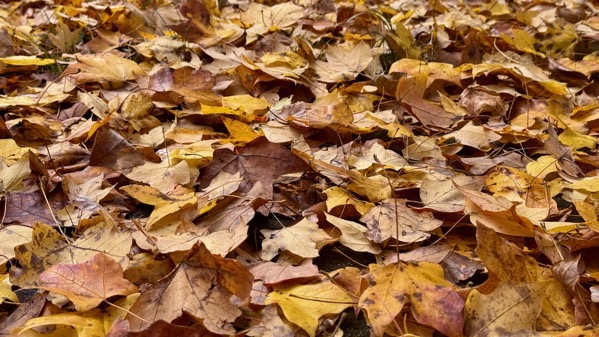
The leaves are down across our lawn, making the equivalent of a (down) duvet keeping the ground from freezing as the temps head for brrrrrr. However, we’re not expecting the White Stuff that’s been falling in the Midwest and even in the mountains down here.

Too forced and artificial?

Translation day

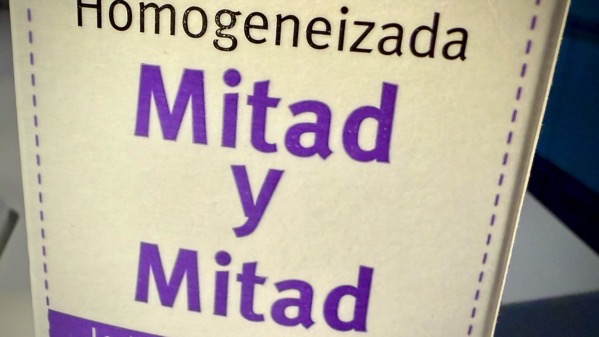
I had this with my coffee and thought, gee whiz, there’s something to post here. Perhaps. [Mitad means half in Spanish.]
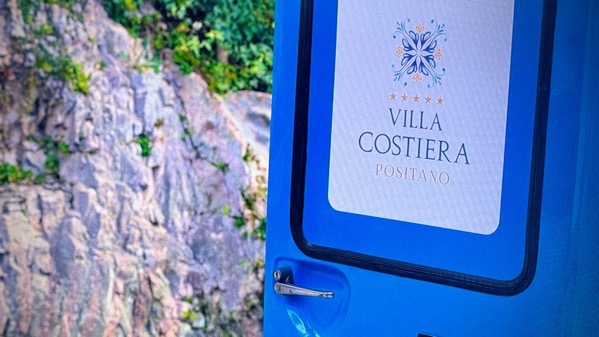
But, this is better. We began a new series of evening TV watching. We sometimes use our choices to be a kind of travelogue, or travel abroad that doesn’t require a passport. This choice is “Hotel Costiera,” set in Positano, on the southern Amalfi Coast. So far, there’s not much food in it; drinks, yes, but little chow. [Not ciao.] Pleasant. Entertaining. Mostly in English.

Is that Barbie pink?

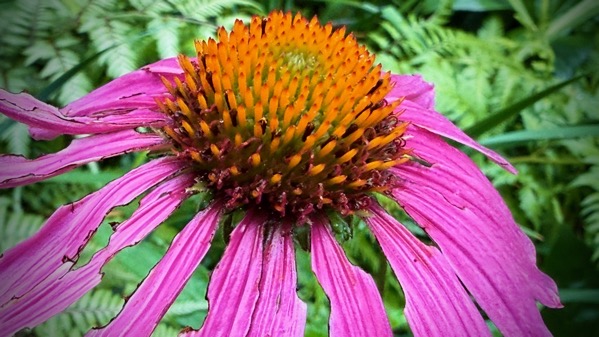
A fleur is a flower is a flor.

Lighting, blooming, more

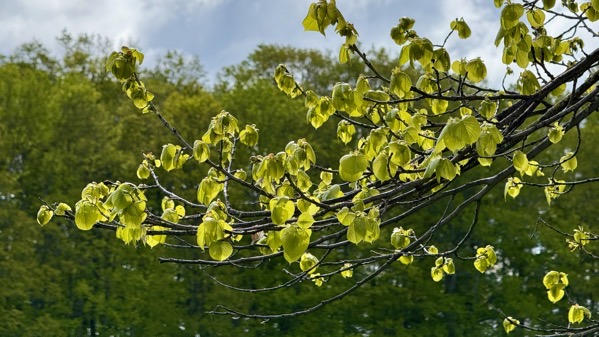
Backlit leaves, aglow.

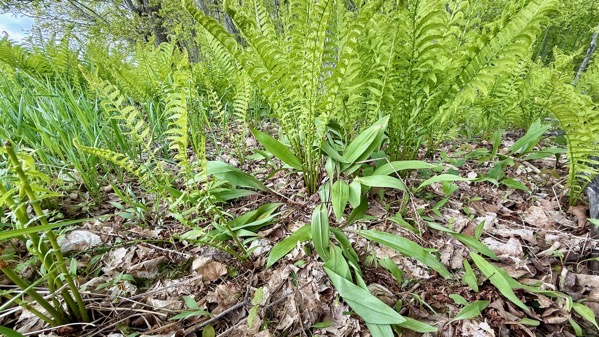
Ferns and ramps (wide angle).
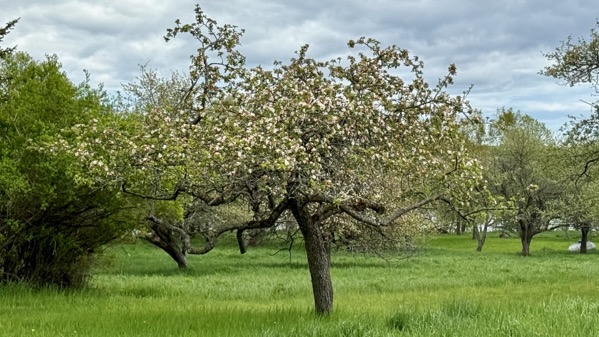
Siberian apple; polinator tree, not for eating. More of the apple trees are blooming.
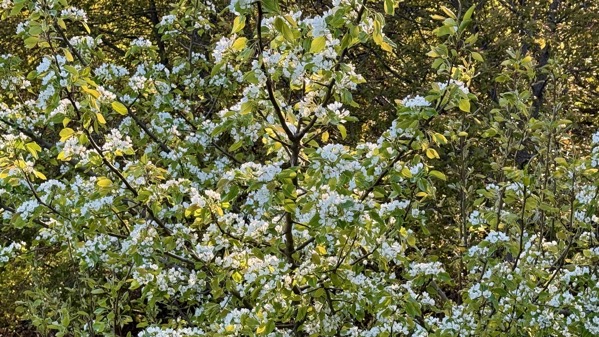
Backlit pear, sure to be heavy with fruit.
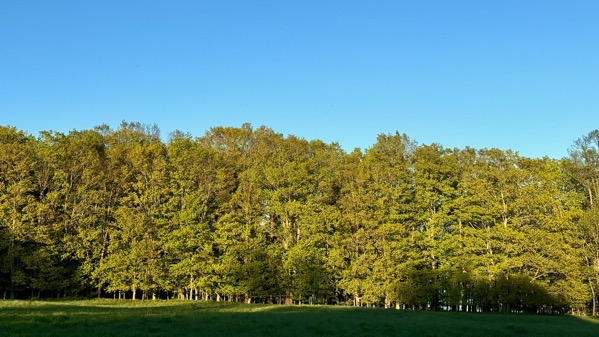
The woods, an hour after the backlit pear, so the opposite direction,. The opposite word/phrase—is it fully-lit?

Don’t be fooled

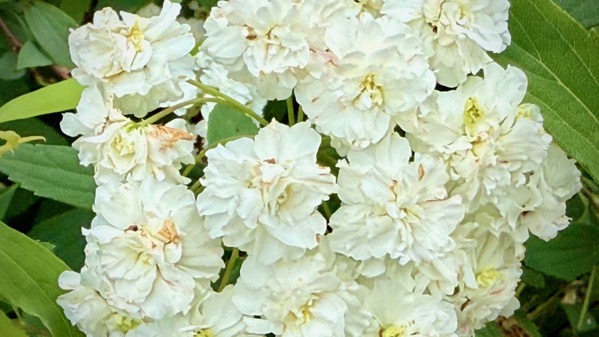
Fleur blanc

Fleur blanc is not beurre blanc.

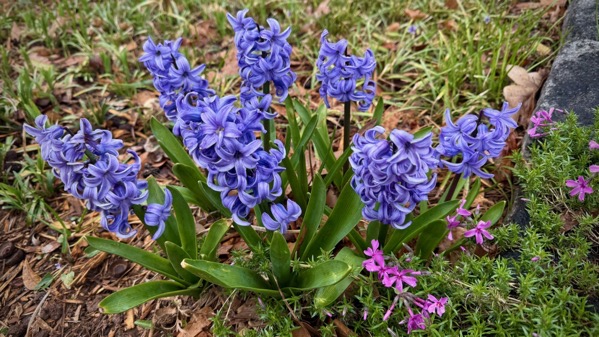
What’s hue opinion?

Blue-purple? Purple-blue? Or perhaps just a shade of blue?
No archaeo, day three

Different day, different museum: Museo de Bellas Artes de Bilbao, established 1908. This is the “Old Building;” behind it, the new is being reworked—note crane. The collection focuses on Basque and Spanish works.

This is Ramiro Arrue’s (1892-1971) “Euskaldunak karta jokoan,” meaning Basques playing cards.

He did it about 1919. I was fascinated by the footwear, especially the boots on the left with exterior laces.

Aurelio Artete 1930 5

Aurelio Artete did this in 1930–35, and called it “Euskal arrantzaleak,” or Basque fishermen. Again: footwear…. I’m wondering if the short boots are of rubber? They do look globular. Also: bare feet.

We saw one Picasso on display: “Still life with glass/bowl of fruit,” dating to 1937 (don’t know the original language of the name). In English, it’s “still life,” but in Spanish it’s “naturaleza muerta,” or, literally, dead nature.

They had three Goyas on display, including the side of the shipping crate they came in from France…I didn’t get the full story. This was the middle painting of the three (yes, I cropped it), the esteemed Bernard Tavira, dated about 1787-88.

Here’s a detail of the Señora’s carnation and ruff.

A few smaller rooms displayed fascinating historical documents and the like that normally no members of the public get to see. These are a pair of pages from “Corpus Iuris Civillis;” it dates to before 1477, and is in Gothic script. This is a later copy of a compilation of Roman laws from AD 117–565; the compilation was ordered by Emperor Justinian I, who was emperor from AD 527 to 565. This copy was made for Pierre de Laval, who became archbishop of Reims in 1473, and died in 1493. Many modern legal systems relate back to these laws.

Here’s a small section of the official document of excommunication of Henry VIII of England by Pope Clement VII and the Holy Council of Cardinals. This is an authorized copy sent to the Spanish court, and dates to 1531.

And then we were outside enjoying the sun…we found groundskeepers at work—here the fountain cleaners.

Here’s Bilbao’s river, the Nerbioi (Basque), or Nervion (English). This view is toward the mouth. This area was once the port area. With larger ships, it’s moved to the bay at the mouth. Note also that Bilbao, the city, is along the river, and the higher elevations are forested.

The façade of this building stood out to us both. It appears to be a private business…. BTW, that’s a pedestrian bridge to the left.

And, our riverfront trajectory brought us back to…this sculpture/building by Frank Gehry (born Frank Owen Goldberg, in 1929).

I very much enjoyed seeing Anish Kapoor’s “Tall Tree & The Eye” (2009) without raindrops.

Here’s this combo moto and lift that I posted yesterday from the other side.

Guggenheim detail. I think this is employee parking on the “back” side.

And, for giggles, a totally different façade, in town, away from the former port area.

We enter Basque territory

Our room last night had a pair of those arched windows on the third story (second above ground floor) that have gold framing. I learned that if you live in a place with narrow streets and multi-story buildings, like this neighborhood, you may not see much sunshine.

Ah, there is sunshine after last night’s rain.

Is MaNachur offering some kind of irony in lighting up the wind turbines?

I wanted to see this church-castle-tower combo for the massive high walls on the tower. I did not expect to have the quirky bonus of arriving when the grounds crew was taking a break, leaving their equipment to mark the spots where they should resume, and highlighting that the priests rely on so much outside labor to strut their stuff.

This is the Castle of Xavier (Basque: Xabierko gaztelua), and the name Xavier/Javier is derived from the Basque Etxeberri meaning new house. [However difficult we thought Catalan was to grasp, I find Basque words impossible.] The Basque Jesuit cleric and famous proselytizer Francis Xavier (1506–1552; canonized 1622) was from here, taking the name of his hometown as his priestly cognomen (or whatever they’re called). Xavier is now used by many institutions, including Xavier University in Cincinnati, Ohio, to honor the man.

Changing gears, the is the entry area for the Villa Romana de Liédena, which was occupied from the 1st through 4th Cs AD, with its greatest size and decorative opulence at the end, including various mosaic floors. This was a villa, so an agricultural complex and a fancy dwelling complex merged together.

A visitor, it seems to me, would pass through the agricultural entry area and into this impressive patio that featured an open-water pool (the narrow-double-stones outline it) that drained toward the lower left of the photo and away from the house.

This large room was perhaps the core of the elite dwelling.

The villa’s location was chosen with this fabulous view of the Foz de Lumbier, or Lumbier Canyon, with the Río Irati in between, as well as the fields this villa controlled.

Next, we followed the Río Urrobi upstream a long ways. We had some precip, but thankfully it was too warm for the snowflake warning signs at the higher elevations to reflect our current situation.

Despite many signs cautioning us about open range animals, this is one of the first we’ve seen, only a trifle worried that we’ve stopped moving.

This is the typical domestic architecture in these parts…very different.

Sometimes, the homes are slightly fancier.

Our guesthouse is to the right, with the green shutters.

Next door is a church, with a portico over the entrance (seems unusual). Goodnight.