language

Our kid eats dirt

Our kid eats dirt

I wish I knew the backstory on this—I mean beyond the obvious….

Feast vs banquet

Table after banqueting before dessert

It’s a long story, but around here, “it’s a feast,” announced at the onset of a group meal, has a complicated history that’s become a bit loaded. We’re trying out substitute vocabulary: banquet.

The noun form works perfectly, but the wrinkle is in the verb—they aren’t as interchangeable.

The photo is at the pre-dessert lag when we all hoped what we’d consumed would compact to make room for…two kinds of pie! With fresh-whipped cream!

Same flavor—that’s good

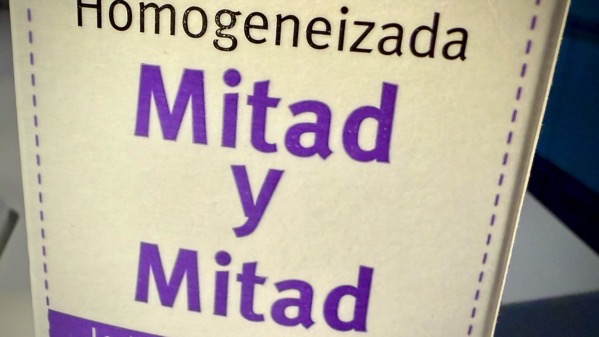
Nueva presentacion sign
Fish jumping out of ice pile

We all want to spiff things up, yet maintain continuity in the good parts. In Il Gattopardo (translated as The Leopard, but it really refers to a serval cat), Giuseppe Tomasi di Lampedusa has Tancredi say “everything must change so that everything can stay the same,” and I think this is the marketing version of the same sentiment….

The fish, however, is making the big (involuntary) change. But not into my basket. We came home with veggies, citrus, and tofu—the kind of strange mix that comes from not having menus in mind when browsing well-stocked aisles.

Recommended

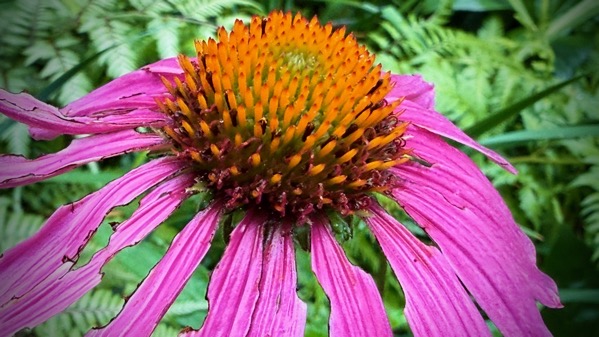
Post bloom flat leaved plants in sun shadow

Louise Erdrich sucked me in. Yesterday I would have told you that maybe by Tues or Wed I would finish Louise Erdrich’s The Master Butchers Singing Club (2003). Turned out I finished it before dark today. Strange, enticing characters, none out of the stereotype box.

And very little on the singing club.

Survival is the theme

Emergency exit only AHC

Partly closed buildings exhibit unexpected signs to herd the after-hours crowd, at least around here, gently.

I confess that I read GWTW at least twice and maybe three times before I was twenty, and mostly for the racy, romantic parts. Much of the rest went right by me.

Tonight I listened to four interesting contemporary women authors discuss Scah-lett, Melanie, the guys, and Margaret’s characters in general, along with other topics related to the book, over at the Atlanta History Center, which is currently showcasing Peggy Marsh and her MS.*

Afterwards, my chauffeur took me home down Peachtree, which was the perfect cap for the evening.

* I couldn’t photograph Peggy’s desk, which would have been my choice for tonight’s visual; it’s tiny, perfect for the closet where she stored it in their small apartment in a building on Peachtree. The desk, quite properly, is front-and-center in the exhibit.

For your doccia

Happy time bottle cropped

I suppose that if I spent more time cruising shelves in the groc store, I’d know about products like Happy Time. A few post-Google clicks, and I discover that the stuff is made “with caring Bamboo Extract and delicious Orange Blossom.”

We found Happy Time (in our shower, duh!) at the agriturismo where we stayed downslope from Francavilla Marittima, in the boot arch zone just above the Gulf of Taranto. The Ancient Greeks established themselves early here, and it was part of Magna Graecia—that is, the Greek lands beyond the Greek homeland.

Our sybaritic day

Sybaris main street pipe centro

“There’s an archaeological site,” Someone Else said, “let’s stop.!”

And thus we had a wonderful guided tour of Sybaris—to the Greeks, or Copia—to the Romans. We saw the ruins of Copia, except for a stretch of the Greek’s road. (Read the Greek community’s history here.

You’re looking SSE toward the Roman center-of-town, which had a large circular city fountain, the theater, and at least one temple.

Apparently the coast side of Copia had a harbor and city gate, but the sea is now several hundred meters away. I guess sediment from the mountains washed down over the ruins protecting wall bases and floors, as well as the roads.

I’m not sure of the hydrology, but we saw and heard two busy pumps, keeping the water at bay. One place we could see the current water level, nearly 2m below the road—so the pumps must run continuously to keep the site from flooding—at least during rainy periods—and we experienced that recently. The yellow pipe is part of the water-removal system.

Thus, we have left Sicily, and are doing a quick perusal of the Ionian coast (Jonian is the spelling here). The B&B we stayed at hooked us up with a local Calabrian restaurant, and we dined with two French couples staying at the same B&B—a linguistic olympics for all of us, as we switched among French, English, and Italian, especially to discuss the foods we were eating. John used Google translate several times; for example, you gotta really know a language to know “white mulberry*” (Morus alba) in it—they were raw, fresh, sweet, and part of the fruit course along with dark, sweet cherries. Yum.

The white mulberries are probably a legacy of the silk industry. A town up the way, Catanzaro, was known historically for its velvet, silk and other textiles; I’m guessing that’s the link to the Morus alba trees….

* mûre

A watchful gaze…sees

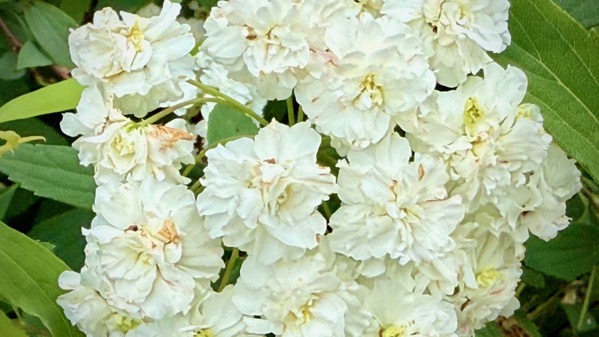
White azalea a budding mar 2011

Azaleas ready to pop, after dark.

He had taken to smoking cigarettes and every time he made one we all stopped to watch. In his vest pocket he carried a sack of Bull Durham smoking tobacco with a round tag with a bull on it hanging out. He also had a thin packet of cigarette papers called LFFs—Loafer’s Last Friend. He would hold a paper curved in his fingers of his left hand and fill it with tobacco. He had a way of holding the sack in his right hand so he could pull it open and shut with his teeth. When the bag was back in his pocket, with the bull showing so we would remember jokes about it and laugh, he would roll the cigarette and seal it by drawing his tongue along it. Then he would h’ist his leg and strike a match on his tight pants.

This was what I liked most to see. He would stretch his duckings leg till the blue was almost white. Then he would draw the match toward him, barely letting the head touch the cloth, and it would flame up a reddish yellow. He would hold the match still till the flame was clear yellow and then light his cigarette. He let me try in, but I did not get my duckings leg tight enough and the match stick broke.

Lots to like here: “cigarette” is never nicknamed or shortened, LFF’s full title is presented blandly, the solid sentences, the graphic imagery. But, mostly: the detailed observation.

How much of Owens’s technology and terminology is…historical quaintness now?

Passage from William A. Owens’s 1966 This Stubborn Soil: A Frontier Boyhood, pp 159–160 in my paperback Vintage Book edition.

Rana o sapo

bronze_frog_or_toad.jpg

Tucked away on a rock, I found this bronze sculpture over in the ABG. A cloud-layer made the sky dull, so my eyes looked down more than up, or I think I would have walked right by. I’m still not clear if it’s a frog or a toad*.

Some Southerners dodge this problem by calling this type of amphibian a toad-frog. There’s some wisdom to not fussing about taxonomic fine points.

More than anything, I think it resembles a dinosaur!

* Another Spanish lesson: rana o sapo = a frog or a toad.

Gecher lingo right

starbucks_splash_sticks.jpg

We’d been calling them (green) stoppers, which is still alliterative, but (at least the local) official name—splash sticks—sounds far more Starbucks-y.