Musings

Hedyotis/Houstonia caerulea, bluet.
I saw a blooming lilac! My standout memory of yesterday’s NC hike was seeing, flashing by at highway speeds, huge lilacs in two different yards. Down here, as I understand it, we don’t get cold enough weather for lilacs to bloom, so no one plants them. I have seen a dwarf variety at the Botanical Garden that does bloom here, but I find the reduced shrub-shape rather unsatisfying.
We also had a ruffed grouse (I think) cross the road, relatively unconcerned at our appearance from around the curve. It looked like a hen, and was travelling alone. No photo.
Those had to be the species high-points, along with the bluets that lined the AT here and there.
Posted at 4:27 PM |
Comments Off on Trail favorites

When jcb and I were concocting a place to hike today, we thought about Black Rock Mountain State Park, but then realized there was a good chance that people attended sunrise services there, and it’d be super-crowded, so we pondered another option—Pickens Nose, up in NC.
Neither of us had been there, so after picking Pickens Nose (har har), we headed that way. We discovered the walk up from the road to the summit is not long, and passes through a “cavern” of rhododendrons, with the buds still small and closed, just gorgeous!
What we didn’t realize is that the area is criss-crossed by enticing trails, and not many roads—how did we miss this? So, after strolling up the Nose (never sure which outcrop that was, nor if we could see it from the crest), we headed down the road to the next gap, parked again, then set off on a stretch of the AT. We skirted Big Butt (no lie!), and the next peak, all on the AT, then, feeling virtuous (and perhaps a bit tired), we returned to the car via the road.
Nevertheless, at this point I’m fried, so stand by for another installment later….
Posted at 9:22 PM |
Comments Off on Slick “cavern�?
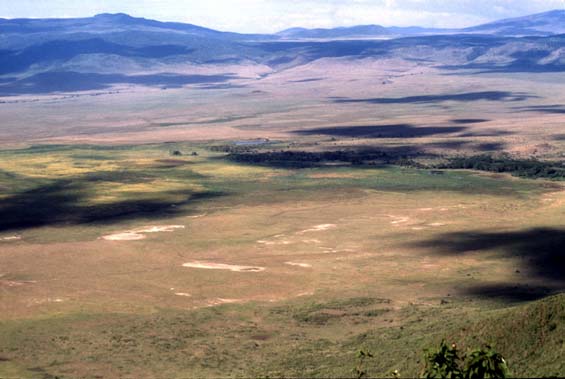
Ngorongoro Crater, filtered by the plane’s scratched window.
I approach information I find on the web with, I think, informed skepticism. I don’t trust it unless I have confidence in its source. I am especially vigilant about Wikipedia, although I think it’s a wonderful idea.
So, browsing the other day, considering the term marches, meaning borderlands, I wondered what had been posted on the Wikipedia, since my usual sources were skimpy on the topic (especially the cascade of Chase-Dunn and Hall papers, and citations of them, and their new friend Turchin—more on the latter in a coming post, I suspect).
Shazzam! Jackpot!
I think!
This sure sounds good:
Mark or march (or various plural forms of these words) are derived from the Frankish word marka (“boundary”) and refer to an area along a border, e.g. the borderland between England and Scotland. During the Frankish Carolingian Dynasty, the word spread throughout Europe. In contrast to a buffer zone, a march usually clearly belongs to the territory of one state, and rather than being demilitarized, it is especially fortified for defense against the neighbouring country.
The Frankish word marka comes from Proto-Germanic marko, which itself comes from the Proto-Indo-European root *mereg-, meaning “edge, boundary”. The root *mereg- gave Latin margo (“margin”), Old Irish mruig (“borderland”), Persian marz (“border, land”), and indeed even English “mark”. It seems in Old English “mark” meant “boundary”, or “sign of a boundary”, and the meaning later evolved into “sign in general”, “impression or trace forming a sign”. The word “march” in the sense of borderland was borrowed from French marche, which had borrowed it from Frankish.
Boundary areas have different histories than neighboring regions, different tensions and economies. Their affiliations may be strong, weak, or, more frequently, fluctuating. Yet, activities in boundary regions have a great effect on core regions nearby. Hence my interest….
Posted at 5:17 PM |
Comments Off on Non-Sousa marches

I have airborne evidence that the Masters Golf Tournament is nearly upon us. At least I think so!
On the ground, Piedmont Park was a hotbed of activity late this afternoon. The kite flyers were having the most fun, followed by the young teen boys throwing footballs, and lots of people were walking dogs and airing their iPods.
Me, I had the GPS (5 1/3 miles at 3.7 mph average) and the camera….
Posted at 8:51 PM |
Comments Off on Blimps & kites
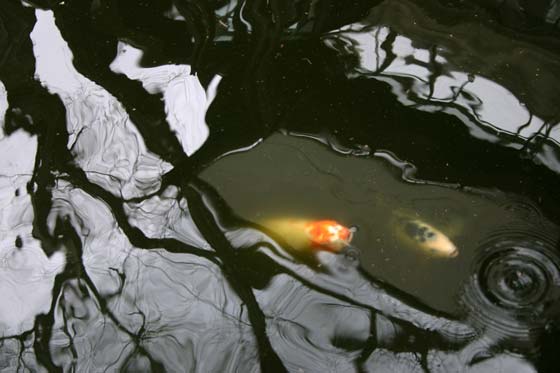
Today, we enjoyed a gorgeous spring day, with temps tipping toward summer, but vegetation solidly in spring. We had the additional fortune of spending much of the day with our friends Kay and Dean wandering around Callaway Gardens. While we certainly reveled in the blooms—especially the banks of azaleas and dogwoods scattered below the pines—we also spent considerable time watching languid koi, bream (HUGE “brim”!), and sunning turtles.
John, perhaps a bit gleefully and perhaps a bit disgustedly, pointed out several egregious misspellings in Callaway’s carefully made signs, e.g., restauraunt, bicyles (we speculated that the pronunciation was “bickles”), and their inconsistent use of typefaces.
Posted at 6:35 PM |
Comments Off on Summery spring
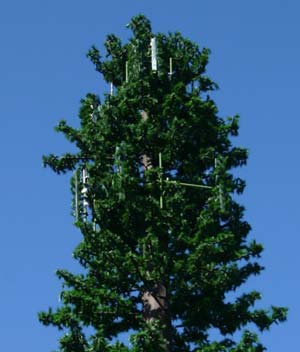
Antenna tree doesn’t decrease carbon levels.
I’ve never heard of The Conservation Fund, but through some now-forgotten web-wandering (perhaps via the press release on that huge new land acquisition by the Nature Conservancy from International Paper?), I discovered their web page, and, even more interesting, a simple calculator for estimating the amount of carbon you and your household are putting into the atmosphere annually based on energy use (electricity, propane, natural gas, petrol, the whole shebang).
I had thought John and I were doing a pretty good job of having low energy usage, and maybe we are for our neighborhood, but the calculator shows it would take dozens of new trees to counteract our carbon production.
Where’s the checkbook? These folks will get them planted for me!
Posted at 9:05 PM |
Comments Off on Airborne carbon
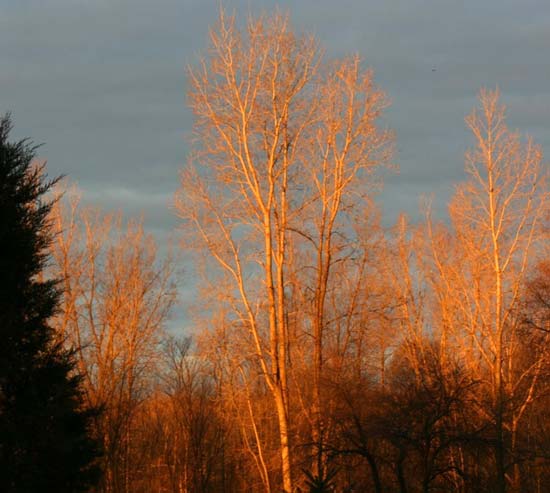
Yesterday’s Cousin Party was a moderate success, the drawback being that the oven took forever. We had great fun and lots of laughs, and that’s the best!
I love the colorful early- or late-day light, the Golden Hour I understand Hollywood calls it. In perhaps the brightest, least overcast moment since I arrived, the sun lit the unremarkable fenceline trees, enrobing them in grandeur.
A university acceptance person on the decision not to rely heavily on standard testing: Ultimately we concluded that testing was an artificial indicator of success and that intelligence is more multifaceted and complex than what can be measured by any single testing system.
Posted at 8:27 AM |
Comments Off on In motion

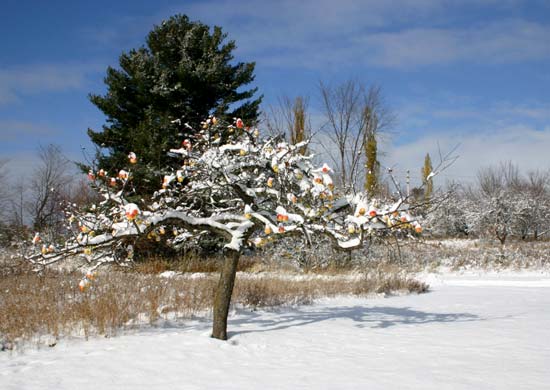
Yeah, this is from a while back, but we had ALMOST this much!
Yesterday was a day of snow with no accumulation, yet we awoke today with a fresh mantle of that precip on the ground, not enough to cover the grass, but still, a new white coat upon the landscape. I see no snow in the air, so this may be all we get!
Peace, of a sort, reigns.
News flash: cousin party tonight!
Posted at 9:18 AM |
Comments Off on White world

In memory of Jack Finlayson: 9 May 1919 to 23 March 2006
Big fat soft snowflakes are drifting down, but upon meeting the unfrozen ground, they melt, leaving us with water not fluff.
Posted at 9:17 AM |
Comments Off on Drifting snowflakes
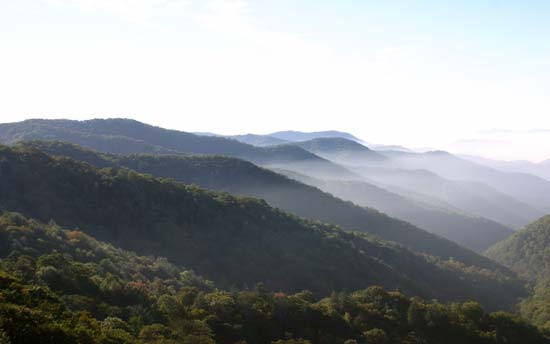
Word is the weather’s changing tonight from the 80s summer temps we’ve been enjoying (?), back to rain and spring moistness.
Here’s an image from the memory banks, taken in early fall last year in the Smokies. I love the “layers” of the hills receding into the distance.
Posted at 8:39 PM |
Comments Off on What season?