Musings

Towns, cities, even small communities, have a plaza (say: plah-thuh here in Spain). In all but the smallest communities, it seems to me, the largest is the Plaza Major (say: mah-yore (kinda)), that is: the biggest plaza. In Medinaceli, it is substantial.

Medinaceli is more famous for this Roman triple-arch—the only triple surviving in Spain.

As near as I can tell, all the row-crops we saw today were this, which I think is winter wheat, that is, planted in the fall, and probably hard/bread wheat. This is what mono-cropping can look like.

Here’s a smaller community’s main plaza, a place called Deza.

This church presides over a playground for small children with two of those ride-a-critter-on-a-spring toys, plus a combo soccer and basketball court for the older kids. The plaza is behind the church from this location, and is about the same size as the one in Deza. This is Mazaterón.

Meet Peñalcázar; peña means cliff. We tried to get to this Medieval ghost town atop an amazing landform. The wind was strong and gusty, too much to fight our way along. If we’d had a 4×4 we probably could have made it up the two-track you can barely see, at least to the outer wall.

The landform won here, too. We tried to climb to the Celt-Iberian settlement that was above us, and controlled this lovely valley, now partly reservoir. We made it about twice this high before we quit. I estimate we were about a third of the way to the site, but it could have been less. Great views, however.
The site is called Aratis, and it is most famous for the several stunning bronze helmets found I believe by metal detectorists. They date to the later Iron Age, probably the 1st C BC. By this time, the Romans were beginning to swarm southern Iberia and Iberia’s Mediterranean coast. Aratis was inland, and at that time safe from incursions.

At our feet were these spiny plants, Genista scorpius, I think. We also trod on what smelled exactly like sage.

We popped up over the lip of a hill, having climbed out of a valley with a large mill complex, now abandoned, that looked like it was in use into the latter half of the twentieth century…and look what we spotted. The configuration and paint job is traditional in Spain (at least now). Outside of Malanquilla.

What a moon as we left our hotel to do some errands. Almost 6pm in Calayatud. The name is a corruption of the Arabic Qal‘at ’Ayyūb, meaning fortress of Ayyūb. Ayyūb is the equivalent of Job, which at least at that time was a common Arabic name. This Ayyūb was Ayyūb ibn Habib al-Lakhmi, the walí, or, roughly, governor, here of al-Andalus, an official reporting directly to the sultan, or, in this case, the emir of Córdoba. There’s a fine hierarchical bureaucracy.

On the top of the list was to scare up some eats, as almost all restaurants in the city are closed on Monday. We went to a large modern supermarket (skipping Aldi). I spotted this offering, probably about 10 different brands/types on offer. [I edited the hooves from the photo; you’re welcome.] I did not look at the prices, but I suspect they were substantial.
Posted at 3:32 PM |
Comments Off on Architectural forms, history, eats: plus…

First light from hotel room. The cloud cover soon dissipated.

We exited town by the back way—our first ford…in, amazingly, a Ford!

Infrastructure slope! From top to bottom…. Various electrical poles. Major regional irrigation water, in pipes, not open channels. Zigzag of roads on slope. Road bridge of at least three arches. Railroad bridge of two arches. Oh, and guardrail to keep us safe.

“I can see Madrid from “my” dead olive tree!” [Hint: tall buildings are visible just to the left of the tree, on the horizon.]

I can also see Madrid over this Medieval well with stabilized walls.

I can see my spouse atop a Medieval bridge!

The shady side of this gorge, where I stood to take the above photo, is so shady, the lichens were this prolific.

On the opposite side, the sunlight means happy mosses, with other types of lichen.

One of my favorite compositions of the day.

We drove up to a famous Late Paleolithic site (and museum) with Acheulean-style tools, with and many animal bone fossils and no hominid remains. We were welcomed first by this beast, two cats on the porch of the museum, and no one to allow us in. Oh, well. [Truth: we did know it would be closed by the time we arrived.]

There’s a day-moon from our last mile, and we’re at our hotel for the night. It’s only a little over an hour before the restaurant opens for dinner service. We worked up an appetite!
Posted at 1:38 PM |
Comments Off on Not in Kansas

First time a pilot came out to apologize for a late flight—he did it twice, over the mic to all, then walked around and took questions. [Really: last night, but first part of flight in essence.]

First high-elevation corporate witticism I had to “share.” [We left about three hours late; our destination: Madrid.]

Best airline food I’ve ever eaten. Yum. Truly.

We took off in the rental car, headed north, and the first time we hit a dirt road we saw our first caballero.

First Roman villa. This is a late one, and the central courtyard-garden still sports a tree.

First five-arch Medieval bridge. Last modified in 1973.

First Neanderthal cave cluster (mostly protected from the elements with a roof or with small openings—fenced, so we couldn’t get closer).

First fabulous sky of the trip.

First mystery. Sign says the water isn’t potable.

First dramatic bottleneck/pass we’ve driven through.

First night’s hotel room view.
We’re getting into the swing of the Spanish lifestyle: we will dine tonight at 8:30; only two more hours to wait. Over and out.
Posted at 12:28 PM |
2 Comments »

The word history traces back to the Greek, where its meaning required investigation/inquiry and research; it wasn’t merely story telling. History also has a context (social, cultural, temporal, etc.), and, sometimes, good luck figuring that out.
Apologies for the two-day delay in posting….
Posted at 10:22 PM |
Comments Off on It’s about timing?

Most recent binge-watch: “La Grande Maison Tokyo” (fiction). Tonight’s binge selection: “Lost Treasures of Rome” (science/NatGeo).
Posted at 7:39 PM |
Comments Off on Look out!

Here’s a sample of recent finds along our beach. What you don’t see is beer bottle frags and plastic trash—too boring to curate. The rusty metal at the rear of the display is a piece of a wood stove that once had some decorative curlicues that now are ghostly remnants on the surface. At one time, this stretch of the bluff must have been the household dump for at least one residence, and now the trash has moved downhill.
Posted at 9:26 PM |
Comments Off on Gravity prevails

I’ve been mapping the distribution of Bronze Age mounds in modern central Turkey, and thinking about the (human) population density, and the agriculture and distribution system it took to feed those people. This is the era of the Hittites (not what they called themselves). I’ve been vastly ignorant of Hittite history, which perhaps is just as well, as there have been several breakthroughs in recent research that has changed our ideas about their political economy to some extent.
Posted at 10:29 PM |
Comments Off on __ on the past

See this magnolia? It’s actually two adjacent trees on the bank of a former railroad ROW (to the right). Now the ROW is the BeltLine, a pedestrian and bicycle corridor, with landscaping by Trees Atlanta. To the left is a shopping center with a Whole Foods and a Staples (guess which one gets more traffic 🤣). Delivery trucks are the most common traffic along this route behind the stores (and us when the “front” is clogged).
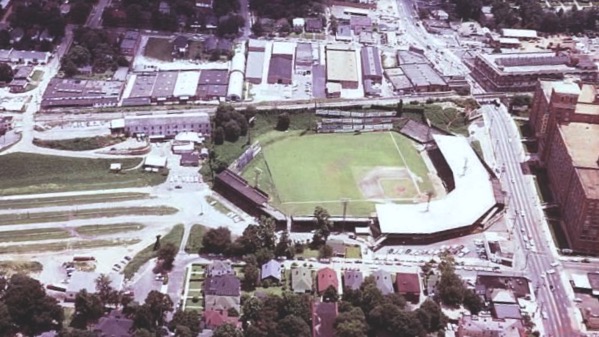
Here’s a ca. 1950 photo from Georgia State’s archives of the Ponce de Leon Ballpark. The info that follows is from 2020 article by Adam C. Johnson (here). In 1890, there was a lake where the field is, and the magnolia was already there. The ballfield was first built in 1907. The photo shows the version built in 1923. If you were sitting behind home plate, you were looking straight at the magnolias. Johnson writes:
If a baseball hit the magnolia tree and bounced back into the field, then the ball was in play because, per the rules, it had to pass through or remain in the tree to be a home run. To this day, the Spiller Magnolia Tree is the only tree in baseball that has been in play, and [Babe] Ruth and Eddie Matthews are the only confirmed players to have hit home runs into it.
Recently, Trees Atlanta has cloned the magnolias, and planted the new trees along the BeltLine.
End of baseball trivia.
BTW, that big building to the far right facing the ballfield was a huge multi-story Sears that had a side track from the RR for deliveries. The building recently was redeveloped and is now Ponce City Market.
Posted at 8:22 PM |
1 Comment »

Metal that degrades with this green color must have copper in it…not all copper, just some. It’s called verdigris. It was a scaly, peeling kinda day, and I’m “still processing,” as the phrase goes.
Posted at 9:13 PM |
1 Comment »

With our fine cuppsa-joe in hand, we strolled across the Fox River bridge rather early in the morn, meeting these googly-eyed statues of two of the four fox-sons of Papa Charlemagne. The St. Charles (Illinois) Chamber of Commerce website tells the story of Charlemagne’s command to his offspring to take care of the EuroAmerican settlers of the valley. I find it a fanciful and strange tale.

Upriver a short way, we came across this statue, also with rather paternalistic words, although I rather liked the figure’s presence.

We continued up the riverwalk to the older train trestle (green), now with a walking bridge nestled alongside (brown). Our friends said long ago when they were children, the daring among them might cross on the trestle…this was long before the river was cleaned up and the walking trails developed. And condos built and development and resurgence…and gee, it’s great someone spent tax dollars to clean up the river….

In the afternoon, we attended a fine party and BBQ, and still later, we caught the smoke-altered sunset en route to our overnight location in Wisconsin. A great time was had by all.
Posted at 10:43 PM |
Comments Off on Quite a day