Musings
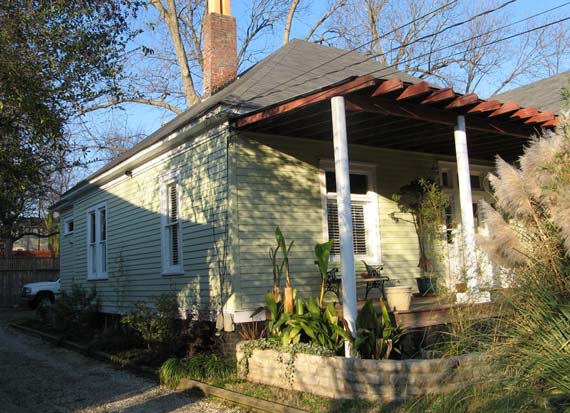
Most Mesoamericanists recognize that households in more or less complex societies provision themselves through a variety of acquisitive acts, including trading and bartering, marketing, reciprocal gifting, redistributive exchanging, and various kinds of resource sharing, all at the same time…
Is your household more like this, or less?
From pg. 268: Wells, E. Christian, 2006, Recent Trends in Theorizing Prehispanic Mesoamerican Economies. Journal of Archaeological Research 14:265–312.
Posted at 6:55 PM |
5 Comments »

Finally the Brits get their collective archaeological act together and investigate the greater Stonehenge area, and wah-lah (as they say down on the GA coast), there’s interesting evidence of feasting and domesticity—don’t skip the fun 32 second animation! For a time, many of my colleagues were smitten with the idea of empty (non-residential) civic-ceremonial centers, and it’s good to know how occupied the Stonehenge area was—and that partying was a big deal. Not a big surprise there, these were the ancestors of some hard-drinking modern types….
I’d have to see more data than the Smithsonian is reporting here (note that the investigations were funded from this side of the Atlantic!) to understand the whole river use angle, but ideology is where it’s at—and the most impossible piece of cultural reality from an archaeological period.
Posted at 6:24 PM |
2 Comments »

Today is the first anniversary of this blahg. As I strolled to the library this afternoon, I attempted to compose a commemorative essay, but every angle I thought up was so boring that I drifted back to contemplating…
…well, when human beings adopted behaviors that led them away from the nomadic hunter-gatherer life that the species had managed to make work so very well in environments ranging from the Arctic north to the Namibian desert, from tropical maritime shores to high-elevation mountain life in multiple continents.
For the most part, purist archaeologists shy away from thinking about the psychological component of the human past—for one big obvious reason: the evidence is scanty and indirect at best (a criticism common to both the processualist and post-processualist paradigms). However, I cannot think about groups of people changing their subsistence patterns (including eating different food and in different ways), changing their priorities, and changing so much else about their lives and what they do on a daily basis, without wondering about the mental component.
Mentioning this in some circles is tantamount to dropping a proverbial bombshell—one that isn’t Marilyn Monroe!
So, since I’m willing to tread these waters, lemme finish the thought. What was the motivation for the change? In a nutshell, I keep coming back to lust. In myriad forms. Just think of the so-called seven deadly sins: lust (originally extravagance), pride, coveting or wrath, envy, gluttony, anger, and sloth—right?). The first four unequivocally correlate to the tendency I’m thinking of, and the others can dovetail with it.
A psychological bent in this direction means increased interest in obtaining things one didn’t previously have, doing things that impress others, etc., leading to increased sociopolitical interactions, a transformed political economy, significant changes to ideology, and, poof, you can see changes that would underlie the shift to life in settled villages. At least I do….
Posted at 4:53 PM |
Comments Off on One year

Worth visiting next time you’re in the area….
Posted at 6:12 PM |
Comments Off on Silver City
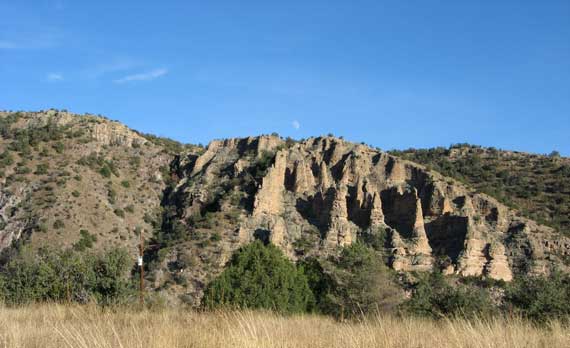
Today’s hike (about 11.5 miles) was a loop that took us through canyons, Little Bear and Middle Fork of the Gila, near the Gila Cliff Dwellings Visitor Center, with only a single ridge to traverse. The main valley near the VC is open, framed on the sides by low rock faces (low if you don’t have to climb them, that is). Some of the flats have various grasses, all a lovely golden, which hides the fact that they’re treacherous this time of the year, inserting their aggressive ,wee, pointy seeds into any passing sock. Coming down the Middle Fork we figure we crossed the river at least thirty times, so I wore my Keen sandals, sockless, thereby thwarting nature’s seed distribution system.
Posted at 9:56 PM |
5 Comments »
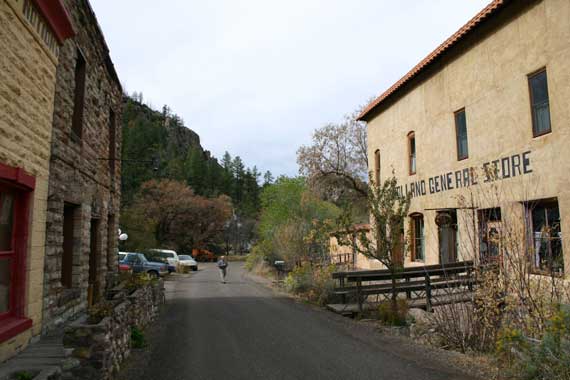
Today’s headline activity: a visit to Mogollón Ghost Town. By UP standards, however, it wasn’t really a ghost town—eight or nine people live there year-round, and several businesses persist, although maybe not year-round.
As Mogollon, it was a booming mining town for several decades, longer than Seney, I think. We found the drive in (from the west) jaw-dropping, just spectacular. After our visit, we went around through Glenwood, and up to the Catwalk, another artifact of mining activities (pipeline up the creek). The overcast sky made photo-taking difficult, and the elevation has kept us from running around much. We do more plodding!
It’s raining now, rather unexpectedly for us, and the rain felt cold on our faces as we, with overabundant determination, took a planned dip in the hot tub, cutting it short due to the inclement circumstances. (Yesterday, we stayed in almost an hour, much of it with the jets and lights off to better see the sky.)
Posted at 11:34 PM |
Comments Off on Mogollón NM
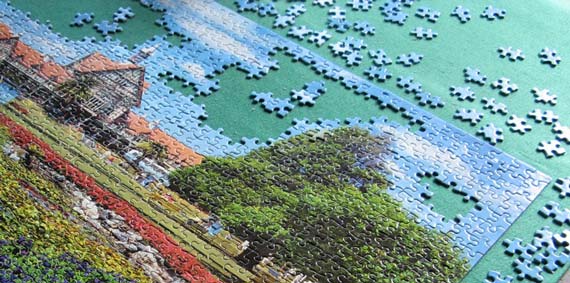
Life is a puzzle. Or, a series of puzzles. Certainly, marriage is! Perhaps it is that any complex system is a puzzle, therefore our ecosystem is a puzzle. Anyway, puzzles abound!

Take a look at changes in the sediment load of the Mississippi River from this NYT article. Of course, you notice first that the overall sediment load has dropped by more than half—yet, the dredges are still busy day and night keeping shipping channels open. Then you notice that the relative sizes of the upstream contributor-rivers has changed dramatically—the upper Miss itself has shifted from being a little stub to a multibranched load-carrier. Maybe next: still the largest single contributor-river is the Missouri. And: what’s the deal with that Atchafalaya drainage fork?
The question I’m left with: exactly which Mississippi River (and which Amazon Basin, which Yellowstone Park, etc.) are we talking about “returning�? to (also, see upper graphic)?
Posted at 10:22 PM |
Comments Off on Puzzling past
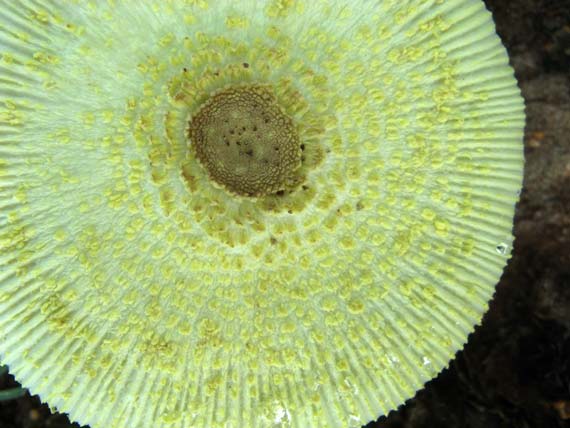
This lovely ’shroom really was this delicate, pale lemon color.
One way to look at it is the gods were watching us this afternoon, and the dark gods removed our DSL connection for a few hours, while the gods of light prodded Apple to agree that they were taking just too darned long to fix the dysfunctional DVD player on our well-loved 12�? laptop—indeed, they said they didn’t know when they’d receive the replacement part, so…John’s magic kicked in, and they offered us a NEW, Intel core DUO, MacBook, black, with built-in iSight and all the other goodies (and including remote control!), whenever jcb showed up at the store.
Of course, he immediately braved rush hour traffic to scoot up to Lenox and nab it—took all of two minutes in the store, he said. That is customer service!
I confess to a few minutes of nostalgia for the old laptop, but I suspect that this one will become a boon companion (of the techno-sort) quite soon….
If you’re expecting me to mention the new date for the latest Neandertals, okay, here’s my take: could be a small relict population in southern Iberia, with the European mainland already cleared of the species and replaced by Early Moderns—that is, if the date is good, just as the good Dr. Finlayson (!) and his team report.
Posted at 5:45 PM |
5 Comments »

Cruising through Google’s downloadable books, I found some miscellaneous publications, including volume 1 of the Journal of the Anthropological Institute of New-York (yes, with hyphen), published in 1871–1872. This canoe is from p. 67, a brief article called “Canoe in Savannah-River Swamp” (hyphens must have been cheap in those days) by Charles C. Jones, Jr. Actually, quite a few canoes, considering how unlikely it is that they would survive, have been found over the years in the Coastal Plain of Georgia and the Carolinas, sunken in the muck. Undoubtedly many are prehistoric.
Posted at 10:22 PM |
Comments Off on Preserved artifact
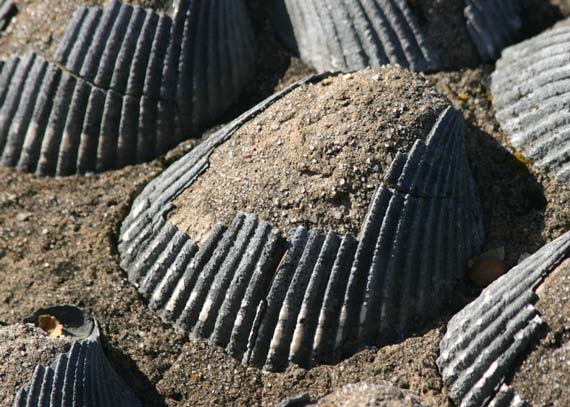

No real theme to today’s musings….
Photos are of a grave in a rural Georgia cemetery, quite a distance from the sea that yielded the shells that decorate its top. Exposure to the weather exposes their lack of durability…. Still, it’s a pretty sentiment….
Outside reading: click here to read a lovely story by Ben Ratliff about how satisfying John Coltrane’s music still is. He notes:
In his time Coltrane had no peer as a player of romantic ballads; he learned from Johnny Hodges, the master of that form. For his first wife, he wrote “Naima�?…. Perhaps it’s the insistent pedal tone, grounding everything, or the wide intervals, or the rich harmony; but “Naima�? almost reinvented this type of tune in jazz, building on Hodges saxophone showcases like Duke Ellington’s “Warm Valley�? yet intimating something deeper, a kind of contemplative, I’ll-see-you-in-the-next-world feeling.
Me, I’m headed for iTunes Music Store to improve our Coltrane playlist….
Posted at 6:13 PM |
Comments Off on Revisiting Coltrane