Sunday visitin’
Sunday, 16 March 2008
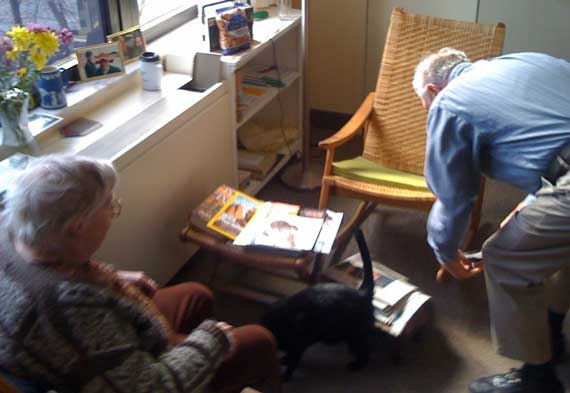
Pretty low-key Sunday. L&C came to visit at the house, and Salem came by at Mom’s to shed some of his black fur.
Sunday, 16 March 2008
Pretty low-key Sunday. L&C came to visit at the house, and Salem came by at Mom’s to shed some of his black fur.
Saturday, 8 March 2008

Today’s All Things Considered included an interview by Jacki Lyden with an arachnologist named Gustavo Hormiga about spider species he’s identified—that’s how Lyden puts it; on his web page, Hormiga writes that his research focuses on the systematics and evolutionary biology of spiders, with emphasis on orbweavers and their close relatives (Orbiculariae).
Interesting and recommended.
I was surprised, however, that they didn’t work into the story any comment about the fact that the scientist’s surname translates as ant.
Extra credit if you know who El Hormigón—meaning The Big Spider—is!
Monday, 3 March 2008
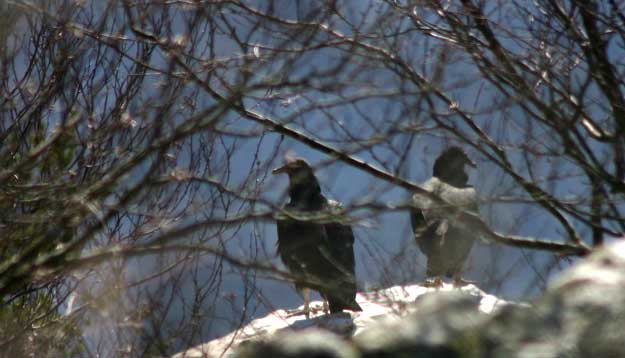
This was our biggest critter sighting on Sunday, two black vultures (I think)—Coragyps atratus. We were hanging out in the sunshine on rocky promontories overlooking the valley, and they stayed on the next rock the whole time we were on our rock. The spot was labeled “High Point” on the Garmin map, and the cartographers were not incorrect.
Friday, 22 February 2008
It’s Friday—well beyond humpday, on the verge of Fri-fest (long story)….
In weather news, we had rain off and on all last night and well into the morning. Our major reservoirs remain low by feet and feet (as of this morning, something like 10 for Allatoona and upwards of 20 for Lanier—the latter is Atlanta’s principal drinking water source), although it’ll be several days before the catchment area completely feeds all the runoff from the rains of the last 24 hrs into the reservoirs. Still, this slow spring rain, while good for plants, doesn’t impact reservoir levels very much.
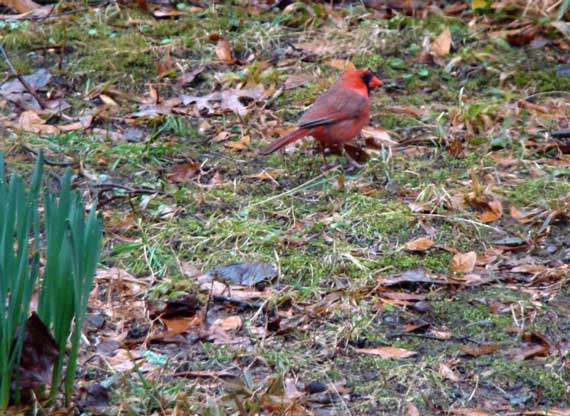
Undeterred, the birds are coming through. We’ve had cardinals in the back yard, and I saw a flocks of busy grackles and robins in the front yard when I came back from errands.
Tuesday, 19 February 2008
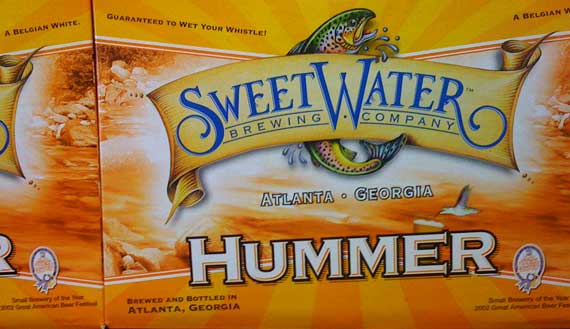
Counterpoint: Hummer beer? From Atlanta’s own Sweetwater brewery?
Biodiversity—the variety of all life, from genes and species to ecosystems—is intimately linked to Earth’s climate and, inevitably, to climate change. Biodiversity and poverty are also inextricably connected. For instance, changes to natural ecosystems influence both climate change and people’s ability to cope with some of its damaging impacts. And in their turn climate change, as well as people’s responses to it, affect biodiversity. Unpicking all these strands clearly shows that conserving and managing biodiversity can help natural systems and vulnerable people cope with a shifting global climate.
Is this assertion by Hannah Reid and Krystyna Swiderska in the abstract of a paper for the International Institute for Environment and Development (IIED) correct? Certainly, the first instinct is to say yes.
But.
Let’s start with biodiversity: it is not fixed, but instead something that has always fluctuated, both through time and across space. The assortment of species we see today and their home ranges have no special or sacred qualities—in fact, they were different five hundred years ago, ten thousand years ago, etc. (let alone, say, thirty million years ago).
So, yes, among the many factors that influence biodiversity, climate is one.
Here’s where I start to struggle: “people’s ability to cope with some of its damaging impacts”…. Climate change is both damaging and enhancing, because those words evidence judgemental perspectives. “Damaging” assumes any change is only negative. Not so.
You sorta have consider the history of the human species as a long, complex trail of significant human-induced landscape change (maybe more of a spreading blotch). These alterations accelerated with the shift away from subsistence that was exclusively from gathering and hunting, and with concomitant demographic increases. Duh. The flip side of all this is that humans are around in such numbers as we see today because we are good at this adaptation stuff, aka coping. But. [Hope I don’t come off as flip.]
It is virtually impossible to prioritize preserving biodiversity as the most important or wisest goal in our reaction to climate change. It may be a wise goal to promote the preservation of biodiversity as leverage to induce people to be more responsible about impacts on the environment within their control, but otherwise the argument evinces more rhetoric than logic.
Wednesday, 13 February 2008
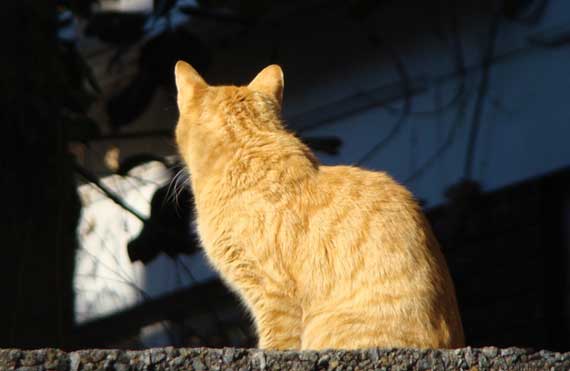
Look at those whiskers!
Yeah, at the Westminster Kennel Club Dog Show the judge picked a cutie-beagle for best in show.
My pet-snapshot is a lovely ginger cat I found sitting in the sun (the other day, I admit; today is not this nice—in fact it’s windy and cold—brrrrrrrrr!)—but looking away. In fact, apparently concentrating on looking away…the way cats sometimes do….
Finally, I did my best to emit a purring sound. The cat turned—and I got the money shot….
The ginger coat-color is a sex-linked trait; ginger cats are most often male. On the other hand, cats with tortiseshell or calico coats are almost always female.
Read the Wikipedia discussion of this—and much more—on cats….
Monday, 11 February 2008
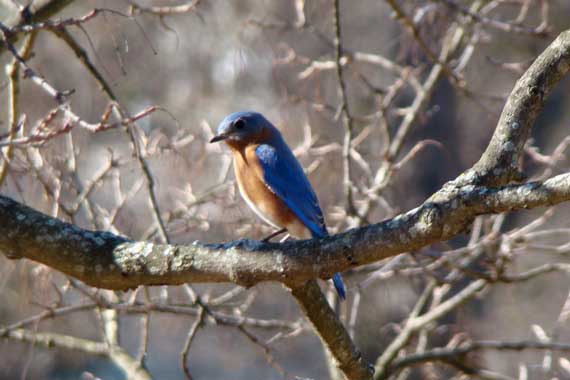
Photo thanks to JCB….
We spotted a pair of these flitting about under a large spreading oak this weekend. I thought it was an Eastern Bluebird (Sialia sialis), and, voila!, a bit of image-googling, and it’s confirmed!
Isn’t it good luck to spot a bluebird?
Saturday, 26 January 2008

Remains of snow-dude or dudette, yesterday afternoon.
Today I realized that I don’t know what elevation the monarch butterflies (Danaus plexippus) soar when they migrate. Not even Wikipedia says, although another site notes some are hit by cars and they may cover 50 miles/day…. So, they’re low-fliers?
Tuesday, 22 January 2008
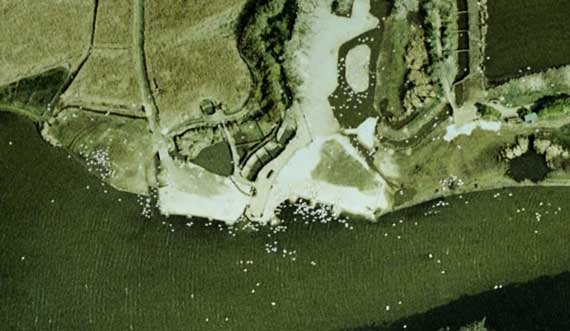
Google Earth image of Abbotsbury Swannery lagoon, with mute swan-dots.
These days I often explore the world using Google Earth (free free free!), spurred by something I read somewhere—cheap trips, no?
Today I noticed mention of the Abbotsbury Swannery in a NYTimes article by Donald G. McNeil Jr. on the global avian flu virus situation (check the sidebar graphic, too). First, on the flu, yup, it’s still a problem, and is now endemic in parts of Egypt, Indonesia, and Nigeria, and probably also in China, Vietnam and Bangladesh—that’s two continents, and multiple flyways. The virus is adept at mutating, and scientists have already identified “10 clades and hundreds of variants”—makes you look a bit warily at those migrating birds overhead….
I’d never heard of a swannery before, and that the Abbotsbury (Dorset, UK) one dated back to the 11th century, well, geeze, my hand was instantly conflicted about whether to google the Swannery or search out the Google Earth icon first! Cleverly, I set GE app to opening while googling for info…. I found a tourist listing, including a photo of a recoverd bomb (looks like a huge black round, well, egg, given its display location at the Swannery!), and, no surprise, a Wikipedia entry, which has a lovely picture of downy mute swan cygnets.
The Google Earth picture is from the green season, and white swan-dots are along the shoreline and floating on the lagoon, and while there are a few swan and beach pictures from Panoramio, most of the nearby Google Earth Community links are to shoreline and bluff “pillbox” fortifications, I assume from WWII.
And, yup, the Wiki-people are alert; there’s mention of the avian flu showing up at the Swannery less than ago….
I love that this travel contributes nothing to my carbon footprint and removes nothing from my savings account….
Friday, 4 January 2008
It seems that the Obama people correctly analyzed the situation: they sought people who would:
So, according to data published by the NYTimes (county-by-county outcome here, and entrance poll profiles here), Obama’s team turned out their backers, and those backers weren’t swayed by others. Ergo, Obama came out of the caucus system with the top score statewide.

Sr. GBH the other day…by JCB.
Seems like too many other candidates have not exploited the whole system: gotta stuff those caucus rooms with your people. Doesn’t matter so much how total people many across Iowa are for you, but how many show up for the caucus and are for you.
The Huckabee situation seems like it wasn’t his organization that turned out people so much, but people who held beliefs that motivated them to turn out. Plus so many other Republican candidates didn’t have many highly motivated backers (think McCain, Giuliani). The profile of Romney backers is informative: They supported him “with reservations” and they felt it important that they thought he’d win nationally. That’s a version of lukewarm and situational. It’s not so much about him, but about the situation. Such folks don’t feel as compelled to turn out.
What all that wonderful NYTimes data don’t show is what candidate were people willing to move to, if they couldn’t stay with their original? And its flip side: who was so entrenched they could move people to their candidate? Pundits are saying that on the Democratic side, fewer caucus-goers were willing to move to Clinton as a second choice, so that Obama and Edwards overwhelmingly benefitted in that situation….
My analysis (not meaning to compete with Russert or Brooks): those candidates whose voters were overwhelmingly of one gender or another are not likely to be viable nationally. This means Obama, Edwards, Romney, and McCain have the most “legs.” Those who are overweighted in one gender: Clinton (more women), Thompson (more men; yes!), Paul (more men).
Back to the first point, however: what it comes down to is whether your backers turn out heavily—since voting is not compulsive in the USA, and so few eligible voters do that ever-so-important civic duty. Even in presidential elections….