Musings

Pan from ATL Bot Garden
I understand that the US builds flood control barriers for what is at the time of construction (and that this assessment is not regularly adjusted is part of the problem) thought to be a “100-year” flood. Of course, that’s theoretical, but it is a label that provides perspective. I also understand that in Holland they build for 1000-year flood events.
HUGE difference.
Meanwhile, at one earthen levee along the Mississippi River:
Officials spent nearly six hours choking off the leak caused by a muskrat burrowing in the soft ground early Monday.*
Six hours, mind you. Now, I’m not the most knowledgeable at natural history, but a muskrat? This is not an unexpected species (Wikipedia has its range as across the continental US), and its habits are well-known. Will we soon be hearing that we taxpayers must ante up X-gajillion dollars because of ONE MUSKRAT?
This from an AP story in the NYTimes this afternoon, dateline Winfield, Missouri.
Posted at 4:23 PM |
2 Comments »

We watched the layered sky become all grey and dark as the storm came in from the west yesterday. Thankfully, it took the edge off the intense heat that had built up throughout the day. I had to pick up loose newspapers from the neighbors ditch, which had been loosened by the gusty winds (they’re laid in a mosaic-blanket between the rows and held down—when it works—by weeds and strategic bits of soil, and function to hold in moisture and control unwanted vegetation).
Today, however, we’re back in the humid soup that stands in for atmosphere in this part of the world during this season. Still, my stalwart helper and I managed to put in almost two hours this morning adding more newspapers around the tomatoes and between the rows of peas—these are rather intellectual veggies, nourished by the New York Times and the Wall Street Journal, and the odd copy of the State News. Before I quit, I also picked lots of strawberries; someone’s going to be making jam or slicing berries for the freezer next week (not me!).
Posted at 9:11 PM |
3 Comments »

The summer heat has arrived with a vengeance. At 10:30 am, it was already 88°F.
Posted at 10:55 PM |
Comments Off on Summer temps

And the floor isn’t safe, either, at least off in the distance….
This is the current view from the master bedroom into the (former) master bath. That’s the edge of the sink in the front left corner, and you can see a peek of the soaking tub beyond the low knee wall (mostly intact). Then, it’s some version of the wild blue yonder where the doorway into the throne/shower area was.
We’re informed that the brown tarp is thicker, and covers lower areas with sharper pokey-uppy-things, with the thinner blue tarps in the upper areas, all of it layered like shingles.
Rain’s headed our way from Alabama if I read the weather maps correctly. So, soon this temporary buffering between outdoors and indoors will be tested.
I particularly like the (accidental, happenstance—really!) juxtaposition of the toothbrush cup and the vagrant oak leaf on the counter by the sink….
Posted at 9:39 PM |
2 Comments »
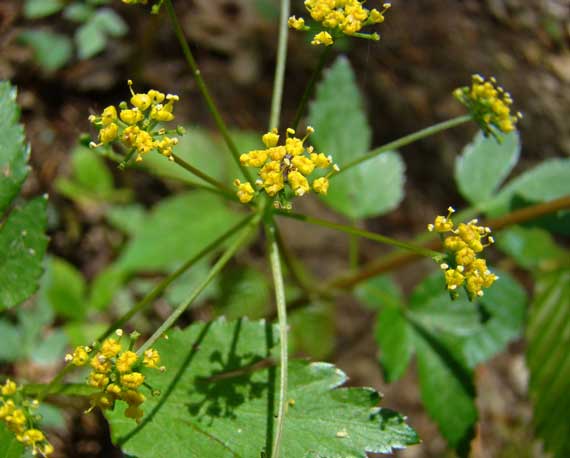
Wild parsnip (Pastinaca sativa)?
Recent rains have whacked the pollen count, and now we’re getting a cold snap. Where’re my socks?
FYI—abbreviation: GHGe
greenhouse gas emissions
And some solid figures from Circle of Responsibility:
Researchers estimate that the average American diet produces more than 15 pounds of CO2 per day which equals 5,600 pounds of CO2 emissions per person per year…. Compare that number to other “practical changes” suggested by respected environmental organizations that ask individuals to cut their carbon by taking shorter hot showers or changing light bulbs. A 10-minute shower is often cited as contributing four pounds of carbon per day (or 1,460 pounds of CO2 per year); this is only about one-third the impact of our daily food choices! [text from here…]
Posted at 10:22 PM |
Comments Off on GHGe

Did I mention they’re big on dinosaurs at Fernbank?
Rainy off and on today. Which is good for plants and reservoirs (Lanier’s still almost 14 feet low and we’re still under exceptional drought conditions).
And will wash away some of the accumulated pollen.
Posted at 4:22 PM |
1 Comment »
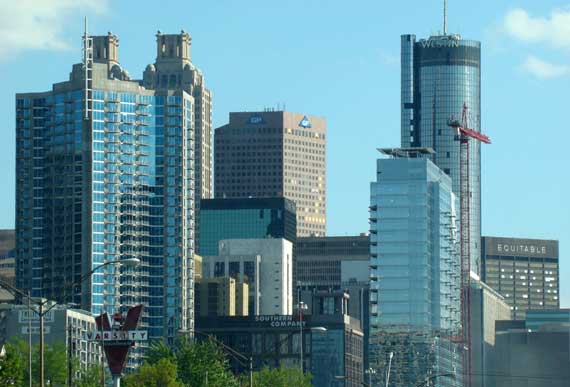
View westward of downtown Atlanta (note Varsity sign)….
Remember the tornado that hit downtown Atlanta back on the evening of the 14th of March? Well, here’s a look at some of the remaining damage.
That’s plywood blocking windows in the Georgia Pacific building (center, brownish), and those black spots on the round Westin hotel building are more broken windows. The tornado would have come from the west(ish), so this may not be the worst of it. Some streets are still closed. Many fancy, made-to-order windows must be special-ordered, and thus will not be replaced for months. I hear the grass in the nearby parks was carefully combed to remove grass shards.
Posted at 5:52 PM |
Comments Off on Downtown damage
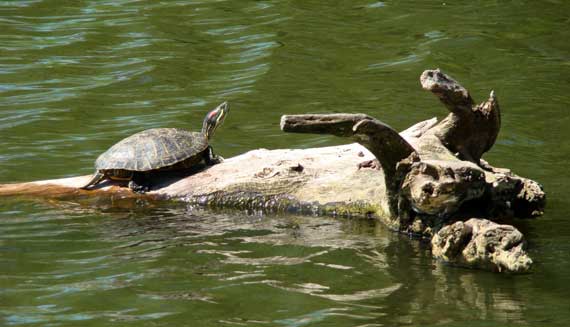
Turtle sunning at Lake Clara Meer.
Sunny today, with temps breaking 70°F. Shall I put away the heavy winter blankets?
Techno-discovery
high dynamic range imaging (often: HDRI/HDR; slow-load Wikipedia link), a compositing technique that yields an image with an exaggerated dynamic range, now easy(ish) to accomplish with Photoshop and its imitators.
Posted at 6:48 PM |
2 Comments »
For unknown reasons (unexercised and unverbalized desire to wander exacerbated by fine spring weather?), I’ve been distracted for a time both yesterday and today looking closely at the Isle of Skye in Google Earth. I even downloaded a 1905 text from archive.org called The Misty Isle of Skye: Its Scenery, Its People, Its Story, and examined places noted therein.
Somewhere along the way, I discovered that those crazy Brits (or Scots) decided that if a Munro is any Scottish mountain more than 3K feet tall, then a somewhat smaller landform, at least 150 meters tall (just under 500 feet for you metric-challenged types), shall be referred to as a Marilyn (get it?), or, roughly, a hill. Or, and I suppose this is entirely possible, those Wikipedia wackos are totally pulling my leg!
Posted at 6:24 PM |
Comments Off on Screen-based wander
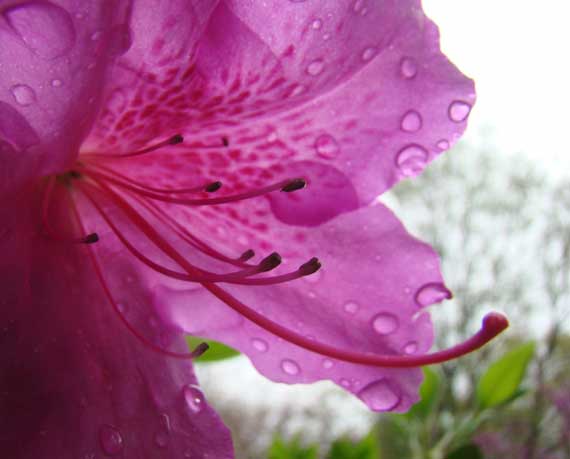
…the rain came and (almost) washed the pollen away.
Posted at 5:57 PM |
Comments Off on Outdoors