Musings

The ten-dollar deal! Note: contains no actual wasabi.
Seriously, this much wasabi powder must affect the global climate—and there were more piles of kilo bags, in various brands, right next to these!
Flowering update
Most of the dogwoods I’ve seen around the city are full open and brilliant, and many azaleas are nearly open; however, the white azaleas in our backyard are only about 20% open. Too overcast/rainy to photo today; maybe tomorrow.
Posted at 5:02 PM |
3 Comments »
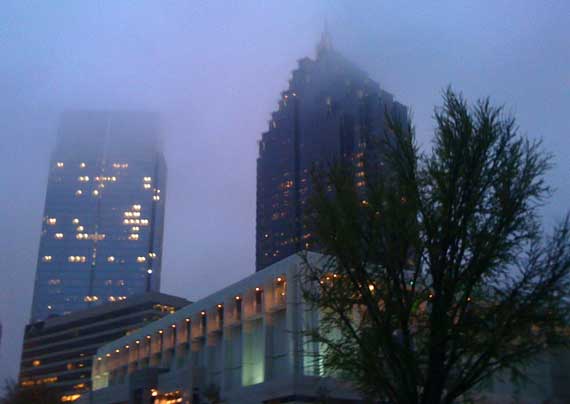
Here’s proof that the tornado almost two weeks ago didn’t get all of downtown—yeah, okay, well, yeah, this is Midtown….
And the fogginess indicates that rain is on the way, so tomorrow’s proposed hike is on temporary delay.
Posted at 9:18 PM |
Comments Off on Night life
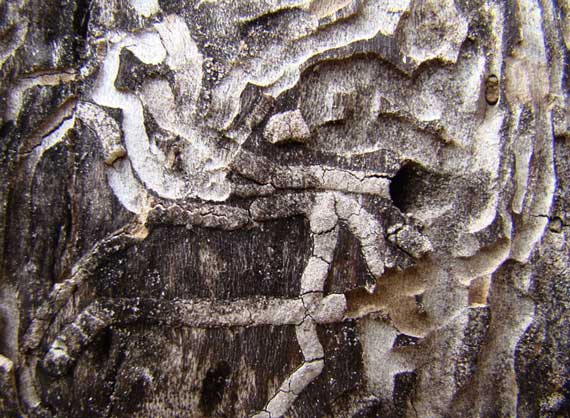
A virus has wiped out lots of dogwoods around here, providing food for scavenger species….
Today, the number of people in the world who are highly vulnerable to drought is enormous and growing rapidly, not only in the developing world but also in densely populated areas such as Arizona, California, and southwestern Asia. Judging from the arid cycles of a thousand years ago, the droughts of a warmer future will become more prolonged and harsher. Even without greenhouse gases, the effects of prolonged droughts would be far more catastrophic today than they were even a century ago
That’s from pg. 238 of Brian Fagan‘s latest book, The Great Warming: Climate Change and the Rise and Fall of Civilizations (2008)—and lacks a closing period, just as reproduced here (oops).
But what I really want to say is that Fagan’s books are far superior to publications by Jared Diamond and other non-archaeologists because of the data he marshals and how he analyzes our human past.
Still, I’d bet that the Great Warming in the title was pushed by the marketing people, because Fagan’s message really is that the changing rainfall patterns, with less precip especially in the central, equatorial latitudes, are what will have the biggest effect on human life—not the warming part, although the two facets of the changing climate are definitely linked….
Posted at 6:35 PM |
Comments Off on I’m thirsty (really)
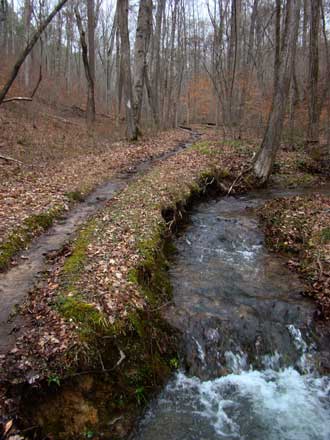 Yesterday’s rain stopped about nightfall in northwest Georgia (in contrast, we had rain almost all night in ATL), so we knew that the trail might be damp. I did not expect, however, that the trail would compete with the creek to drain the landscape! Despite the constant overcast, we had a great 6.7 mile trek, with, we agreed, just the right amount of up (meaning “not too much”).
We rescued a box turtle who was trucking down the gravel road (never know exactly where to put them and which way to face them), and saw many active, humongous millepedes. Otherwise, the critter-count was pretty low, although on the drive back to ATL we saw a pair of wild turkeys dusk-grazing in a newly-green pasture.
We found a fine early spring assortment of wildflowers beginning to bloom (I don’t remember most of their names—sorry), and few of the flowering shrubs—none of my favorite wild azaleas, for example, but maybe they just don’t grow in that terrain.
* Bosque is Spanish for forest or woods
Posted at 10:22 PM |
Comments Off on Post-rainfall bosque*

I can’t even guess what kind of phlox this is. BTW, phlox is a funny word, with its roots in the Greek word for flame. Appropriate, no? Yet, phlox varieties are native to North America and northeast Asia!
Today I heard lawn mowers for the first time, both to the south and to the east. Believe it or not!
Of course, the operators could have been conducting last-minute leaf-herding, instead of trimming spring-fresh grass….
In neighborhood news, Dish, once a favorite upscale restaurant of ours, is gone and defunct. A carpenter working on the redesign says the new restaurant going into the former gas-station location will be called Diesel. Still, I’m not warming to the idea of a restaurant named after a poison.
I’m not sure I’d feel that much better if it were named Biodiesel….
Posted at 5:18 PM |
1 Comment »
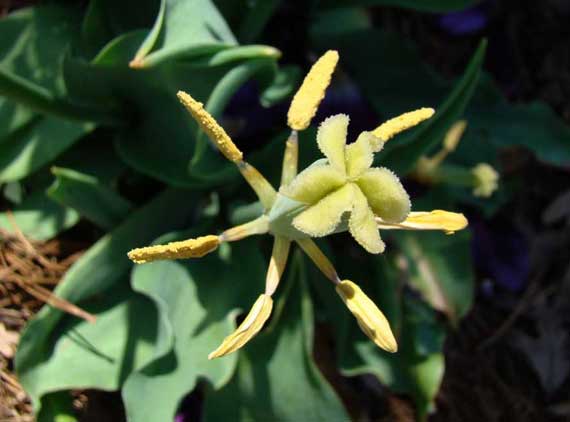
I’m not a tulip devotee, or at least I haven’t been historically, mostly ’cause bulb-growing in the upper Midwest—my place of origin—means annually replanting them so they don’t freeze (guess I haven’t much Dutch heritage).
Now, down here in the mid-South, I have learned to just leave ’em out there to do their thing. And this is the current version of their thing—look at all those nekkid flower parts, trying to survive the dessication phase! And the central stalk trying to swell from successful concupiscence.
Late breaking news: Lake Allatoona, north of Atlanta, is at near summer flood-pool levels (indicating a part of the year when it’s affected by seasonal drawdown), and at a level it has not reached since MAY 2006. Let’s hope for more rain!
Posted at 8:34 PM |
Comments Off on Flower sex
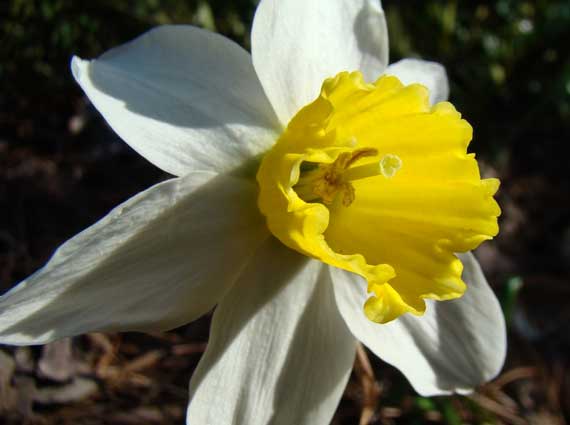
…is that They* are predicting temps below freezing overnight….
* They in this case are meteorologists…which sounds like a term that should refer to scientists who study meteors, but instead refers to science-types who focus on “the processes and phenomena of the atmosphere,” and, therefore, actually means more than just weather stuff. But (third but of this entry), meteorologist does sound a bit tidier and more, well, serious and empirical, than “weather forecaster” or even the more colloquial weather-dude or weather-babe.
Posted at 10:19 PM |
1 Comment »
Recently I encountered this article abstract, Virtual water: Virtuous impact? The unsteady state of virtual water (2007), by Dik Roth and Jeroen Warner, and the phrase “virtual water” sure caught my eye. What they mean is water needed for crop production, with the implication that if you get your food from elsewhere, the water needed to grow (and ship) that food comes from that environment, not locally to you. I first encountered this concept, absent the catchy name, when a guide we had in Tanzania observed that flowers grown in Africa and shipped to the voracious flower markets in Europe meant Africa was effectively exporting water since flowers take so much to grow to the blooming stage. Anyway, having yesterday driven through flooding in Ohio and water sluicing in ditches in Kentucky, while thinking about the drought here in Georgia, water’s been on my mind.
To reduce the amount of virtual water you consume (or cause to be used), consider following Michael Pollan’s prescription: Eat food. Not too much. Mostly plants. (Pollan’s link, and a NYTimes article….)
Today’s vocabulary: iteroparous
Applies to organisms that reproduce more than once during their lifetimes. Examples include mammals, perennial plants. Iteroparous plants are more common in the tropics. In contrast, semelparous organisms reproduce only once in a lifetime. In general, semelparous species will produce more offspring from their single breeding event than iteroparous species. Iteroparity appears to be an adaptation to environmental (and thus reproductive) uncertainty.
I thought this a fine word (well, pair of words) for springtime….
Posted at 6:14 PM |
1 Comment »
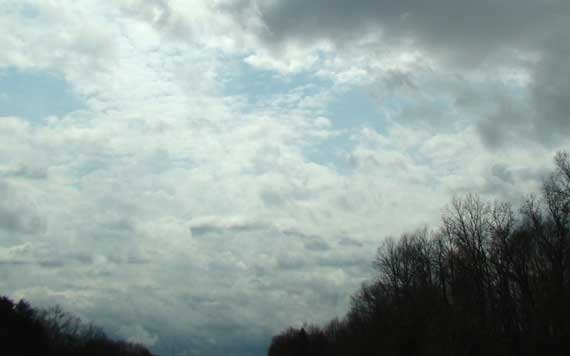
Southbound on I-75 today, we went through rain, actually several wide bands of rain; fortunately, the Prius handles sodden (paved) roads pretty well. We left in fog around 6:15 am, then the misty-moisty fog became rain and intermittent wipers would no longer keep the window clear. Eventually we went through (miles of) real rain, and I watched beige-brown waters flowing down the hillsides and through ditches where water only combs the grass when it rains heavily, leaving them dry within hours after the precip ceases.
Luck finally arrived in southern Tennessee, when the rain petered out and the clouds began to break up. In celebration, we left the Interstate at Ooltewah and wandered cross-country, passing through Red Clay, the capital of the Cherokee Nation while they were under seige by EuroAmericans during the 1830s*, and eventually meandering down to ATL, using the iPhone’s lovely current-traffic info to avoid highway blockages with evasive route selections.
* The State of Georgia wouldn’t allow the Cherokees to meet, so they moved their venue from New Echota Georgia up to Tennessee (you might also like this link from the state of TN). I admit I didn’t know why the name “Red Clay” was rattling around in my mind until I did the googling for this blahg entry….
Posted at 10:22 PM |
Comments Off on Travel serendipity
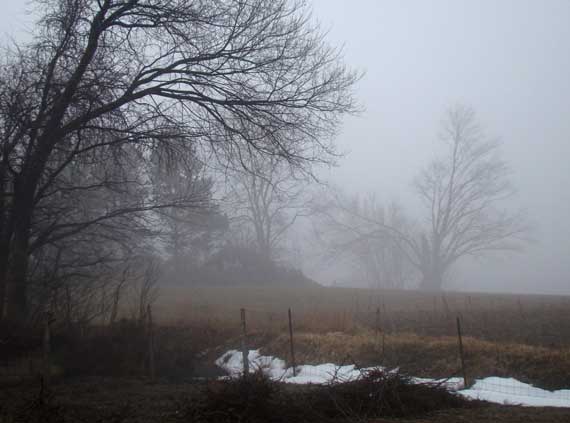
Today, the sky lightened long after dawn, with only enough light to make the trees emerge from the thick fog. Rain will reduce the remaining snow banks and plow piles, and the rivers will overflow.
Posted at 10:22 PM |
Comments Off on Weather’s a’changin’
