Musings

Yucatán Peninsula: cenote at Chichén Itzá.
When I first started this blahg I should have mentioned Antipixel, the blog of a terrific photographer who’s Australian and living in Japan while working as a web coordinator. His images are amazing and his words are thoughtful and lovely, and Antipixel has to be added to the list of blahgs that inspired me originally, and continues to do so. Take a look at this photo of trees and moss and green-ness on the island of Yakushima (never heard of it; looks gorgeous!), at, get this, a kilometer above sea level! You can even download a higher-res version for your desktop—I did!
Posted at 1:56 PM |
Comments Off on Forest green
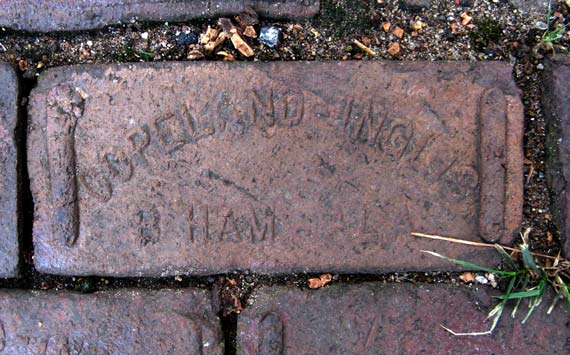
You can find history under your feet, and you don’t have to dig for it!
Against all odds in this hustle-bustle city, there’s a street over by Piedmont Park that is still surfaced with brick pavers. Most are plain, but a few were made by Copeland-Inglis, of Birmingham, over in ’bama.
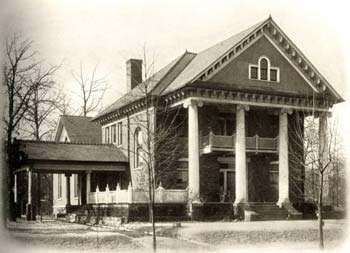
Only a tiny bit of rudimentary googling, and I found this 1910 photo of John R. Copeland’s house in the Norwood neighborhood, and the note that Mr. Copeland was President of Copeland-Inglis Shale Brick Company. Elsewhere I found a note about the house’s owner, and a tidbit about the building’s history:
Birmingham city directories indicate that the Copeland family moved out in the late 1920s, and the house was then divided into six apartments. It remained an apartment house for decades.
Speaking of molded items with their maker’s names incorporated, I think I’d drink more beer if the bottles still had the manufacturer’s name and city molded into the bottles. Several times when I was doing archaeological surveys in the Upper Peninsula, I found old bottles with this info, from breweries in Manistique, Marquette, and Munising.
Of course, earlier today I was flipping channels and saw someone showing off a “DeSoto Beer�? can, probably found by metal-detecting (I hope they had the land-owner’s permission). Apparently the company lasted only a year or so, down in Tampa.
Anyway, back to the present…. But check what’s under your feet once in a while, okay?
Posted at 4:41 PM |
1 Comment »
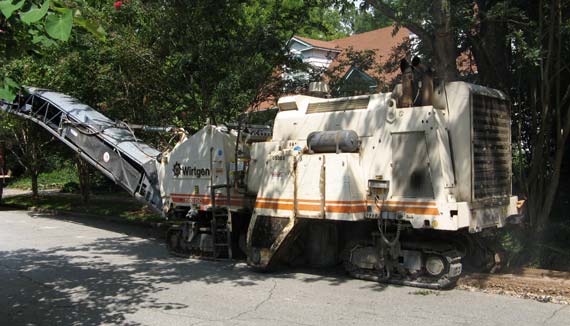
For the last few months, huge machines have been touring our neighborhood at a snail’s pace, replacing first sewage and now fresh water pipes. This massive and noisy monster worked its way down our street the other day, shaking the house, and emitting vibrations I could feel in my bones. Either that, or historian David Christian’s 2004 Maps of Time, about what he calls Big History, is more monumental than I thought!
For several excellent reasons, I recommend this volume over anything by that Diamond guy. Christian says his book is a modern creation myth (pg. 2), and I’d say it’s more, more scientific and fairly comprehensive, and lacking in the huge contradictions that often stud creation myths, although the Big History tag seems more commercial and like a marketing gimmick than I prefer….
Posted at 6:33 PM |
Comments Off on Big History

Here’s another Michigan park, Fayette.
Here’re US home values, adjusted for inflation over time, in a graph from the NY Times meant to to indicate that since the late ’90s, they’ve risen precipitously. But, in Tufte-eque terms, this is misleading. While strictly speaking, the plot is probably correct, what it’s meant to convey—that we’re in a huge real estate bubble—would be attenuated if these data were plotted against household income or something similar. In other words, the cost of a home is one thing, but the dent it makes in the household income is something different. Also, if you took out one or a very few markets (e.g., NY itself), I suspect the average home cost over the last few years, and even previously in the century, might not have increased so dramatically….
BTW, can we consider these kinds of statistics just a window in time, for better or worse?
Posted at 10:22 PM |
Comments Off on Ah, statistics…
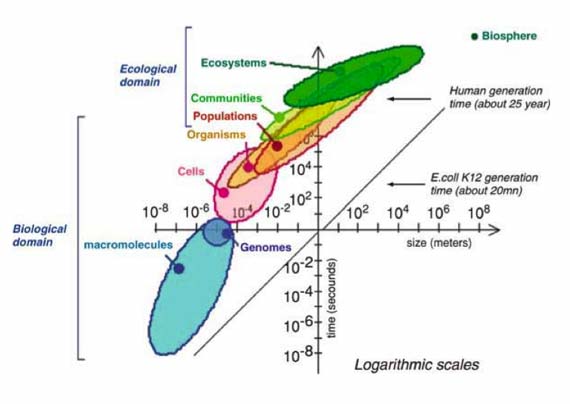
One thing I’m grappling with these days is how to graphically portray scale and time. It’s a gnarly problem. Here, Alain Pavé shows overlapping scales of interactions for entities ranging from teeny things smaller than genomes to ecosystems and biospheres, all wrapped up in a single package, that at least on first blush, looks accurate. (Just how small are the smallest organisms anyway?)
Obviously, using two axes is an obvious solution (time on y and scale on x). I’m pondering adding a z axis, with a third variable (e.g., another kind of scale, for example size in extent—hectares—vs population). Hurts my head to try and actually generate that figure, however.
Fortunately, my bright, wise hubby, the Genius Wizard, has just purchased the latest Edward Tufte, so a guide is at hand….
* Pavé, Alain. 2006. “Biological and Ecological Systems Hierarchical Organization,” in Hierarchy in Natural and Social Sciences. Edited by Denise Pumain, pp. 39–70. Dordrecht: Springer. Figure 2, page 48.
Posted at 6:20 PM |
Comments Off on Hierarchy, graphically

Charleston Lighthouse, Morris Island, SC, ca. 1863, by J.R. Foster (Accession #1994.91.52)
Our Smithsonian has a slew of historic photos online for perusal and inspiration. This photo isn’t a bad place to start, or you could begin with all the flashy intro stuff here. Beware the visitors’ keywords, although the Smithsonian’s own keywords are inconsistent, too.
Here’s the Washington Post’s take on the photo web site, courtesy of a $500,000 gift (half a million smackers; I’m in the wrong biz!), and more info….
Posted at 10:22 PM |
Comments Off on Old photos

Sign from Oaxaca, years ago.
Below is table of some numbers I’ve been contemplating late this afternoon, estimated populations for some cities, with populations above 10,000 people, across Mesoamerica at the time the Spanish arrived in their grand quest for wealth and souls.
The obvious conclusion is that they encompass a wide variety of population densities—probably because the community is spread across rugged ground or substantial areas between the houses are allocated to gardens, although there may be other reasons. But what else?
| name |
region |
area (ha) |
population |
density |
| Tenochtitlan* |
Central Mexico |
1350 |
212,500 |
157.41 |
| Tzintzuntzan |
West Mexico |
674 |
30,000 |
44.51 |
| Texcoco |
Central Mexico |
450 |
24,100 |
53.56 |
| Mayapan |
Yucatán |
420 |
21,000 |
50.00 |
| Zacapu |
West Mexico |
1100 |
20,000 |
18.18 |
| Huexotla |
Central Mexico |
300 |
17,100 |
57.00 |
| Yautepec |
Central Mexico |
209 |
15,100 |
72.25 |
| San Juan Teotihuacan |
Central Mexico |
250 |
13,500 |
54.00 |
| Chalco |
Central Mexico |
250 |
11,000 |
44.00 |
| Otumba |
Central Mexico |
220 |
10,700 |
48.64 |
| Naco |
Southeast Mesoamerica |
160 |
10,000 |
62.50 |
*Where the center of Mexico City is now (the Zócalo).
Posted at 6:00 PM |
Comments Off on Data stream
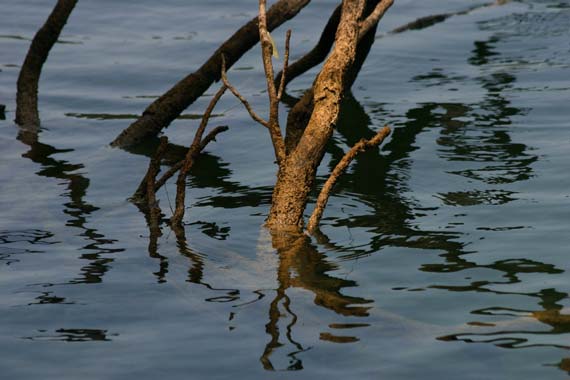
In principle, I’m a fan of historical fiction—just so it’s labeled as fiction. My current favorite is Farley Mowat’s The Farfarers. Mowat didn’t write pure historical fiction though, as the book alternates between archaeological and archival data chapters and his imagined version of the peoples who headed west from northwest Europe to Iceland, Greenland, and the New World (before they had those names, of course). It’s a masterful weaving, and makes the past come alive. He avoids expending much energy generating internal dialogue, instead concentrating on obvious material issues—watching weather, missing family, dietary concerns.
I had hoped Laura Esquivel’s Malinche would be a similar tour-de-force. The topic is right: contact-period central Mexico, and the turbulent times initiated by the arrival of Spanish plunderers and murderers and their not-so-noble men of the cloth. Esquivel completely captured my attention with her lyrical Like Water for Chocolate, and I hoped that her imagined version of the Spanish meany Córtes’s female translator’s experience as Córtes’s slave and servant would be similarly admirable. Early in their relationship, as Esquivel describes it, Córtes rapes Malinalli (aka Malinche, and considered a traitor by most Mexicans) and she is both dreamy and unconcerned. I tried to read more, but was too disgusted to continue. I expected far more from Esquivel. Don’t waste either your time or your money on this book.
The Farfarers, on the other hand, is worth every penny.
Posted at 5:39 PM |
5 Comments »
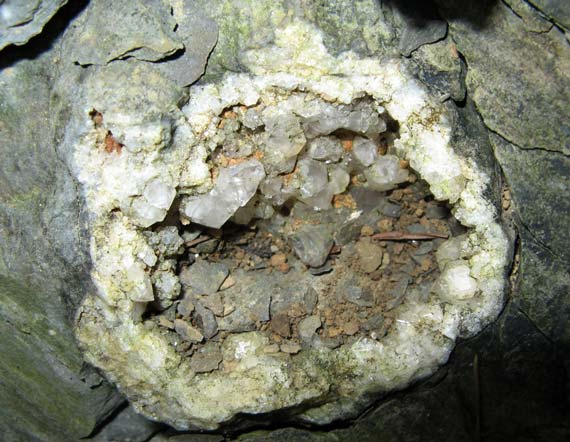
All by itself, the word diacritical commands your attention. Then, when the scorn-bearing word marks is added, its impact intensifies. Thankfully, for those of us who forget our diacritical marks, Wikipedia has a detailed entry to jog our memories, along with separate entries on each of them. Remember caron? Cedilla? Ever learn ogonek? I missed that one. Now I know what those dots above mean, too!
Off to make goat cheese and lamb and spinach packets in filo aka phyllo dough….
BONUS: For a while I thought I might blahg on this comment by Niles Eldridge:
Some of my more naive colleagues insist that the “hypothetico-deductive method” is what sets science apart from all other domains of human experience. One frames a hypothesis—they never bother to explore where those come from, even though that’s the most interesting bit—and devises a test. If the test fails, the hypothesis is falsified; if the test “passes,” we can only say that the hypothesis is corroborated—or at least not falsified. The logic involved is exactly the same as anyone with any savvy at all brings to buying a used car.
Instead, I’ll just give you the link, if you’re interested. I agree with him, by the way: how did you get that idea after all? How much alcohol was involved? Did the germ of the idea arrive in a dream? “Interesting�? has quite a range, here….
Posted at 5:16 PM |
Comments Off on Say die-ah-critical
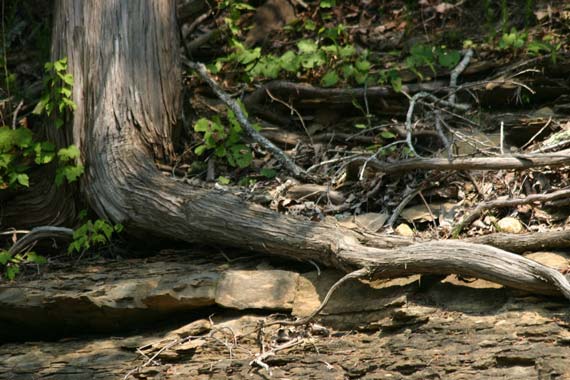
Reservoirs are a great example of our colonialism of the environment. Here’s a hardy cedar that’s coping pretty well with having it’s forest neighbors on the downhill side totally obliterated. Reservoirs also eliminate human inhabitation, as happened with the town of Rowena, Kentucky, now moved to dry land. Our planners here in the US are pretty arrogant. Long ago, I worked on the archaeology of a lovely pre-horse Pawnee hunting camp (bison butchering site) that was going under the Calamus Reservoir, in central Nebraska. At the time, the Calamus River was the most constant-flowing river in North America. Now it’s dammed up, and the wild, sandhills flavor of this part of Loup County is muted.
Don’t even get me started on the impact of the Three Gorges Dam.
Posted at 10:22 PM |
Comments Off on Reservoir colonialism