Musings
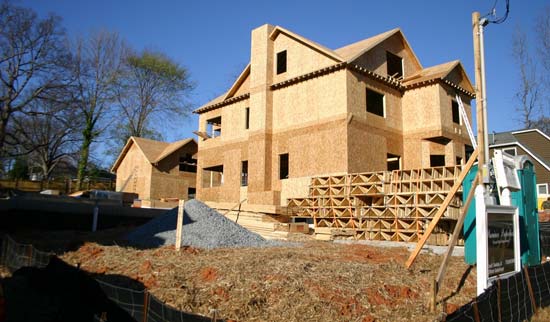
Adjacent lots entirely ravaged by new construction in Atlanta’s Virginia-Highland neighborhood.

You can find lots of neon in the downtown Seattle area, and the NY Times reports that the future of a Wonder Bread sign is up in the air, since the building under it is facing demolition and replacement, in a transition from factory to housing and commercial space.
At the core of this is the age-old problem of what to preserve and what to tear down and replace. Sometimes, we chose to walk away from the old and build anew elsewhere—witness, the abandonment of center-city areas in many US metropolitan areas in the late 20th century. Sometimes, we chose to rebuild in the same locations—hence the buildup of tells across the Middle East.
Right now, there’s a furor in Atlanta over McMansions, new homes replacing early 20th century bungalows and other modest, often one-story residences, bringing looming third stories, shadows, and increased taxes to the neighborhood. The mayor even tried a moratorium on permits to halt this trend, but it was only a blip on the city’s history, as the moratorium was quickly overturned in the face of considerable pressure from builders and many others.
Of course, archaeologists are happy with any choice—replacement, maintenance, or abandonment—which gives us evidence of political, economic, and demographic disruption or continuity.
Posted at 9:08 PM |
Comments Off on Neon harbinger
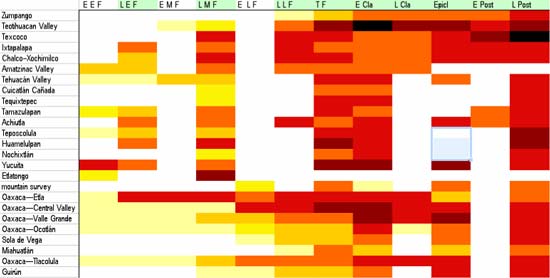
Here’s yesterday’s graphic tweaked, with better logic/data/math behind it; I know it looks like more of the same, but now I feel I can better defend the trends it shows.
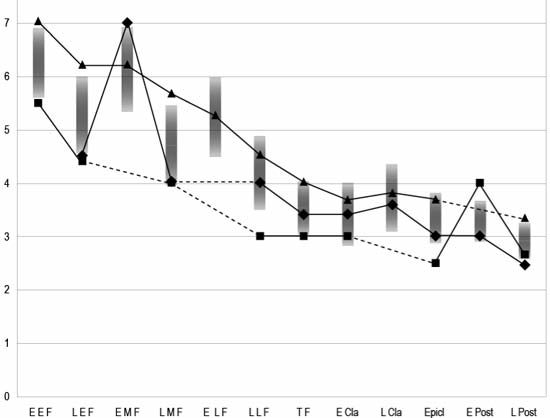
Okay, here’s the freaky thing. The triangles, squares, and diamonds are averages of some of the same data in orange and red and yellow at the top, along with means and standard deviations (the gray graduated bars). Hey, it hurts my head to think about it, so I know your eyeballs are crossed!
Interpretation: the short version is that, over time, the populations of all these places tended to become more centralized (but the variations to this trend are exceedingly interesting and informative); the long version is the book this is destined for!
P.S. Did I mention that I was bouncing between FileMaker and Excel a while back? Now, it’s Canvas, Excel, and Illustrator! Oh, my!
Posted at 6:37 PM |
Comments Off on Time lines 2
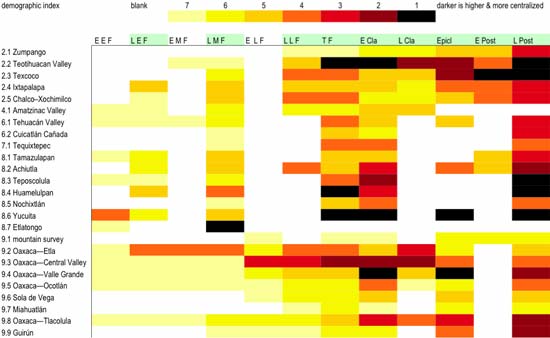
I’m guessing this doesn’t make much sense, but it’s what I’ve been working on for the last few days, and need to tweak a bit more.
The short version is that time goes from left to right (right is most recent), and white means I have no (comparable) data. I’m trying to generate an index of demographic centralization using regional survey data, and this is how far I’ve gotten. The darkest colors had the most centralized populations (more people lived in large communities). Stand by for adjustments.
Posted at 9:43 PM |
3 Comments »
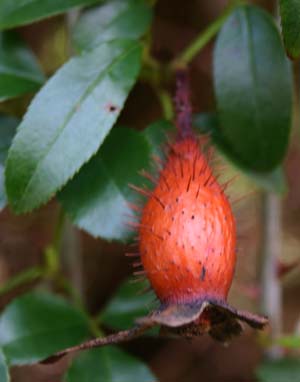 The fruits, or hips, of the Cherokee rose are huge!—an inch or so long! I found this one on the bower in the rose garden at the State Botanical Garden in Athens. (Thanks, Bill!) The rose garden is surrounded by a big fence, detracting somewhat from its beauty….
Sources on the web indicate that this rose is really native to China and southeastern Asia, and now is naturalized in southeastern North America. Unlike most roses, it’s fairly easy to grow.
Georgia’s state flower is the Cherokee rose, and the plant is linked to the Cherokee Trail of Tears, when Euroamericans drove the Cherokee west to resettle those who survived in Oklahoma. The petals symbolize tears of grief for the four to five thousand Cherokees who died en route.
Posted at 4:24 PM |
Comments Off on Rosa laevigata

Tamales and atole for breakfast.
Nixtamalization is a process discovered by the Aztec and Maya civilizations of Mesoamerica….*
False.
So superior is nixtamalized maize to the unprocessed kind that it is tempting to see the rise of Mesoamerican civilization as a consequence of this invention, without which the peoples of Mexico and their southern neighbours would have remained forever on the village level.*
Please!
Archaeological data suggests the lime-treated ground maize dough was being made and eaten when the largest Mesoamerican settlements were villages.
Overall, however, I do find useful information in this volume, and am glad to have it. Still, foodies must be careful that their received knowledge has a basis in science—and the rest of the real world!
* From entry “Nixtamalization” in Alan Davidson’s The Oxford Companion to Food (1999, Oxford University Press), page 534.
Posted at 6:20 PM |
1 Comment »

It’s bowling in a living history exhibit—visit Bryant-Lake Bowl and you’ll feel like you’ve stepped back in time.
You get your own shoes from the rack on the wall. You keep your own score with a number 2 pencil. The lights over the pins may malfunction, so you must watch the pins to know your score. Come on a Saturday morning and order brunch to be delivered to you as you wait in the player settee.
As you rememerge into the light of day, blinking, you remember what you didn’t experience at Bryant-Lake Bowl that you associate with the days when all the alleys looked like this: clouds of cigarette smoke.
Posted at 12:46 PM |
Comments Off on Bryant-Lake Bowl