Musings

It, indeed, was a foggy morn, but there was more than that going on. Here’s the earliest light. Just magical. My eye found more pink in the sky than this shows. If you like pink.

This was at the beach mid- to late-afternoon. I think this is a native mint/mint family. Love the flower-collar at the leaf junctions. [Kindly substitute the botanical terms, if you know/care about them.]
Posted at 9:02 PM |
Comments Off on Visual complexities in my day

Clear, warm, and somewhat humid. Still, we did about eighty minutes of hard work this morning before the sun’s intensity ramped up—mostly cutting and vanquishing grass and weeds.
That’s the cycle of life around here. It’s either too cold for plants to flourish (or grow at all), or we’re in the brief period when it’s warm enough, and they grow with great urgency to make it through the growth cycle and produce seeds before freezing weather repeats.
This goldenrod (probably Solidago canadensis) is late to the blooming game, yet I know it’ll manage to be reproductively successful before the first killing frost.
Posted at 6:38 PM |
Comments Off on Solidago souls

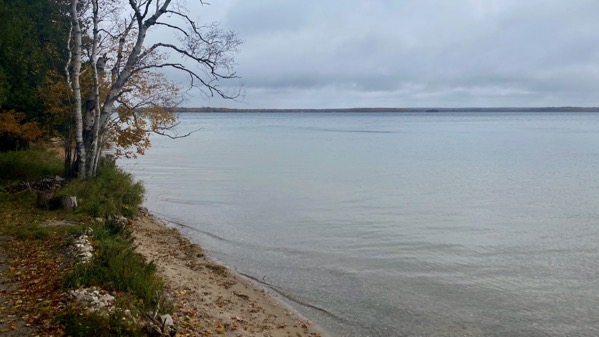
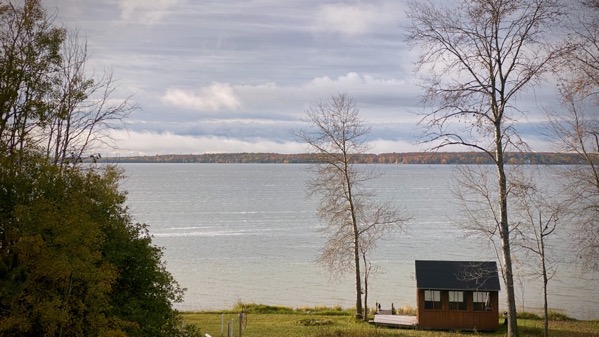
It’s official. We’ve reached the land of calm waters (at present)…

…and glowing white birches.
Life is good. [Also no extraneous critters that breathe (like mice or bats) were in the house, only a few dead “bugs” (like flies and spiders).]
Posted at 9:14 PM |
Comments Off on We are lucky 🍀

It’s August…it’s even the first half of August. Yet, I see the early-leafing redbud is already dropping a yellowing leaf…an early harbinger of autumn. Or fall. [Get it? Fall? Falling leaf? Fallen leaf? haha]
Posted at 8:42 PM |
Comments Off on Autumn in Aug?

When I’m not focused on something, my mind drifts back to the Galápagos, including marine iguanas (Amblyrhynchus cristatus)…

…and Galápagos land iguanas (Conolophus subcristatus).
Both do lots of thermoregulating and basking.
My body is finally starting to get used to being here. The relatively brief overnight flight Sun/Mon is what messed me up, I’m pretty sure. Last night I was asleep shortly after 8:30pm, and I slept over nine hours.
And tonight—hey, I’m still awake. 😎
Posted at 9:04 PM |
Comments Off on Regulating w/o thermal

Not long after we got on the (major, national) divided highway this morning, we came upon a construction zone, and got shunted over this side route leaving both travel lanes to the repaving crew.

During this morning’s jaunt, we came across several groups of bicyclists, leading us to conclude that Saturday is for bicycle outings and practices.

We also found this wide load (carga ancha). Not sure what it was, but it looked rather like a reviewing stand, with many streamers.

Just off the highway, we made our turn at this church to take a very local road to the parking area for hiking in the Pasochoa cloud forest, officially Refugio de Vida Silvestre Pasochoa.

For all but perhaps fifty meters of the 5.3 km access road, we bumped along at a very slow speed. Many pickups passed us, despite this being such a narrow, one-and-a-bit lane road.

The land use change is the edge of the park, with farmers pasturing animals right up to the forest.

Here’s the map of the hiking trails, aka senderos. We opted for the medium-length middle one.

The path was okay, not muddy thankfully.

We immediately found bromeliads.

The path was in the selva (jungle), but just in it along the edge of a field. I suspect some of the plants we saw were introduced from agricultural undertakings. Not sure about this, but clover seemed like it was a pasture escapee, as they looked like the versions I’ve seen in fields in North America.

I had one of these, far less vigorous, in my freshman dorm room. I never got to see the new, beige leaflets.

Here is the downside of the path. It went up and up and up, to perhaps 9800 feet (from perhaps 9100 at the parking lot). We took it very slowly, and looked for plants, flowers, and creatures of interest.

I found a slug on a trail marker and heard a very few bird calls. I expected more….

Descending, we found a great valley view. Green green green.

The last feature before the parking lot was a fancy “pic-nic” area. We saw maybe nine of these.

We bumped along that miserable 5.3 km, then took a different route than we came through in the morning, to avoid Sangolquí, which I have nicknamed Traffic Jam Town. This is our turn off the highway to access the route to the hotel. As you can see.
This was a very different day than the previous ones we’ve spent here in the Ecuadorian valleys. Nice to have the diversity. This place is high-altitude for us, and today we really felt it. And survived.
Posted at 8:50 PM |
Comments Off on Pasochoa expedition

Today’s goal is to go southeast, crossing a major pass, then turning south toward Tena and Río Napo (~1300 feet was our lowest point), on the west edge of Amazonia. We’re climbing away from the greater Quito metro area. I noticed these large rolls of steel(?) on this truck. Little did we know that we’d be amidst many of these trucks Quito-bound from Amazonia. I do not know where the metal was mined or processed.

I loved watching the clouds “sitting” on the ridges and peaks. The road markings are warning drivers to slow, this time for a sharp curve.

And, of course, the clouds mean waterfalls below.

And with the increasing elevation, the temperature drops. Significantly.

Crossing Paso Papallacta, all evidence indicates we got up to 13,330 feet. Plus or minus. Breathe deeply.

Also, watch out for spectacled bears (Tremarctos ornatus). Ecuadoreans often mentioned seeing them; however, I don’t know if they were wild and free.

We descended far enough to encounter homes and agricultural undertakings, complete with places to stop and eat.

Clouds are now above us. Sign urges protecting alders and nut trees.

Again, that persistent cloud layer engenders landslides and waterfalls.

Shown here…but the road is open! And navigable in a mediocre rental car.

I’m guessing the regular bridge is left, and we were sent across a “temporary” bridge. Speculation.

Fresh landslide, perhaps two days ago, but not last night.

Horse grazing roadside. Ditch and vegetation clearing crew ahead.

We encountered stopped traffic. An official came by and said there was a bad accident ahead, and it’d be two hours before we could continue.

Our car was stopped with the rear wheels on a bridge over Río Quijos. I could step out and get a great shot, not through the windshield.

And also find flowers to photograph. We were very lucky. In perhaps forty-five minutes we heard a whooping and whistles, and drivers dove into their vehicles. We do not know why down-bound traffic got to go first.

Soon, we saw some of the accident remains. This was on the left. Note the vegetation on top of the tank; it must have rolled. On the right (no photo) was a dually axle. Note the two huge wreckers. Not sure what happened, but it was awful. Not far down the road, we entered a busy town, and the first sign I saw was gruas, that is: wreckers.

We descended and the terrain became much flatter, and the temperature rose (eventually to 88°F).

Another ridge to cross. Glad we don’t have to go straight.

And an overlook: mirador. Not complete Amazonia flatness, but close enough for these two first-time visitors to South America.

We weren’t too happy with the defective metal decking plates on this bridge over the Río Ñachi Yacu.

Note the frond roofing; different plants grow here in numbers. And the tire atop the circular structure and sheet plastic on the others.

We roll into Tena and find it busy with locals, non-locals, and a wide variety of commercial activity. This town is humming.

And someone had the money and will to build a green-glassed building on a busy corner.

We crossed the new bridge over the Río Napo.

Río Napo’s headwaters are from the flanks of Volcán Cotopaxi and other mountains, It flows 668 mi before joining the Amazon. Clearly, it’s capable of carrying lots more water here, yet is plenty wide today.

We recrossed the river on the old, one-lane bridge.

We are even less happy crossing the Río Ñachi Yacu bridge northbound, closer to the branches and flagging tape.

Aha, here’s the other part of the accident vehicle. We had no clues on why the vehicle rolled.

We took a side trip on a loop through Papallacta, as we’d heard so much about the thermal baths there. Here’s the hotel by the spa and other facilities. Looks special. We did not stop to bathe.

Northbound, we could take the old road out of town (one way), and saw this, Laguna Papallacta. It’s clearly a reservoir, and there was no power generation facility. I speculate it’s to protect the town, which isjust downstream.
There was more rain as we reached the higher elevations. Otherwise, the trip back to the hotel was a version of what I’ve already portrayed.
A fabulous day.
Posted at 10:22 PM |
Comments Off on SSE exploration

Traffic circle art. Today we drove south to Riobambo, observing flat valley bottomland, quebradas (dissected rivers), fewer flat areas, framing mountains, and modern life. A sample of images follows.

Río Chiche quebrada. Deep.

Out in the countryside, you can see the fields often go up-and-down on the slopes, rather than horizontal. Land division patterns usually have a particular history.

Huge numbers of shade agriculture structures here and there. This is one of the largest complexes we have seen. Some are just three or four adjacent. Also: dairy.

We’re on the right road (yay!), headed for Ríobamba, by Latacunga and Ambato.

Passing a military base. Another statue.

Abandoned structure. Why? Because the highway took their land and thus the family’s economic support? Speculating….
Also, we are beneath overcast, and the wind bends the trees.

Shade structures and open fields. The overcast was filling in.

Elegant fellow.

Farm fields transitioning to settlement.

Ambitious modern building.

Look at the distant mountains!

Landslide cleanup.

Steeper flank. We are closer to the cloud-bottoms.

Riverside fields, plus those on steeper ground.

Stringing fiber. Two guys on two long red ladders (one pictured), and one on the ground, and another further along with the spool. Never spotted a truck.

In-town lumber mill.

Aha! There’s what we can see of Volcan Chimborazo. Because the earth is not round, and is “squashed,” the top of Chimborazo, at 20,548 ft, is the farthest place on land from the center of the earth. Here we see the lower flanks, and just above where we see snow, the clouds cover the peak and the glaciers there.

Unusual wooden building, with structural elements revealed. Many windows on the second floor, and none on this side on the first.

Pipeline construction on the other side of this quebrada.

We have seen at least two dozen groups of workers trimming the median, and sometimes the sides of the roads. They trim the grass and larger plants, then blow or sweep the bits up, leaving the ditches clean and the surface manicured. I have not see a truck with them yet.

Helado (ice cream) and fruit, cold drinks and snacks. Roadside alimentary temptations. In Mexico snacks is tacos or bocadillos; here it’s more commonly meriendas, which pertains to the afternoon, at least technically.

Elaborate firefighter statue.

Large wood flooring factory.
Posted at 10:22 PM |
1 Comment »

A hot breakfast comes with our room near the Quito airport. Nice, but not the quality that Alejandro and Washington produce on the Grace. Or I’m sure the other chefs that work there when they are off. Interesting sausage-slice “flowers.”

John went and got our rental car, not as straightforward as you’d think, but not too terrible. We set off northward, toward and to Ibarra. Row crops and fallow fields mosaic.

Crossing Río Guachalá.
These photos are not terribly good. Please look beyond reflections, dirty windows, and distracting power lines to absorb what they capture about the Andes and the people living there now.

Note the adobe wall separating this lot from the street/ditch. Much of our first leg was away from the normal long-distance traffic, and rural life was more apparent. Commercial activities are focused along the main roads. Along with many busy buses.

While most areas have straight-walled domiciles, this is one of two areas where we noticed these overhanging second stories, sometimes with an ambitious additional overhanging third story.

Green. Lush. On Galápagos, we heard it was the dry season. Doesn’t seem the same here. Of course, the mountains making the clouds rise will bring rain.

Only really old vehicle I’ve spotted. Many dating back to the 1970s, however.

Urbanization. Ibarra.

Scattered toll plazas, not particularly frequently. Always one dollar.

Scrappy neighborhood with scrappy roads. Think about what happens after a good rain. And many people navigate these streets on foot, like this tiny elderly woman on the right.

Many towns have large artsy signs, sometimes with a statuary. This is the only one that we saw riffing on the Hollywood sign.

If this were Mexico, I’d call this a zocaló in front of the Palacio Municipal. I don’t know if either of these terms are used in Ecuador.

We took a detour to see Laguna Cuicocha, dramatically within Cuicocha’s caldera. With two islands.

Truly lousy photo of a careful stack of maize stalks, with all the butts to the exterior. I will look for another one, but may not find one during our brief survey. Fascinating. I presume the stalks are for animal feed.

Valley town.

I’m calling this Flower Town; more stands sold flowers than groceries. Some or many of the shade houses around here must hold flowers. Flowers are a pretty way to export water.

Let’s close with this tree, festooned with lichens(?), rather cloud-forest-y.
Posted at 10:22 PM |
Comments Off on North exploration

Pre-dawn. The colors are ripening.

Left for a wee panga tour of Caleta Tortuga Negra, called Black Turtle Cove in our literature, on the north side of Santa Crúz island. We left at 6am, or dawn. First up: cattle egrets, still in overnight positions at 6:07am.

Less than thirty seconds later: the exodus begins. They fly way inland to feed all day.

About two minutes later; heading deeper in the cove. Sky color still eye-catching.

I could see the napping shark here with my eyes, but my otherwise talented camera could not. This cove is a shark nursery. We saw several young reef sharks and more adults in this cove.

Ducking to get deeper in the cove.

Sea turtle? Can’t remember.

We returned to the larger, outer cove in time to see a feeding frenzy. What you can’t see is that a shark (or perhaps two) came at a school of larger fish, which turned tail and scooted the only safe direction: up. And the birds could see this happening, and hunted the school from above. Carnivores.

Great egrets. Sleeping in compared to the cattle egrets. This was twenty-seven minutes after the cattle egret shots.

Heron, pretty sure, but don’t remember which one.

Rounding the Grace’s stern just before 7am, ending our last wildlife adventure.

We breakfasted while the captain moved Grace into position for us to disembark for the last time. Our breakfast assortment included tamale with a fat sliver of yummy cheese. The maize flour has far more flavor than boring MaSeCa.

The dock we’re headed to is behind that fancy sailing ship.

It’s our final panga ride, of course wearing our life-jackets, with one of these dangling on either side. Despite temptation, I never pulled one. 😎

Waiting for our plane to arrive; it was a little late. We left through Gate 3. While waiting a pair of finches were flying hither and yon beneath this high ceiling and far below that giant fan. One briefly landed on my hat as I sat quietly pondering our terrific trip. Of all things.

Our final steps on Galápagos were on Baltra Island, headed for our ride. Seats 5A and 5B.

Our bland, large, corporate hotel room near the Quito airport NNE of Quito in the next valley. We are clearly no longer on the Grace.
Posted at 10:22 PM |
Comments Off on Flights