Musings
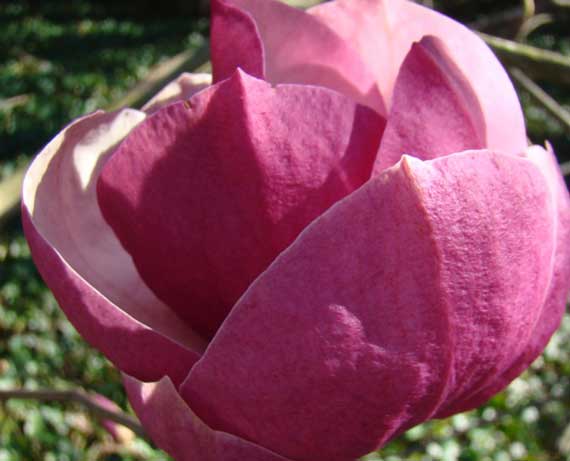
Sunny, gorgeous day, with some blooms spreading their scent; the few pears that remain around the Va-Hi corner are in full glory.
I know this as a Japanese magnolia, apparently originally from China, but Wikipedia has so much info about magnolias, I’ll just back off and say, Wheeeoooo!
Posted at 8:21 PM |
Comments Off on aka Big-flower
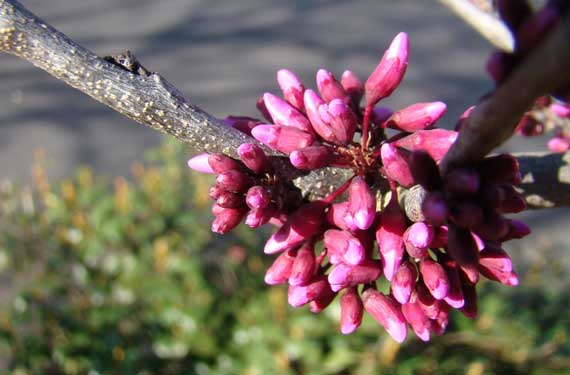
Despite the cloudy overcast that haunted us all day, the redbuds are almost ready to bloom (photo from yesterday, which was sunny).
Posted at 5:18 PM |
Comments Off on Ready redbuds
About 6:20 this morning the smoke detector chirped and the power went out. For about an hour. While the house slowly cooled. We’re in another cold spell.
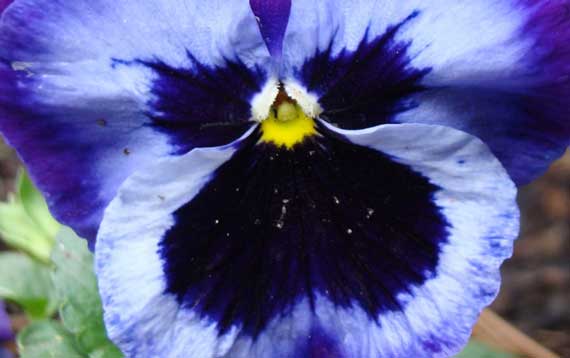
Yet the pansies are still in bloom!
These days I’m loving the power of cropping in Photoshop….
Posted at 10:22 PM |
Comments Off on Close-up
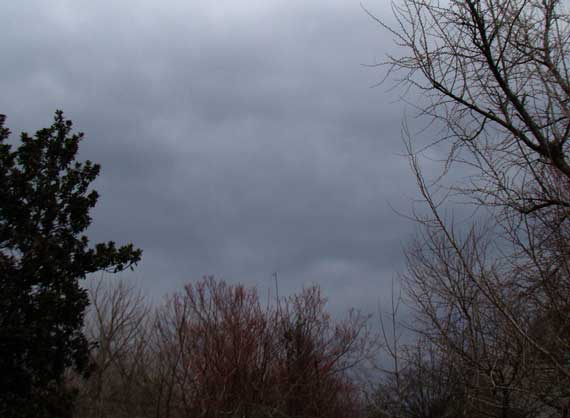
Cielo enojado, this afternoon
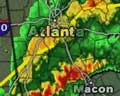
A huge front came through this morning, with two lines of heavy rain, the first shortly after 6 am. Guess what woke me up?
Then we had a mixed weather through the afternoon, including several short-lived appearances by the sun. By the time we finished a short walk to the library, (apparently) malevolent skies reigned again….
Meanwhile, I’ve been thinking about the institutional reorganization of the highland Epiclassic and lowland Terminal Classic—two names for (approximately) the same period. Yes, in Mesoamerica….
…and down in Florida, the power’s out in many places, including Disney World….
Posted at 4:42 PM |
Comments Off on Grey skies…
It’s Friday—well beyond humpday, on the verge of Fri-fest (long story)….
In weather news, we had rain off and on all last night and well into the morning. Our major reservoirs remain low by feet and feet (as of this morning, something like 10 for Allatoona and upwards of 20 for Lanier—the latter is Atlanta’s principal drinking water source), although it’ll be several days before the catchment area completely feeds all the runoff from the rains of the last 24 hrs into the reservoirs. Still, this slow spring rain, while good for plants, doesn’t impact reservoir levels very much.
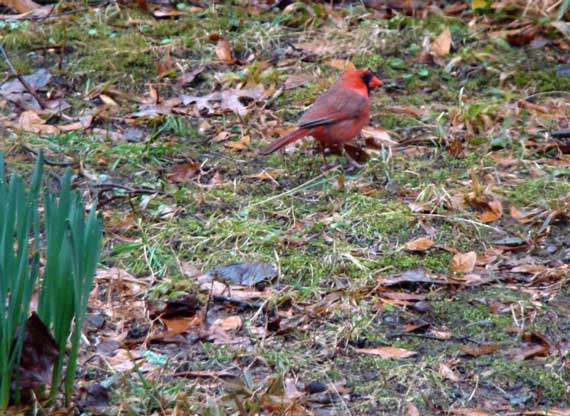
Undeterred, the birds are coming through. We’ve had cardinals in the back yard, and I saw a flocks of busy grackles and robins in the front yard when I came back from errands.
Posted at 5:46 PM |
Comments Off on News bits

Currently, Atlanta’s version of the national (multinational, but not global?) economic slowdown can be difficult to discern. Here’s the old White Provision Company (mmm, meatpacking, aka slaughterhouse*), originally built in 1910 and now listed on the National Register, being transformed into mixed use: commercial space and housing units.
The building is not far from GA Tech, and college/university towns/neighborhoods seem somewhat insulated from this downturn.
Note, too, the rain (the iPhone camera’s really better than this example—crappy light). VGood! Yea! We’re especially happy that it swept in Leslie à la Mary Poppins (not really) via Amtrak’s Crescent route (here on the Amtrak site, and here on Wikipedia).
* And also, if you believe the White Provision building web site, the building hosted Brad Pitt and David Duchovny et al. for location shooting for Kalifornia (1993).
Posted at 6:33 PM |
Comments Off on Repurposing
Biodiversity—the variety of all life, from genes and species to ecosystems—is intimately linked to Earth’s climate and, inevitably, to climate change. Biodiversity and poverty are also inextricably connected. For instance, changes to natural ecosystems influence both climate change and people’s ability to cope with some of its damaging impacts. And in their turn climate change, as well as people’s responses to it, affect biodiversity. Unpicking all these strands clearly shows that conserving and managing biodiversity can help natural systems and vulnerable people cope with a shifting global climate.
Is this assertion by Hannah Reid and Krystyna Swiderska in the abstract of a paper for the International Institute for Environment and Development (IIED) correct? Certainly, the first instinct is to say yes.
But.
Let’s start with biodiversity: it is not fixed, but instead something that has always fluctuated, both through time and across space. The assortment of species we see today and their home ranges have no special or sacred qualities—in fact, they were different five hundred years ago, ten thousand years ago, etc. (let alone, say, thirty million years ago).
So, yes, among the many factors that influence biodiversity, climate is one.
Here’s where I start to struggle: “people’s ability to cope with some of its damaging impacts”…. Climate change is both damaging and enhancing, because those words evidence judgemental perspectives. “Damaging” assumes any change is only negative. Not so.
You sorta have consider the history of the human species as a long, complex trail of significant human-induced landscape change (maybe more of a spreading blotch). These alterations accelerated with the shift away from subsistence that was exclusively from gathering and hunting, and with concomitant demographic increases. Duh. The flip side of all this is that humans are around in such numbers as we see today because we are good at this adaptation stuff, aka coping. But. [Hope I don’t come off as flip.]
It is virtually impossible to prioritize preserving biodiversity as the most important or wisest goal in our reaction to climate change. It may be a wise goal to promote the preservation of biodiversity as leverage to induce people to be more responsible about impacts on the environment within their control, but otherwise the argument evinces more rhetoric than logic.
Posted at 5:16 PM |
Comments Off on Hummin’ humans

I’ll just slip this onto the server before the storm front arrives. That old saying “April showers bring May flowers” just doesn’t match this latitude….
Okay, for fun, where do you fit on the generational timeline? Are you brownish, beige-ish, or blue? Or that other greenish shade?
Posted at 4:11 PM |
4 Comments »

On today’s park-walk I saw a very few daffodils (but none of their bulb-brethren), one scraggly forsythia (not common in these parts), several pink camellias, and various pre-blooms like this on (I think) an assortment of malus varieties. I suspect this one’s an ornamental cherry.
Posted at 10:22 PM |
3 Comments »

…from the mountains last weekend…
This morning I noticed it’s getting light earlier—for the first time in this winter-ending portion of the annual seasonal cycle.
Today’s vocabulary: part/fragment/segment…
The whole is equal to the sum of its parts—part being a general term for any of the components of a whole. But how did the whole come apart? Fragment suggests that breakage has occurred (fragments of pottery) and often refers to a brittle substance such as glass or pottery. Segment suggests that the whole has been separated along natural or pre-existing lines of division (a segment of an orange), and section suggests a substantial and clearly separate part that fits closely with other parts to form the whole (a section of a bookcase). Fraction usually suggests a less substantial but still clearly delineated part (a fraction of her income), and a portion is a part that has been allotted or assigned to someone (her portion of the program). Finally, the very frequently used piece is any part that is separate from the whole.
…definition from the Apple Dictionary, of course….
Posted at 6:17 PM |
1 Comment »