Musings
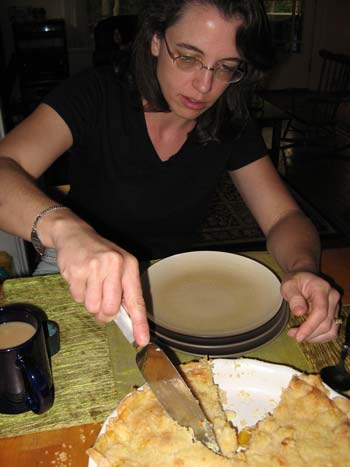
Good friends are the best! We enjoyed a great evening with M The Archaeo and Banjo B, and their lovely daughter! Among the best was M’s peaches and cream pie (sorry, no recipe), mmmm. M says the summer she found the recipe, she made it every week and had to quit when she gained ten pounds!
They’ve just moved into a new place, and somehow have found the time to begin transforming the back yard into a place of beauty. They transplanted all their favorite plants and veggie garden, and we found both tomatoes and peppers among the flowers, including dahlias, and several familiar ones I don’t know the names of.
The apparent downside of our lovely stroll: I seem to have acquired at least two chigger bites!
Posted at 10:22 PM |
Comments Off on Peaches & cream

Here’s a map of distribution of fluted points (loosely “arrowheads,�? but they were really spear points or knives) by county across the US (mostly), current as of 1998, with the density reflected in the darkness of the blobs. The fluted points were made by the peoples who successfully colonized the New World, although there may have been earlier arrivals who did not leave genetic or linguistic evidence of their presence. These data suggest the fluted-point people did not arrive along an ice-free corridor through the Rockies, but instead worked their way considerably southward along the Pacific coast, then crossed eastward from what’s now southern California. Although there’s discussion of earlier and later arrivals from Europe/Greenland, this bunch came from Asia. These fluted points date to the 1500 years prior to 11,200 years ago.
John and I heard the latest on this from Dave Anderson, at a lecture at Fernbank (site loads slowly) recently.
Map from: Anderson, David G., and Michael K. Faught. 1998. The Distribution of Fluted Paleoindian Projectile Points: Update 1998. Archaeology of Eastern North America 26:163–87.
Posted at 5:41 PM |
Comments Off on Fluted points
<

Wall-sign frequently seen across Mexico, but it’s not a national mantra. Avoid excess! Yeah, right.
Today, after I got in a modest increase to the word count by 8:30 am, we played hooky and scooted up to Neel’s Gap to head east/right/toward Maine on the AT, not walking it ’cause it was the AT, but ’cause it was easy access and a good, shady route for a hot day.
No doubt about it, the highlight of the trip was Sr. No-Shoulders, stretched across the path, on the move. Never saw his head, but saw the rest of him from not far below. Down at the end of his tail? About eight buttons. I give him about three feet, at least 32-33 inches. Coloration? Dark, almost black towards the tail, but diamondy closer to the head. Overall, darker rather than sandier. His Linnean name? I’m not sure. Crotalus spp. for sure, but Crotalus horridus (Timber or Canebrake) or C. adamanteus (Eastern Diamondback)? I’ll have to ask F&D….
BTW, No-Shoulders is the generic name for snakes I learned from country people living inland on the South Carolina coastal plain, way back in the 80s when I was working near St. Stephens. I always thought the term extremely evocative. I learned it when well-meaning heavily-accented fisherman kept screaming at me as I was sitting in the water at the edge of a reservoir (water-screening soil samples, of course), and a sinuous beastie, a cottonmouth as I recall, was swimming toward me and my tripod, curious I’m sure, rather than hungry.
Posted at 10:22 PM |
Comments Off on No-Shoulders

Peer-reviews and book publication paradigms are shifting. Nature has announced an online peer-review process, which itself is under discussion online! They ask:
What is the best method of peer review? Is it truly a value-adding process? What are the ethical concerns? And how can new technology be used to improve traditional models?
Yale University Press is even letting the author of one of its titles post a PDF of the book on his own web page for download. The professor: Yochai Benkler, Yale University Law School. The title: The Wealth of Networks: How Social Production Transforms Markets and Freedom.
Without a doubt, the internet and associated technologies like standard file types facilitate exchanges at scales never before possible. I’m loving seeing traditional institutions incorporating new capabilities into their workflows and distribution networks. If I had another beer, I’d probably argue that such shifts are the root of changes we most love to talk about in anthropology!
And the illustration?—statues and roads of Rapa Nui (known back in the old days as Easter Island), showing routes emanating from a quarry in the eastern part of the island published by Carl Lipo and Terry Hunt. Yellow-dot statues (those huge ones) are scattered around the island.
Posted at 5:17 PM |
Comments Off on Institutional evolution
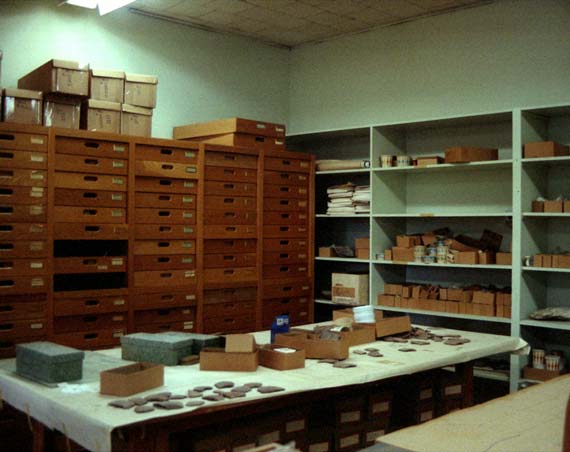

John’s been periodically scanning old slides and dumping the images into iPhoto, for my delectation and for archiving, and I today I poked around and found this picture of the long-time Archaeology Lab from the second floor of Baldwin Hall (yes, at UGA). The lab was eradicated when the cultural hegemony decided that an ecological focus to the Anthro Department was new, hip, and the way to go. Their supreme ignorance was that the archaeologists had been doing this since, oh, at least the 1950s, and way before if you count Kroeber, never mind that the department was established by archaeologists!
This is also by way of mentioning a new blahg by Mouse, who’s in the midst of Freshman finals (I think), supervised by Emily the goose. She (they?) has had several recent interesting anthropological observations, and I missed commenting on one of the best recently when I was in impoverished wifi conditions while in temporary residence in rural Ingham County.
Sorry I can’t get the caption to work for the modified Google Earth image I found on the web: thought it’s pretty darned neat! Here’s where it came from….
Posted at 5:39 PM |
1 Comment »

Sorry I didn’t note the name of the photog who made this wonderful shot of crewing at the Olympics—reminds me of a water strider!
Today’s NY Times reports great news for fans of the nearly absent American chestnut tree—a stand near Albany (say Al-benny, like two guys names), in South Georgia, that appears to be resistant to the blight that’s killed off most of their relatives. Our Southern oak forests used to have a huge component of chestnuts, most of which were killed off in the early 20th c. Some chestnuts do sprout, but are usually dead before they are 20 yrs old, still from the blight. Up in the mountains, loggers as late as the 1960s were removing fallen chestnut logs, because the demand for the wood was so high.
Apologies for repeating myself about the chestnut blight, but I had to pass along this good news….
Posted at 10:22 PM |
Comments Off on Chestnut victory?
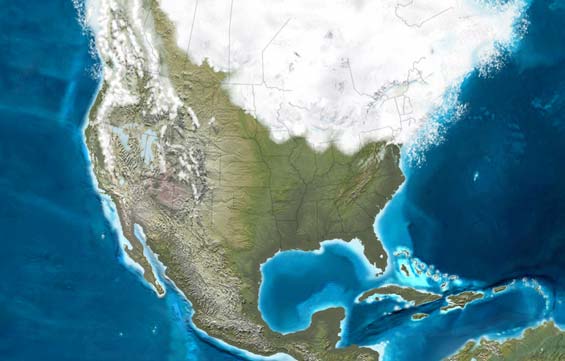
Last glaciation in North America borrowed from this site. Isn’t it gorgeous?
Plotting continental divides on a map can produce some interesting patterns. Here’s a web page John pointed me to that considers the Gulf/Atlantic divide and the drainage divides across Georgia. Note the many parallel linear drainages across the piedmont and coastal plain, I’m guessing because of the longevity of this pattern.
If you’re in the mood to wander the web, you might also be interested in this blog that looks at GIS, geospatial technology, and, okay, I admit it, their intersection with archaeology. The blogger, Matt, posted a link to this nifty site with images constructed of the last 550 million years of North America’s surface geography, like the one above. This is roughly the period when humans arrived in North America, and we’re hip deep in arguments about whether they took sea routes or arrived via a proposed ice-free corridor along the Rockies. Of course, some recent publications have argued for a Pacific Coastal route that was less blocked by ice than shown here and there was no ice-free corridor. Stay tuned to the relevant journals, as this discussion will likely continue over innumerable beers. However, if another golden oldies bunch is right, a wave of hardy vagrants, whose descendents may or may not survived to meet later waves of immigrants, arrived 50,000 to 70,000 years ago, and that would have been earlier than this image.
Posted at 4:35 PM |
Comments Off on Web maps

Superintendent’s house, Fayette, Michigan, a ghost town.
Looking back at my overall impressions of fiction published in English over the last hundred years or so, I keep thinking most stories are best in the first third, and weakest in the last third. Few, however, achieve the elegance Jim Harrison invests in the opening lines of The Beast that God Forgot to Invent:
The danger of civilization, of course, is that you will piss away your life on nonsense. The discounted sociologist Jared Schmitz, who was packed off from Harvard to a minor religious college in Missouri befoe earning tenure when a portion of his doctoral dissertation was proven fraudulent, stated that in a culture in the seventh stage of rabid consumerism the peripheral alwyas subsumes the core, and the core disappears to the point that very few of the citizenry can recall its precise nature. Schmitz had stupidly confided to his lover, a graduate student, that he had in fact invented certain French and German data, and when he abandoned her for a Boston toe dancer this graduate student ratted on him. This is neither specifically here nor there to our story other than to present an amusing anecdote on the true nature of academic life. Also, of course, the poignant message of a culture spending its time as it spends its money; springing well beyond the elements of food, clothes, and shelter into the suffocating welter of the unnecessary that has become necessary.
Not only is this fine fiction, but it is provocative. After all, is rabid consumerism really a foregone conclusion in civilizations? Do you in fact spend your time as you do your money, or are you more parsimonious in one than the other?
What among the unnecessary has become necessary for you? Beyond the internet, I mean….
Read a longer excerpt of Harrison’s story here. Or make the tale “necessary” and dig it up at your local library or bookstore….
Posted at 4:50 PM |
Comments Off on Lace curtains

Yellow stargrass (Hypoxis hirsuta) at trailside, yesterday.
Random bits from the web:
Whoever desires to have their hair grow a lot and to make the head smell very good, should get used to combing the hair, with vulture grease, in the sun. (Find more hygenic comments here.)
Here’s an innovative and well-crafted website about an important 8000-10,000 year-old archaeological site in south-central Turkey named Çatalhöyük. The buildings on this site are similar to the Puebloan housing blocks in southwestern North America.
Archaeologists consider it unethical and unprofessional to buy and sell artifacts, much as physicians would not buy and sell livers or kidneys. But what is subsistence looting? In poorer regions where finding an ancient pot or statue would mean immediate government control, the peasant farmer who unearths such an artifact might instead quickly sell it to a dealer to bring money so an impoverished family will to be able to eat. (Read more here.)
It is clear that 90% of humanity have subsisted on a 90% vegetarian diet. Modern carnivorous men and women are the exception not the rule. (Read more here.)
Archaeology is largely a field subject and, as part of your course, you can expect to be working out of doors for weeks on end, often away from proper housing and facilities. (Read on here.)
Posted at 3:47 PM |
Comments Off on Vulture grease?

We’ve arrived at That Season, when the streets are alight with the glow cast by layer after layer of branches laden with these blooms. We are in the midst of Cornus florida days….
BTW, the Linnean system designates this plant (according to The Web): Plantae>Magnoliophyta>Magnoliopsida>Cornales>Cornaceae>Cornus florida L.
PS Here’s an idea that didn’t work….

Posted at 9:02 AM |
2 Comments »