Garden evolution
Friday, 19 August 2022

This is where I’ve been dumping the coffee grounds. They are fresh…and yet, look, they’ve been colonized! I shouldn’t be surprised, I guess, as I do know that fungi are decomposers.
Friday, 19 August 2022
This is where I’ve been dumping the coffee grounds. They are fresh…and yet, look, they’ve been colonized! I shouldn’t be surprised, I guess, as I do know that fungi are decomposers.
Sunday, 14 August 2022

I got some patio time on a friends’ patio, and found this loverly bloom. Actually there was a pot of them, but I thought this was the most perfect-rime.
Monday, 8 August 2022

Zinnia. Sunflower family. Native to the New World. If this is Zinnia elegans, it’s native to what we now call central Mexico.
Sunday, 7 August 2022

Watching “Emily in Paris” (saison deux) for the exteriors in Paris.
Title does not refer to photo; flowers are not trees.
Monday, 1 August 2022

Bye-bye July. Hello school year.
Basil has no relationship to either of those.
Sunday, 31 July 2022
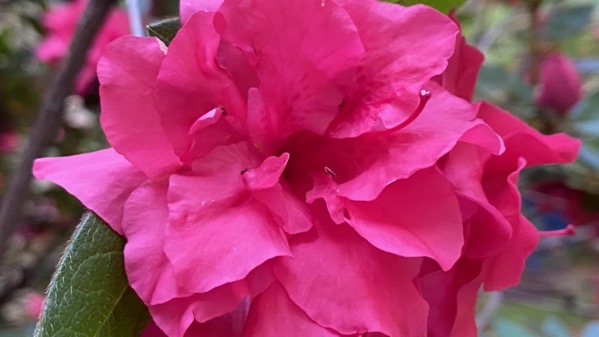
I’m guessing this is bloom cycle five of 2022. This bush is persistent, even though it’s very hot and humid and maybe not the best weather for being a flowering azalea with high energy demands.
Friday, 29 July 2022

Wow. We had some rain come through 5ish and it cooled things off…to a mere 79°F now. Take me back to the equator, please! [Where it’s cooler, at least on the water.]
Saturday, 23 July 2022

Not long after we got on the (major, national) divided highway this morning, we came upon a construction zone, and got shunted over this side route leaving both travel lanes to the repaving crew.
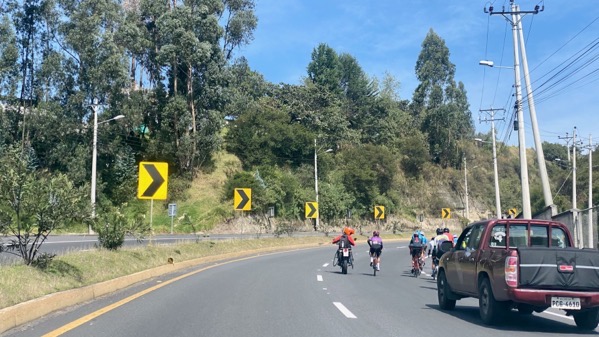
During this morning’s jaunt, we came across several groups of bicyclists, leading us to conclude that Saturday is for bicycle outings and practices.

We also found this wide load (carga ancha). Not sure what it was, but it looked rather like a reviewing stand, with many streamers.

Just off the highway, we made our turn at this church to take a very local road to the parking area for hiking in the Pasochoa cloud forest, officially Refugio de Vida Silvestre Pasochoa.

For all but perhaps fifty meters of the 5.3 km access road, we bumped along at a very slow speed. Many pickups passed us, despite this being such a narrow, one-and-a-bit lane road.

The land use change is the edge of the park, with farmers pasturing animals right up to the forest.
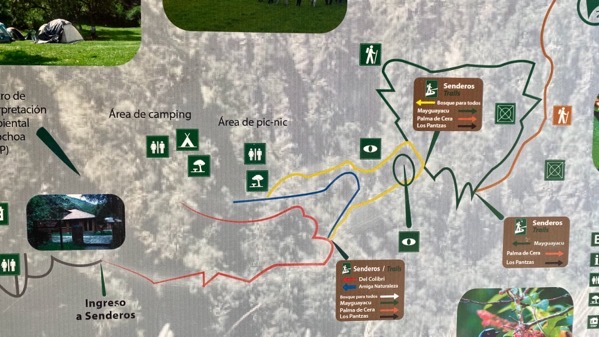
Here’s the map of the hiking trails, aka senderos. We opted for the medium-length middle one.
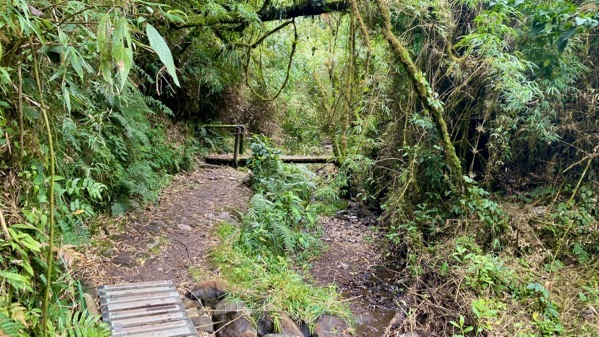
The path was okay, not muddy thankfully.
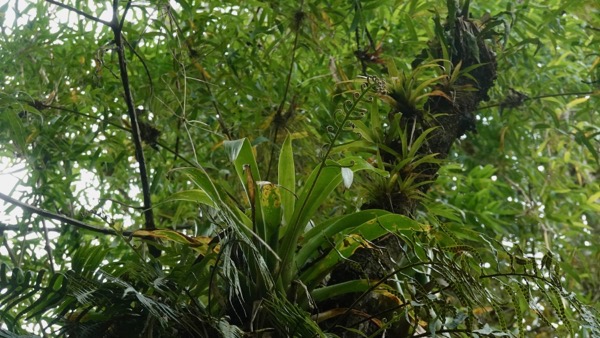
We immediately found bromeliads.

The path was in the selva (jungle), but just in it along the edge of a field. I suspect some of the plants we saw were introduced from agricultural undertakings. Not sure about this, but clover seemed like it was a pasture escapee, as they looked like the versions I’ve seen in fields in North America.
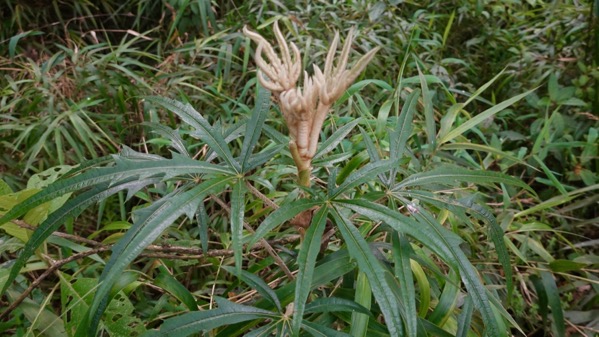
I had one of these, far less vigorous, in my freshman dorm room. I never got to see the new, beige leaflets.

Here is the downside of the path. It went up and up and up, to perhaps 9800 feet (from perhaps 9100 at the parking lot). We took it very slowly, and looked for plants, flowers, and creatures of interest.

I found a slug on a trail marker and heard a very few bird calls. I expected more….

Descending, we found a great valley view. Green green green.

The last feature before the parking lot was a fancy “pic-nic” area. We saw maybe nine of these.

We bumped along that miserable 5.3 km, then took a different route than we came through in the morning, to avoid Sangolquí, which I have nicknamed Traffic Jam Town. This is our turn off the highway to access the route to the hotel. As you can see.
This was a very different day than the previous ones we’ve spent here in the Ecuadorian valleys. Nice to have the diversity. This place is high-altitude for us, and today we really felt it. And survived.
Monday, 18 July 2022

Another glorious sunrise.

Clockwise: husband coffee, wife coffee, husband batman oreos. Actual breakfast followed.

Commonly described as resembling a “Chinese coolie” hat, feast your eyes on Sombrero Chino, the destination of our immediately-after-breakfast walk. [When will this island be renamed for PC reasons?]

It began with a panga tour along a section of the lava-liscious coast, searching for wildlife.

Aha! Close view of a Galápagos hawk. Truly special to see it like this.

Wet landing, then part of the walk was on coral bits. This is the first time we’ve seen concentrations of coral like this.

Lava flow, cooled in place on its gravity-fed descent.

Water meets lava.

We spent some time watching the land iguanas emerging from this space between rocks where they had huddled together for warmth through the night (it was still early). They would stop almost immediately, perhaps doing internal iguana-yawns. Here are two adults and two young.
Back aboard we had lunch followed by our check-out briefing. Sad to contemplate the end of our fabulous excursion in the eastern Galápagos, the part with the older islands—older geologically, so more soil development in general, enabling more diverse plant life.

Afternoon dry landing on Cerro Dragón. This beach had teeny shells and sea urchin spines. Those are the fat tubes in Gustavo-the-Guide’s hand. He said his father and his contemporaries used those spine chunks on slate in school, and thus the common name is pencil sea urchin.

The tide was out a bit, exposing a sandy area with many hermit crabs, mostly not seen. They did leave evidence, not only their burrows, but also these sand balls. They take in the sand, filter all the organic matter that’s in it, then spit out the sand in these little balls.

Sleeping/resting dragon.

Brackish pond.

Stilt? Already forgot.

It took Gustavo’s sharp and well-trained eyes to spot this katydid, right by the trail.

Mature male land iguana. “Doing what they do best,” as Gustavo said.

Mature male iguana in “our” trail. Burrow nearby. Linear patterns in the sand are tail drag marks.

Finch.

View to sea.

Bartender Javier’s preparations are underway for the goodbye meet-up and toasts with the crew. Scarlett the Cruise Director once again went along the crew line-up, detailing their responsibilities and names. [This also helped us with tipping before we disembarked.] Several of us short-timers made a little speech of thanks. I did one in Spanish on behalf of all of us; my Spanish, although still stilted, has come back relatively rapidly after, what?, perhaps twenty-five years of disuse. Good for my brain.

Best tomato soup I’ve ever had. I am not a Campbell’s fan. This has no cream, and includes potatoes. The crew kindly used Google translate to make and print a recipe for several interested guests. The first ingredient was a certain amount of “dad.” Someone among us was clever enough to realize this was a translation of “papa.” While, of course, not an incorrect translation, it was the wrong one here. Papa means papa/dad, the Pope (as in Father), as well as potatoes.
