Musings
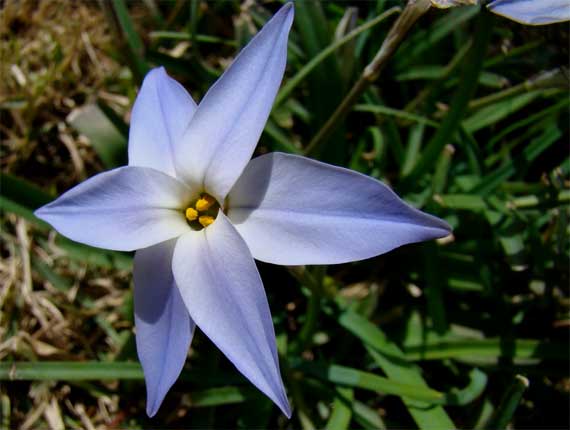
I have it from an extremely reliable source that this is a Star of Bethlehem, which certainly seems like an appropriate name. It’s a lovely bulb-flower that doesn’t linger long. Speaking of bulb-flowers, the daffodils that were flattened a week ago by the heavy, wet snow (still can’t believe we had snow!) are now up and waving in the breeze as if nothing happened.
Posted at 9:22 PM |
2 Comments »

Here’s proof that this year spring is coming later compared to the last few years. This picture is from two years ago, and these guys are still buds today….
Posted at 8:48 PM |
Comments Off on Time travel
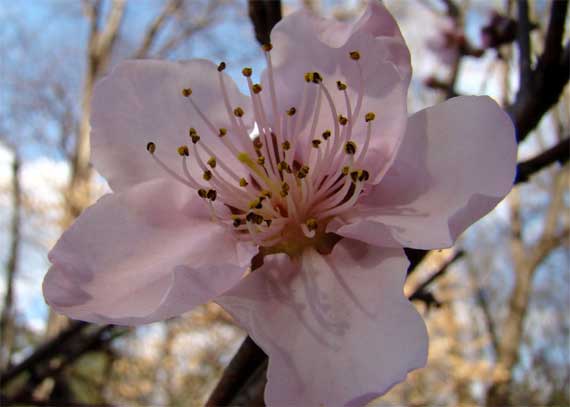
This tree is gnarled and old and heavily pruned, but the few blooms it has this year are huge and spectacular.
Is this a metaphor? Maybe for the desired outcome of all these economic and financial shenanigans*?
* No singular for this term of unknown origin….
Posted at 10:22 PM |
1 Comment »

I know you’re wondering: D Day is in June; what’s that whacky blahgger thinking?
Well, this is the spring D Day, I’m calling it, based on all the daffodils I saw on my walk today—including this one with a peachy-orange center.
Posted at 6:23 PM |
4 Comments »
Our President bids us to look at our (national) finances with honesty and openness—i.e., to use critical thinking and to not exercise denial.
I heartily applaud that. Even though it’s painful.
I look at our household finances, and, um, it’s no fun to do that. Also painful. Actually: painful squared.
I suppose there’s another element in play here. Unlike our government, we’re cheapskates*.
Science comment: while species distribution has long been linked to climate, tada!, it’s not that simple. Instead, more complex issues may constitute the determining factor, as shown by this study of western hemlock distributions in western North America. Climatically similar areas may offer different competitive situations, as with more frequent fires and more disturbance-adapted species keeping the western hemlocks from proliferating in the Rocky Mountain region, as compared to the Pacific Coast region.
* Interesting word: cheapskate. The “cheap” part is from an Old English word referring to bargaining or trade, from the Latin caupo, or small trader/innkeeper. The “skate” part is from a term for a worn-out horse, or for a mean, contemptible, or dishonest person. According to the Mac dictionary….
Posted at 5:38 PM |
2 Comments »

The hyacinths are coming! The hyacinths are coming!
In my dreams I really write well—like Colin Thubron describing an ancient vehicle, still in service: “Already its body was disintegrating, half its dashboard had gone, its radio mercifully dead, and styrofoam belched from its seats.” That’s from pg. 62 of his Shadow of the Silk Road (2006). Here’s a longer passage from that volume (pg. 124–25):
The only purpose in the silk moth’s life is to reproduce itself. During its two-week existence it never eats and cannot fly. Instead this beautiful Bombyx mori lays eggs from which larvae as thin as hairs are born: offspring so light that an ounce of eggs yields forty thousand caterpillars.
At once they start to gorge ravenously. Their only food is the white mulberry, whose pollarded skeletons line the fields of Khotan*. Peasant families exhaust days and nights feeding them, with an ancient care which no machinery can match. Sightless, almost immobile, the silkworm has been reduced by millennnia of cultivation to a helpless dependence on humans. The caterpillars are like neurotic babies. They thrive only on fresh leaves, gathered after the dew has evaporated, and served to them, at best, every half-hour. Ideally the age of the mulberry shoots should coincide with their own.
In five weeks of frenzied feasting they consume thirty thousand times their weight at birth. The munching of their jaws makes a noise like rain falling. Centuries ago the Chinese noted that the colour of their forelegs anticipated the tint ofthe silk they would sping. Abrupt changes of temperature or lapses in hygiene, any sudden noise or smell wreaks havoc with their nerves, and they may die. But after a month each silkworm has multiplied its initial weight four thousandfold, and has swollen to a bloated grub, its skin tight as a drum, with a tiny head.
Then suddenly—when moulted to creamy transparency—the caterpillar stops eating. For three days the future silk flows from its salivary glands in two colourless threads which instantly unite, and it spins these about its body with quaint, figure-of-eight weavings of its head. Even after it has sealed itself from sight inside its shroud, it may sometimes be heard, faintly spinning.
Then comes the ‘great awakening,’ as the Chinese say. Within twelve days, locked in an inner chysalis, the wings and legs of the future moth like folded on its breast. Then it stirs and bursts with dreamy brilliance into the sun.
Here in Georgia we once had, locally-speaking, a large-scale silk industry. It was in New Ebenezer (founded 1736; the nearby original Ebenezer was founded in 1734), a settlement established by Protestant Salzburgers upstream from Savannah, ca. 1740. Read more here and here.
* Khotan, also spelled Hotan, is on the southwest edge of the Taklamakan Desert in far western China.
Posted at 8:18 AM |
1 Comment »
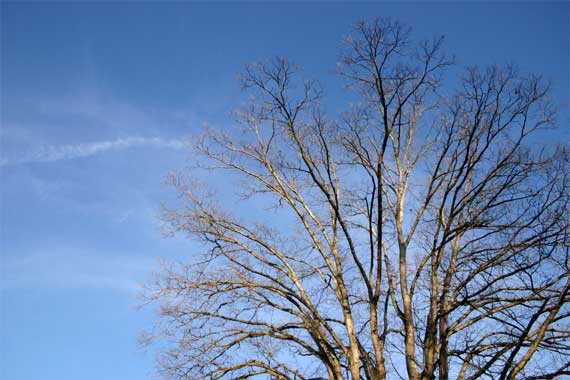
You’ve heard of those studies using indirect methods (e.g., diaries, letters) to reconstruct climate patterns? I offer this photo from five years ago this day. I know it isn’t a close-up, but it still looks approximately like the trees do here today.
Posted at 10:22 PM |
Comments Off on Past is present
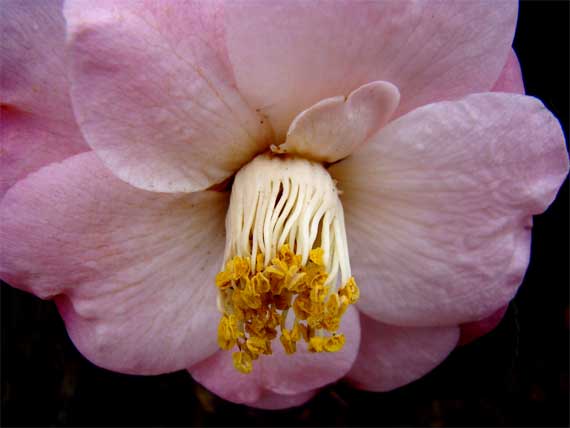
With the drippy-breezy weather we’ve been having lately, the camellias are sustaining damage, yet they’re still bright spots in the transitioning-to-spring landscape.
Posted at 10:22 PM |
1 Comment »
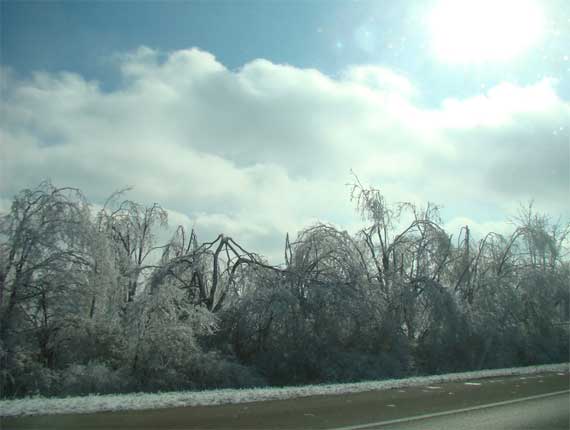
Can you see the splits where limbs have separated?
Driving north on I-75, and seeing the amazing destruction wrought by the ice encrusting the vegetation across Kentucky—and we’re far east of the places we saw on the news. This was a big, bad storm!
Posted at 10:22 PM |
Comments Off on Icy destruction
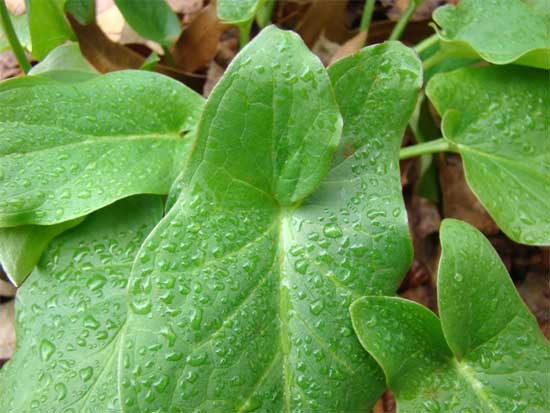
I don’t know if you remember the series of pictures of the jack-in-the-pulpit that grew out of nowhere in my unattended flower bed in the back yard in May through July of last year. I first noted its distinctive look in mid-May. By June, the leaves were yellowing and it was well into its reproductive activities. By early-mid July, the fruiting bodies were beginning to turn bright read, and within a few days most had fallen from the spadix. Now, the cycle continues. Even the cold weather we’ve had lately has only temporarily wilted this vigorous and fun plant from time to time.
Or, at least, this leafy plant is growing in the very same spot, so I assume it’s (the very same) jack-in-the-pulpit….
Posted at 6:37 PM |
1 Comment »