Musings
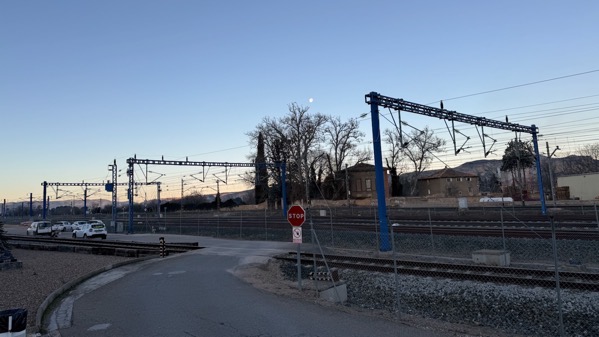
We got on the road before sunup, having quite an adventure trying to get the gas pump to accept our credit cards–no problems yet anywhere else. JCB finally used cash…and we zoomed off….
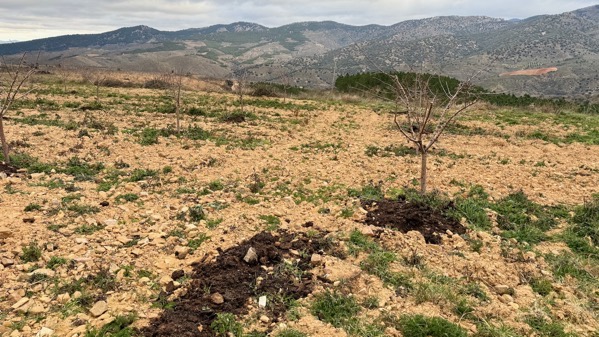
First stop was a ghost town amidst active agriculture high on a slope above the Río Grío, a tributary of the Jalón, which flows by Calatayud.
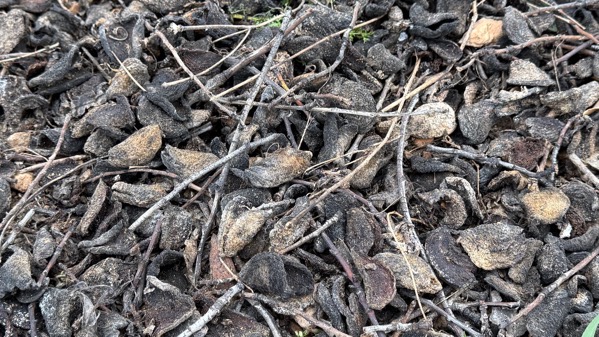
Almond parts: seed/nut, shell, then these: hulls…dessicating and rotting roadside next to an almond orchard.
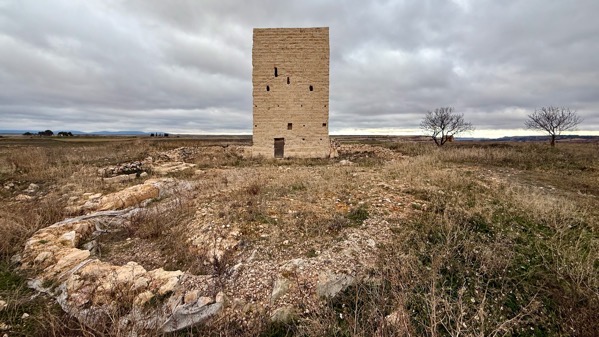
We walked into the Castillo de Langa del Castillo, and found this central tower still standing; a sign indicated the excavated area in the foreground was a church.
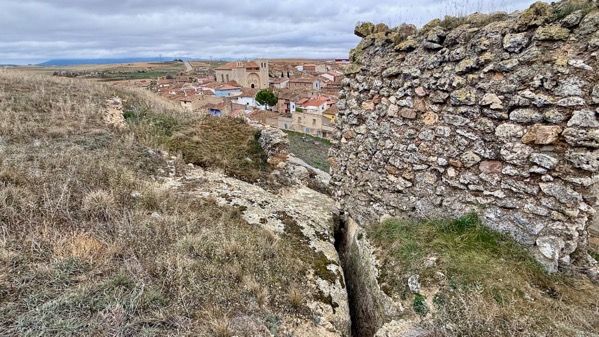
The Castillo fortification has steep walls and only one entrance. Portions of five wall-towers remain. Notes indicate this was a large enclosure for the time. Note how sections of the fort are starting to hive off. Conservation is never-ending.

From one “corner” of the castillo, we could see the piscina municipal below. We’ve seen swimming pools in quite small towns, like this…suggesting there was a provincial or federal program supporting their construction.
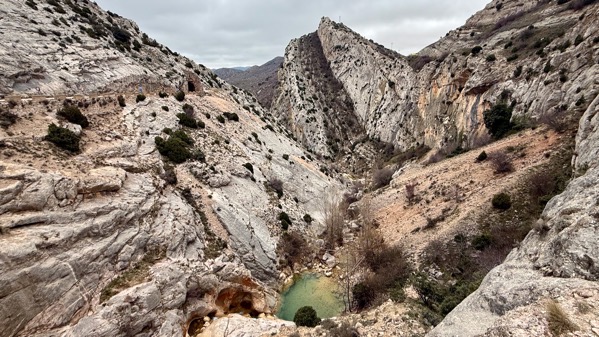
Somewhat later, we zig-zagged through some complex geology/geomorphology along the Río Aguasvivas near Segura de los Baños.
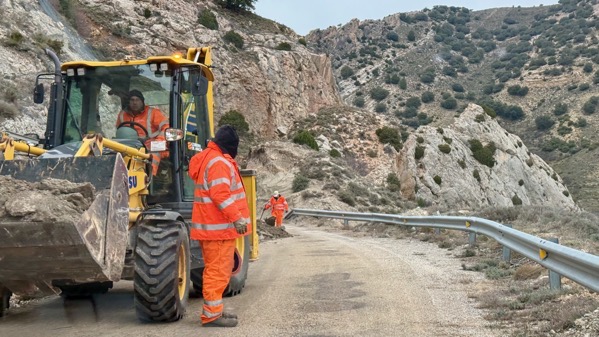
We also encountered a road crew cleaning up after a rock slide. Yes, the car fit between the pile and the guardrail.
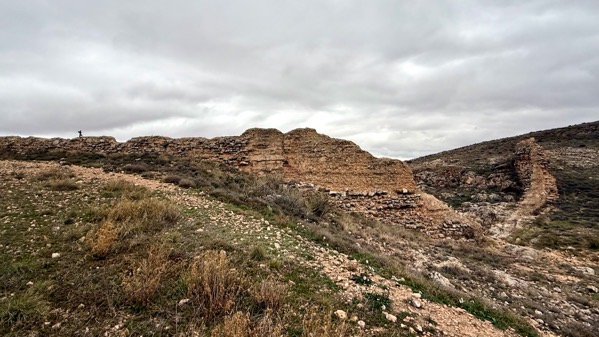
Here’s a look at the upstream side of a Roman dam south of Muniesa. See the curve helping the dam be strong against the weight of the water?
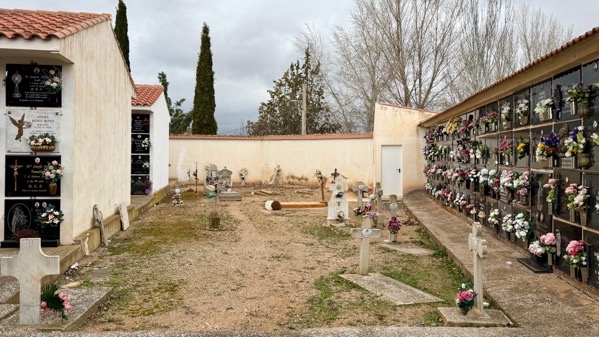
Later, we went toward Muniesa proper, and checked out the cemetery on the edge of town, established in 1903. Most people are planted in a many-rowed columbarium, and I was surprised how many continue to be deposited here. Many plaques note that they were placed by relatives, listed not by name but by relationship: sister, nephews/nieces, cousins. Interesting.

In town, we walked around Iglesia de la Asunción de Nuestra Señora. Doors were locked (we’ve yet to find an open church…although we haven’t been persistent, either.) Note their lovely Mudéjar tower.
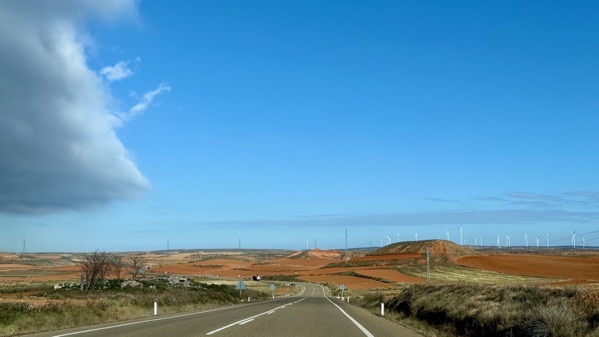
We were so glad to leave the gloominess behind, as it turned out, at the same time as we reached open terrain and commercial agriculture.

Our next stop was a Roman villa in another flat agricultural area, on a low hill. Obv, it’s well-excavated, but not open today (s’okay). The dwelling has a porticoed peristyle layout, with under-floor heating (a hypocaust system). An attached building has two mills and five beam presses, for olive oil. The tanks that received the oil have an estimated combined capacity of >17,845 liters. That suggests the villa controlled a large field area, although their mills/presses could have processed the olives of neighbors, too.
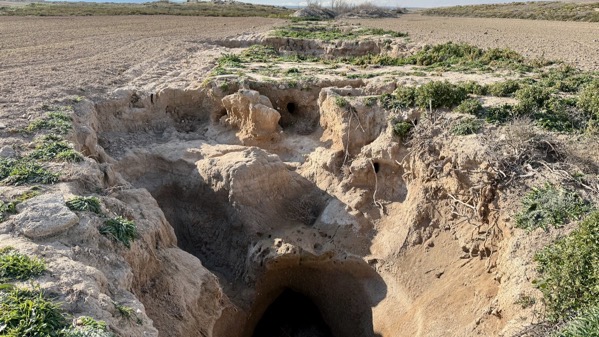
Here’re the remains of a qanat/qanāt, which is an underground Arab (supra-Mediterranean) tunnel system for moving water in arid places. They dig gently sloping tunnels for the water to flow through, with periodic vertical shafts. This is an eroded vertical, with the horizontal visible at the bottom…holding water! I was pretty excited to see this, having read about qanat systems for years.

Near the qanat, we have the best room in the house! Dinner begins at 8:15, and breakfast at 9:30. We’re still adjusting to these mealtimes, which in the evening give me an opportunity to create my posts before we eat. And here you go, you seven gentle readers!
Posted at 1:26 PM |
Comments Off on Water management, more

Towns, cities, even small communities, have a plaza (say: plah-thuh here in Spain). In all but the smallest communities, it seems to me, the largest is the Plaza Major (say: mah-yore (kinda)), that is: the biggest plaza. In Medinaceli, it is substantial.

Medinaceli is more famous for this Roman triple-arch—the only triple surviving in Spain.

As near as I can tell, all the row-crops we saw today were this, which I think is winter wheat, that is, planted in the fall, and probably hard/bread wheat. This is what mono-cropping can look like.

Here’s a smaller community’s main plaza, a place called Deza.

This church presides over a playground for small children with two of those ride-a-critter-on-a-spring toys, plus a combo soccer and basketball court for the older kids. The plaza is behind the church from this location, and is about the same size as the one in Deza. This is Mazaterón.

Meet Peñalcázar; peña means cliff. We tried to get to this Medieval ghost town atop an amazing landform. The wind was strong and gusty, too much to fight our way along. If we’d had a 4×4 we probably could have made it up the two-track you can barely see, at least to the outer wall.

The landform won here, too. We tried to climb to the Celt-Iberian settlement that was above us, and controlled this lovely valley, now partly reservoir. We made it about twice this high before we quit. I estimate we were about a third of the way to the site, but it could have been less. Great views, however.
The site is called Aratis, and it is most famous for the several stunning bronze helmets found I believe by metal detectorists. They date to the later Iron Age, probably the 1st C BC. By this time, the Romans were beginning to swarm southern Iberia and Iberia’s Mediterranean coast. Aratis was inland, and at that time safe from incursions.

At our feet were these spiny plants, Genista scorpius, I think. We also trod on what smelled exactly like sage.

We popped up over the lip of a hill, having climbed out of a valley with a large mill complex, now abandoned, that looked like it was in use into the latter half of the twentieth century…and look what we spotted. The configuration and paint job is traditional in Spain (at least now). Outside of Malanquilla.

What a moon as we left our hotel to do some errands. Almost 6pm in Calayatud. The name is a corruption of the Arabic Qal‘at ’Ayyūb, meaning fortress of Ayyūb. Ayyūb is the equivalent of Job, which at least at that time was a common Arabic name. This Ayyūb was Ayyūb ibn Habib al-Lakhmi, the walí, or, roughly, governor, here of al-Andalus, an official reporting directly to the sultan, or, in this case, the emir of Córdoba. There’s a fine hierarchical bureaucracy.

On the top of the list was to scare up some eats, as almost all restaurants in the city are closed on Monday. We went to a large modern supermarket (skipping Aldi). I spotted this offering, probably about 10 different brands/types on offer. [I edited the hooves from the photo; you’re welcome.] I did not look at the prices, but I suspect they were substantial.
Posted at 3:32 PM |
Comments Off on Architectural forms, history, eats: plus…

I’m guessing that’s a beech, the one with the tan leaves. They hold them very long, and bud out early.
The messy green shrub in front is, I think, some kind of honeysuckle nastiness. I say that because it offers little in the way of pretty.
Posted at 9:32 PM |
Comments Off on Shrubbiness posing

I can’t figure an angle on this photo, today’s weather and news, and what I have read lately that doesn’t seem trite. So, I beg off with a simple goodnight.
Posted at 9:24 PM |
Comments Off on Over and out

Lucky me. The light was so right on these nandina berries this afternoon.
Posted at 9:27 PM |
Comments Off on Sun-lit

Cut flowers are usually shipped miles, often by air. Also, they are often irrigated, including if grown in a hot-house (or similar). Thus, cut flowers are not-green green…and essentially represent a transfer of water from one part of the world to another…where they are thrown out, or sometimes composted (probably with chemicals (herbicides?) on them).
Posted at 9:50 PM |
Comments Off on But they’re pretty

We had rain off and on all day, and I looked out into the gloom at one point, and a sprig of a 5 foot tree in the understory sported bright yellow leaves, such survivors.
I found out today that coral and jade are the 35th wedding anniversary materials.
Posted at 9:55 PM |
Comments Off on Survivors = troopers ?

Can you tell these are ginkgo leaves? They are, and they’ve dropped…one of those mysteries in the plant world is that they fall at the same time. BTW, that renegade garnet leaf on the left is from a maple.
Posted at 9:05 PM |
Comments Off on Drifting yellow

I decree: the lacy maple leaves are electrifying the sunshine.

On another street, I found a fallen sweet gum ball en route to becoming duff.
Posted at 7:24 PM |
Comments Off on Autumn organics

I went out for a quick walk late afternoon and found these dogwood leaves posing in the brilliant sunshine.
Posted at 7:39 PM |
Comments Off on Lucky me