Recipe notes
Monday, 21 January 2008
BTW, I’ve added a couple of new, winter-appropriate recipes….
You might enjoy James’ Borscht Stew, if you’re up for spending more time cooking, or a fast-meal of soup—with myriad variations—I just developed.
Monday, 21 January 2008
BTW, I’ve added a couple of new, winter-appropriate recipes….
You might enjoy James’ Borscht Stew, if you’re up for spending more time cooking, or a fast-meal of soup—with myriad variations—I just developed.
Sunday, 20 January 2008
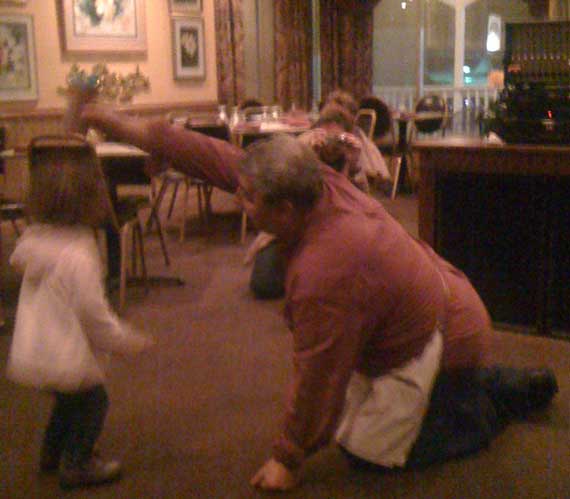
Sometimes the best food comes in unassuming packages. Tonight we ventured into the cold (for here) and had the Family Style Dinner (and more) at Nicola’s, a Lebanese restaurant not far from here. Excellent.
And the best part was when Nicola himself came out and danced, first with this youngster, then with me, then with the belly dancers! Nicola is so smooth on his feet that he can balance a glass of wine, or, here, a kid-cup, on his head without it moving one bit as he gyrates!
Nicola came out first with a tray with a lit birthday cakelet for this kid’s table, and danced a bit, then danced down to his knees, still balancing the burning cake-and-candles, then gestured to the adult b-day celebrant to blow out the candle. As the guest bent forward to do so, Nicola bent backward, more and more, until the guy finally had to get up to blow out the candles! What fun!
Thursday, 3 January 2008

Immature. But which hawk? Sharp-shinned?
Impulse led me to check the Internet Archive to see if Brillat-Savarin’s oft-mentioned 1826 (I think) work, Physiologie du goût (The Physiology of Taste) was there—and it was!
Deep within the text I found a couple of jokes (adapted by me):
Hey, have a raisin.
No, thanks. I don’t like wine in pills.
That cracked me up. Here’s another:
Monsieur (said an old marquise to me one day), which do you prefer: Burgundy or Bordeaux?
Madame (I replied), I have such a passion for contemplating this matter that I always postpone the decision for a week!
Tuesday, 1 January 2008
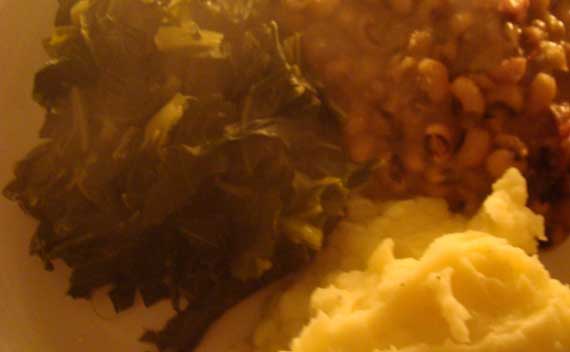
Even transplanted Southerners make sure they work the magic available on New Year’s Day. The Magnificent JPB conjured up pots of collard greens (to bring money in the coming year), black-eyed peas (to bring luck in the year ahead), and mashed potatoes (’cause you just gotta have them to round out the meal), along with cornbread (not shown; included because all true Southern meals have a side of quickbread).
BTW, I haven’t written enough here about my talented BIL, JPB. Among other impressive undertakings, he composes a weekly comic strip you ought to check out. He calls it Grumbles, and it’s outstanding.
Saturday, 29 December 2007
Sunny today, but more rain expected. In a burst of winterliness, we’re having white bean soup for dinner.
It’s also a good antidote for examining theories about civilizational decline and transformation.
Thursday, 27 December 2007
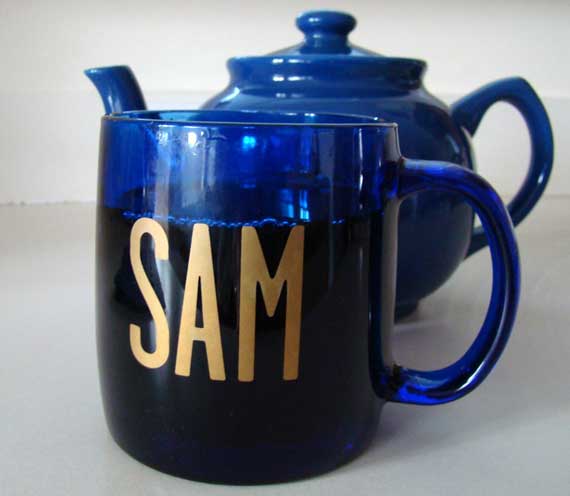
I have a new passion (passionette?): charcoal-roasted green tea aka hoji-cha. Xmas gift. Yamamotoyama brand. Highly recommmended!
And don’t you think my Seattle Art Museum mug is pretty special?
Wednesday, 26 December 2007

A lovely bottle of bubbly we shared on Xmas Eve; hand-carried to us all by S. from Germany.
The OLPC laptops are making a (positive) difference, the WP reports; kids favor especially using the camera and video capabilities. Their story is from very rural Peru. Give one (or more) here. You can choose to get one for yourself, too!
The snooty discriminating French may bow to market pressure and expand the geographic area that can produce effervescent wines that can legally be called champagne. Well, at the earliest in 2009, and the vines won’t come on line until, um, at least 2015…leaving them plenty of time to reverse or adjust the decision….
The NYT has finally published (dated yesterday; hmm, I was too busy to read the paper and missed it then) an article that explicates the anthropologist’s analysis of Diamond’s “Collapse”—basically too much environmental determinism and an unbalanced argument about human decisions. Diamond is a geographer, and gets it a bit, well, skewed (you’ve probably gotten that from me eight or ten times; apologies for the repetition). Yes, climate change is a factor, but, the complexity of cultural evolution isn’t addressed properly in D’s volume. [Reminder to self: get that MS finished!]
Tuesday, 25 December 2007

One huge stalk of Brussels sprouts: that’s the four bucks….
Our non-traditional menu today: chicken cacciatore (mmmm, mushrooms, olives, green herbs, mmmm) with a side of Brussels sprouts freshly harvested from the stalk, a huge green salad, pie. Choice of pumpkin and apple, of course—or both!
Saturday, 22 December 2007
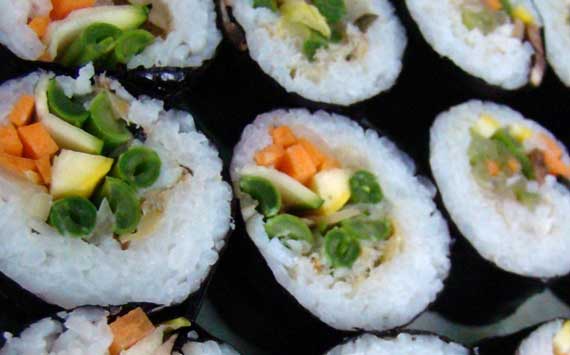
This wonderful veggie sushi is by the Lovely L.
Buffet sushi is not my most favorite way of eating sushi (too much breading and rice and mayo-based goop for my taste), but Ru San’s, a chain that began here in good ol’ ATL over fifteen years ago, does a pretty good job.
We broke up our shopping expedition to lunch at a nearby Ru San’s and I was reminded of an observation I’d made several years back—the guys in the front of the open kitchen are Asian or Asian-American, but the guys farther back tend to be Latino (are they cheaper to hire? more available? what’s the deal?). One guy working today had a perfect Classic Maya profile!
Here’s the link I found with the most info on Ru San’s (after only a quick google), which doesn’t have a real corporate web page, just a stand-in I won’t even link to. Hmm. Business opportunity for my web-page-adept friends? No, must be a conscious management decision…perhaps to make them seem less, well, corporate, and like a chain?
Friday, 21 December 2007
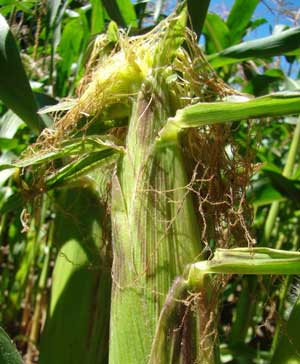
Grain is the closest thing to an industrial commodity: storable, portable, fungible, ever the same today as it was yesterday and will be tomorrow. Since it can be accumulated and traded, grain is a form of wealth. It is a weapon, too…; the nations with the biggest surpluses of grain have always exerted power over the ones in short supply. Throughout history governments have encouraged their farmers to grow more than enough grain, to protect against famine, to free up labor for other purposes, to improve the trade balance, and generally to augment their own power. *
Note: wheat prices on the global market have doubled in the last year.
Implications? Yes, the modern global economy pivots on more than food, but food prices, especially of the underpinning of the modern diet—grain, as Pollan repeatedly notes—have substantive implications, including of sociopolitical instablity.
Archaeologically, evidence of food storage takes myriad forms: below-ground pits, pots and baskets and other containers…. Of special interest: where those were located—out in public view or hidden in a domestic structure….
* From Michael Pollan’s The Omnivore’s Dilemma: A Natural History of Four Meals (2006; now available in paperback!), page 201. Read Pollan’s page here, and the NYT review here.