Musings

I’m still annoyed that they cut those windows into the Coke sign. This was when Fleeman’s Pharmacy morphed into a hip modern (no “e”) kinda place. Actually, the HMKP was closed for a while recently—no, not because of a biz downturn—it was a mooovie set!
Yeah, I’m annoyed even though it’s not an old Coke sign; it’s an 1982 re-creation of an older style Coke sign.
See why historic preservation issues/decisions can make your head ache!
Posted at 6:33 PM |
1 Comment »

This is the house that Vernon built.
Vernon Elvis Presley, that is.
Yup, the father of Elvis Aaron Presley.
And, we’re told, it’s the house where Elvis was born.
Posted at 10:22 PM |
Comments Off on The house that Vernon built

Today we crossed Oklahoma west to east. That’s a lotta miles. We came across the Panhandle to see what communities that JCB read about in Timothy Egan’s The Worst Hard Time (2005; NYTimes review by Elizabeth Royte here) look like today, something like seventy years after the Dust Bowl.
This about sums it up. Some communities we went through were doing better than others, especially as we drove farther east, but many had long-empty buildings, both commercial and residential.
Once again we crossed paths, in space if not in time, with John Steinbeck, who wrote about both Okies/the Dust Bowl people and the people of Monterey Bay (Cannery Row, 1945), where we were in late October.
Posted at 10:22 PM |
Comments Off on Dust Bowl revisited

That picture is not just a visual texture. It’s the roof of Cave 3 at Gila Cliff Dwellings National Monument (natural light; no flash). It took lots of smudge and smoke to get that sooty coating on the stone (although some has flaked away). Realizing this may be of little interest to you, Gentle Reader, I include a second picture.

This is a top-down view of a model of the linked rooms in this same complex, dating to the late AD 1200s. What’s especially interesting is the chain of rooms built across the inside/back (top) wall of the natural caves, and that they all have connecting doorways. This means that people in front had no way of knowing whether people were traversing the back of the cave, perhaps to heighten surprise during a ceremony viewed by an audience in the front of the cave?
Posted at 10:22 PM |
Comments Off on Cliff dwelling details

Most of the time we were at Casa Grande today, we were thinking about ancient times, when Hohokam farmers kept irrigated fields between and around their mounds and houses, out in the flats near Coolidge, Arizona—not quite so near to the modern town of Casa Grande. One of those quirks….
Anyway, people go to the Casa Grande ruins to see the ruins, and we did, especially the big ruin protected from the rain by a big FL Olmsted-designed roof. We also spent time gazing up at this Great Horned Owl (Bubo virginianus), denizen of the roof, keeper of the ruins, and demographic controller of the immediate area (for selected species).
Tidbit from USPS website: “Did You Know? Casa Grande Ruins National Monument was the first cultural and prehistoric site to be protected by the United States government. It was set aside in 1892 by President Benjamin Harrison.“
Posted at 11:22 PM |
Comments Off on Owl’s classy digs

On a lark (haha), we stopped and did a quick walking tour of the remains of the mission San Juan Capistrano. I didn’t notice any swallow nests, except for a display on them.
Not surprisingly, the part of the grounds that I found most interesting were the ruins and the little bits of covered archaeological excavations.
Posted at 11:05 PM |
Comments Off on In ruins (swallow your tears [haha])

I know you probably heard the travel news of the day (alternately, the infrastructure deterioration problem of the day): San Francisco has another bridge closed from parts failure.
Fortunately, we didn’t plan to cross that bridge today, but we did plan to cross the Golden Gate—southbound. And this is what we encountered. Southbound lanes were squeezed to two, and the other four lanes were a flood of cars coming out of downtown. We made it just fine through the funnel of four-lanes-to-two, since out here people drive right up to the funnel before reducing lanes—smoothly and graciously—none of that get into the reduced lanes a mile back from the funnel, then frown at those who don’t also line up far from the funnel (if that makes sense).
We also wandered a bit through the decommissioned Presidio, very fascinating, but that’s a story for another day.
Posted at 10:22 PM |
Comments Off on The public trust…
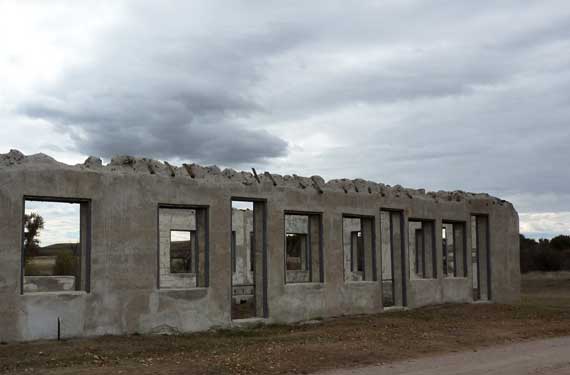
The sky had been pretty darned clear, extending from horizon to horizon as is common in the west, then, as we were arriving at Fort Laramie, the historic fort not the town, the clouds appeared overhead. So we toured the parade ground and open buildings under dramatic swirling greys, catching a few drops as we scurried for the car after checking out “Bedlam,” the boarding house (if I recall correctly) that is the oldest standing historic structure in Wyoming.
This ruin may also have merited the moniker Bedlam, but is properly called the administration building….
Posted at 10:22 PM |
Comments Off on Visiting “Bedlam”
…you’d be home by now!
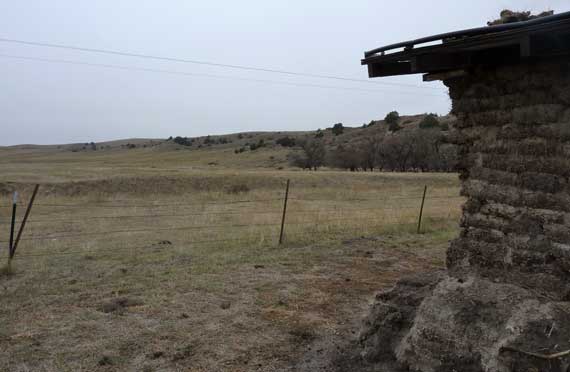
Viewed under homogeneous blue-grey skies, sod house life struck me as rather tedious and grim. In sunshine: perhaps not so much.
This sod house in far western Nebraska is open to the public, with an interior bare of accoutrements and even wall stucco/plaster, and thus hominess. The walls appear to have had two thick layers of sod, but the outer one has mostly eroded away—or maybe it was just double along the lower part of the wall, for buttressing?
As to the roof, it’s been updated, as traditional sod house roofs are no picnic and take lots of maintenance (and leak when it rains). I love that they put enough soil on the metal roof so it looked more like a soddy (although some has washed off), and prickly-pear cactus have colonized it.
Posted at 10:22 PM |
Comments Off on If you lived in a sod house…
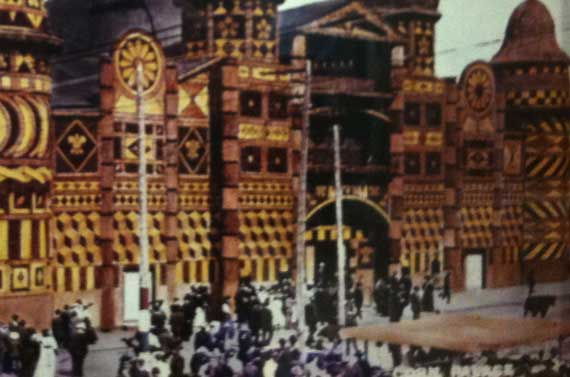
Is this an “Only In America” place?
A building decorated annually with murals made of food?
The Heartland contrives some interesting promotions, then perpetuates them for generations.
You may recognize this building from this historic photo; it’s the Mitchell Corn Palace, originally the Corn Belt Exposition. For more info, try WikiPee or their own (cringe) website.
Posted at 10:22 PM |
1 Comment »