Musings

We stayed up late (as in: after dark) last night chatting on the lanai/patio. At least three of these little lizards showed up to hunt bugs around one especially bright light. I hadn’t seen these pale ones before. This one has a shortened tail.

This morning I felt like I needed fluids. I doubled up with coffee and kombucha. After two portions of each, I felt not-quite-so-dry.

Our big expedition was to the Pearl Harbor Memorial. They’ve been fixing the landing dock for over a year, and we could not land, so we motored by, with first one side of our boat facing the memorial and then the other side, as passengers were required to stay seated at all times. The flag pole is attached to an original part of the Arizona‘s mast. The white float far right is above the bow. It was a solemn visit. The 20+-minute video before we boarded the boat was excellent; visitors were instructed not to talk during it and indeed (surprise), people were quiet.

Mid-afternoon, the Guru and I entered Puowaina, more commonly known as Punchbowl Crater. More military dead are interred here, in the National Memorial Cemetery of the Pacific. I believe the current tally of dead exceeds 53K; markers are all flat, which contrasts with Arlington National, for example. We were surprised that the floor of the crater is so high.

Then, we went to the core of the civic-ceremonial and governmental section of Honolulu. This is the ‘Iolani Palace; construction began in 1879. It replaced an earlier building that dated to the early 1840s (if I have it right), built during the reign of Kamehameha III (born 1814; died 1854; reign 1825–1854). This building dates to the reign of King Kalākaua (born 1836; died 1891; reign 1874–1891). TMI?

This fenced area is on the palace grounds; it is a burial mound and super kapu (forbidden—because of its extreme sacredness). The lands around the palace, including other city blocks, was part of a royal sacred area prior to the arrival of foreigners. Behind the fence on the back side, I saw a guy shooting up and that was during an idle glance; that was not something I wanted to see (and have seared into my memory). Elsewhere people were sleeping on sidewalks and on the grass. Homeless problem here, too, in that end-of-the-road way….
Posted at 12:32 AM |
Comments Off on Sacred places

We trekked to Manistique and parked by the historic water tower and a cozy, small historic house that was the home of a friend of my grandmother’s.
Quelle surprise! Both were open! This is the view from the window at the stairs next to the small bedroom under the roof. I liked the pattern from the lace curtain very much; however, I don’t think it is “antique.”

Those two buildings are right next to the famous siphon bridge, which only did the siphon thing for about eight decades. The surface of the bridge was below the surface of the water (yes, it’s possible), and beneath the bridge the water was deeper, and this “sucked” the water beneath and past the bridge, and removed much of the pressure of the water level being higher than the deck of the bridge. If I understand correctly.

Despite the date on this plaque for construction of the siphon bridge, 1918, the centenary was celebrated this year. All other info we read indicated the bridge dates to 1919. These discrepancies happen with historical archival info.
Posted at 9:37 PM |
Comments Off on Manistique news

The Île de la Cité will never be the same. The gargoyles are still coughing (I’m pretty sure).
Posted at 6:18 PM |
Comments Off on Hot mess

These cormorants are waiting for whatever cormorants wait for. Food? More than food? These rocks were under many more feet of water for decades in a huge mill pond.

Downstream of the cormorants, some of the later mill buildings survive, most repurposed as river-front apartments now that the dams are gone and the water is white, as it was through the early 1800s. This is the Chattahoochee at the Fall Line in Columbus.

Now, venturesome people in funky short kayaks dare the once-again fast-flowing river to overpower them. [This guy was just fine; this moment looks scary, however.]
Posted at 9:25 PM |
Comments Off on River stories

Gentle Reader, you may have noticed by now that I notice patterns…not all patterns, but certain ones. Like this…

And this….
Not entirely symphonies in grey (not tightly related to the patterns), but close….
Posted at 9:49 PM |
Comments Off on Distorted grids
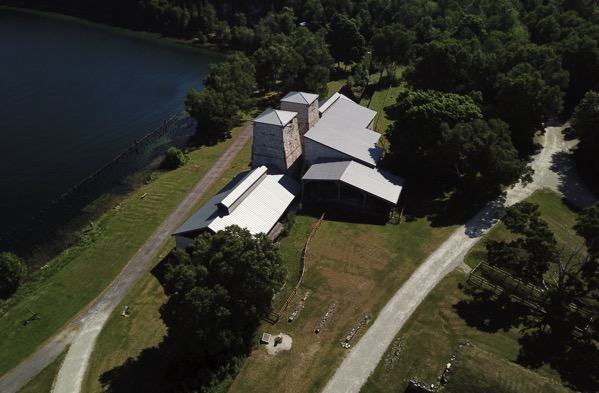
We headed out early, down the Garden Peninsula to the ghost town of Fayette. Here’s the business part of town, where workers made charcoal pig iron for 24 years. The market began to decline and the hardwoods they made the charcoal from were no longer nearby…and, pfft, an industrial town went out of business.

I always take harbor-pilings photos. The water seemed higher than the last few years.

We made our return via Kitch-iti-kipi, the Big Spring. Love the raft ride, powered by park visitors’ arms.

More trout(?) that I ever remember seeing swam in the depths as we made our slow crossing and return.
Hot day; good day to avoid outdoor chores by going sight-seeing!
Posted at 9:16 PM |
Comments Off on Excursion SW day
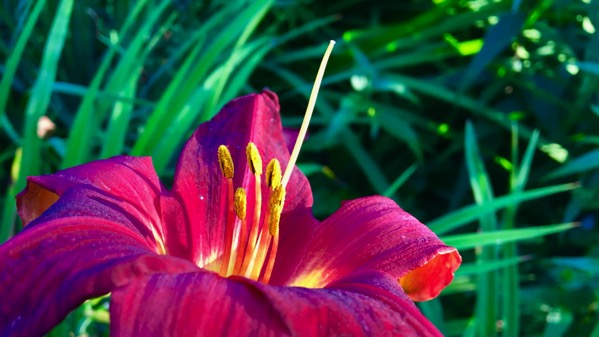
I was out early as temps were predicted to reach 90°F, and the low-angle sunlight was stunning on this lily.
Indoors, I did some reading about khirigsuurs, Bronze and Early Iron Age civic-ceremonial monumental stone constructions in Mongolia I’d not “heard” of before. I did not find out how the word is pronounced, although GooTranslate indicates it includes Mongolian, but the software/database doesn’t “recognize” the word khirigsuur.
Posted at 8:39 PM |
Comments Off on Expanding my horizons

Oh, look! Last night’s rain here was snow on the peaks!

Off to the last museum of the trip (right???). Turns out no photography inside. [Mr. Plaid is a ringer, not a member of our party.]

Thankfully, there’s a sculpture garden and scattered monumental art. This is a giant Apache Spirit Mountain Dancer (Craig Dan Gosayun, 1995).

We looped by the Rail Runner, the train down to Albuquerque. Oregon and Michigan have the same problem, in that the capital city is not the business center of the state. Here, they’ve implemented a train to zip commuters back and forth. Yay!, New Mexico.

Beautiful sunset light on our compound’s main residence.

Will miss the flowering shrubs…this place is lovely. [Surveyors were here today marking off lots in the land that’s presently part of the property, so I suspect the main house and the casita will be amidst many houses, driveways, and hubbub, and not the quiet oasis in the high(ish)-altitude desert that we are enjoying. Sigh.]
Title refers to exclamation overheard from an 83-and-a-half-year-old this evening during a viewing of a few food pictures from our recent France trip; she may have had just too many pinto beans.
Posted at 9:25 PM |
1 Comment »

We visited an ancient pueblo (village) atop a mesa today…still without electricity and with perhaps fifteen year-round, permanent residents. This is the view down; I have no good shots of the view up at the plateau-top architecture. This is considered the winter housing, roughly, of the people. In summer, they mostly lived down by their fields on the flats below.

There are no flowing water sources atop the mesa, and this was an open cistern the people used anciently, and empty today. Residents now customarily drive water in barrels and plastic containers up the steep, paved road to their homes. Part of the road is visible in the first photo.

These are among the documented oldest walls/homes in the pueblo. Using a cannon and other means, Spanish thugs destroyed much of the pueblo in 1599, so the many buildings standing in the 16th C were more than decimated.

This is a double ladder to the roof of a kiva that post-dates the Spanish destruction. The Spanish were keen to convert the Acoma to Christianity and get them to abandon their pagan practices. But the Acoma people disguised their previously circular kiva ceremonial rooms by making them rectangular like the house rooms. The second ladder behind the double one descends into the kiva. Except for a few special events, only men entered the kivas. Our guide, the young woman shown, did not say if that is still true, but I’m guessing it is. The Acoma are matriarchal, and the women own the homes, fields, crops, and most other household items.

This humped structure is a baking oven, used for food not pottery. These days, I’m guessing they are mostly only used at special times of the year, and not on a weekly/monthly basis.

That snow-dusted mountain in the far distance is Mount Taylor, a sacred place to the native peoples of this region. The beams supporting the roof of the early 17th-C church atop the mesa were cut on the mountain and brought by the men of Acoma under order and direction of a Spanish priest. The Spanish did not permit four special beams used in the altar to touch the ground during the whole process of carrying them BY HAND (not using animal labor) to the church. What high-handedness.

Okay, switch gears. This is the walkway to the casita the Guru and I are staying in, an independent outbuilding of the main house, where the rest of the party are staying. The whole place is lovely, wonderful, and relaxing. Except maybe this stepped path for The Foot—no, really, it’s good exercise.

Here’s the view from the living room area of our casita. See? Relaxing.

We went to a nearby restaurant for our evening meal…boy, are we lucky; the food is outstanding; I mean, it could not be better. Oh, yum. This is a version of chile relleno I’ve never had, with a splayed roasted chile stuffed with a mixture of corn kernels, mushrooms, and pine nuts, with a bit of cheese on top. Soooooo tasty. I expect we’ll be eating here again, perhaps as soon as tomorrow. We shall see.
Posted at 11:45 PM |
1 Comment »

Kinda drippy, so we drank coffee and pondered the universe, leaving just before the drippiness was predicted to end at noon. The large building on the left is the main building of the École Militaire complex, a military school for training officers, founded in 1750. Thought it appropriate that two Jeeps awaited a green for their left turns….

École Militaire is also a Metro station, one of those close to our habitation.

We took a train (no changes!) to the Bastille station, about a half-hour ride. When we emerged from the earth, the weather slowly clearing. This is the monument in the Place de la Bastille. Of course, the famous prison is long gone. It initially was built mostly in the late 1300s as a fort to reinforce the east side of Paris and to protect the adjacent city gate, Porte Saint-Antoine, with its drawbridges; the building was modified over subsequent centuries. Within decades, the fortress was sometimes used to hold prisoners; by the mid-1400s, it was the state prison used by the king, who also hosted dignitaries there—a multifunction complex…. Anyway, that’s an older version of the prison that became the symbol for the revolution in July 1789. By November of that year, the prison was mostly destroyed. By 1792, the area was a square honoring liberty, with a central fountain added in 1793.
The name bastille is probably rooted in bastide, a medieval term for a fortress. I don’t know if the term was attached to this fortress from the beginning, or the name came later….

Part of the ditch that fortified the Bastille is now the Bassin de l’Arsenal, mostly used by houseboats—some quite commodious. It was a commercial port until 1983. That boat on the left is named Ypie, I’m thinking the pronunciation is yippee.

We followed the lock (écluse) to the Seine and turned downstream toward the famous islands. This was in the upstream park on Île Saint-Louis. Pretty!

At the other end of the island, we lunched at a brasserie we’ve visited several times before. We discovered it was unusually jammed by many tables of rugby fans, in Paris for the national playoff (I think). Rah!
The Guru had a ham and cheese omelette with fries; I had a pork shank, roasted with homemade applesauce. I took a gamble on my dish, not even looking up jarret de port grillé before ordering. Sometimes you have to live on the wild side (even if it’s a limited wild side).

After escaping the sweat-inducing heat of the dining room, we headed on to the Île de la Cité, arriving on the “back side” of the Cathédrale Notre-Dame de Paris. The building was once painted, and not the stained browns it is now; I have no idea what colors/patterns. I wonder if it’d be safe to assume that most of the exterior was in the cheapest colors; some paint pigments (pigments de peinture) were quite dear in older times.

We crossed a bridge and began to work our way along the south bank, periodically looking back at the stubby towers of the cathedral. Even stubby, they’re pretty darned tall! By the way, the cathedral’s bells (cloches) are named—mostly with male names, but not exclusively.

Many boats (bateaux) passing by, many large and packed with tourists either on a tour or using them as a taxi between places of interest. This one was an unusual cargo vessel, even transporting a car.

This is the third gal we’ve seen in bridal gear being photographed (bride is mariée). She looks quite happy. Behind the photo crew were several women in jewel colored gowns—emerald, royal blue—and one in black. I assume they were the bride’s attendants.

I got out the macro lens and looked at mosses that have taken up residence on the railing above the river next to the sidewalk. They are slowly breaking down the stone/concrete. Moss is mousse, which is also the word for foam on top of a latte (latté).

We made quick groc-shopping stops just before heading in for the night (tired feet! happy tourists!). This was in the window of the bakery…pain bio means organic bread.
Posted at 2:47 PM |
Comments Off on Water-centric exploring