Musings

Yes, I know this is dill….
On more than one occasion, I have thought that Mark Bittman has made an astute observation about food and flavors and cooking.
I don’t get this, though. He says “at a quick glance” lavender and rosemary “resemble each other”.
NOT! (says The Botanist’s daughter…)
Posted at 8:37 AM |
Comments Off on Morphological similarities?

I took this picture several days after the tree fell, when I needed some pretty. This has been a long week, and when I look at this picture, the stress is diminished.
Posted at 6:46 PM |
Comments Off on Soft rose
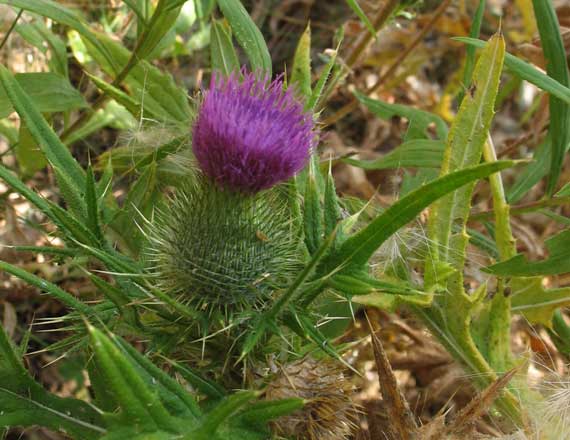
I know we “did” thistles the other day, but I ran into this picture from a year ago today when a select group of us went to Seney on a picnic and photography excursion.
The Botanist, if I remember right, said this was an introduced species, and he called it a Russian thistle. When I google that phrase, the search is dominated by tumbleweed entries—apparently that’s another common name. But that doesn’t mean The Botanist wasn’t right!
Posted at 10:22 PM |
3 Comments »
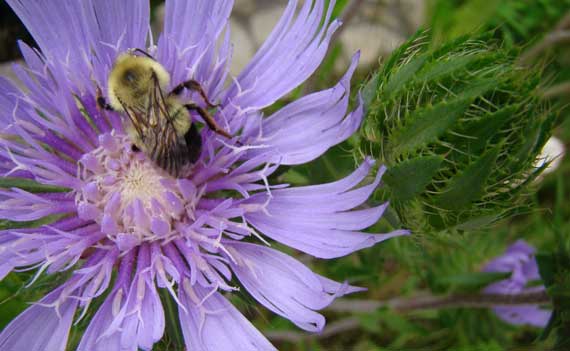
When I was a kid I thought a teasel* was probably a kind of thistle**, because they were both prickly, which is a good defense against wandering herbivores. It turns out that botanically they’re in the same class (Magnoliopsida—more or less), but that’s the closest they’re related.
I snapped this at the Bot Garden the other month, so this is probably a non-native and it may not even be a thistle, although it resembles one (sorry, I neglected to take notes while I was photographing). Love the bumbler….
* Apparently teasels are favored by some weavers for brushing new fabric to raise the nap, and they were cultivated to assure a proper supply. Who knew?
** In Celtic symbolism, thistles and burrs apparently refer to nobility of character and of birth, a lovely thought for what I think of as annoying weeds that typically grow in poor soils.
Posted at 5:07 PM |
1 Comment »
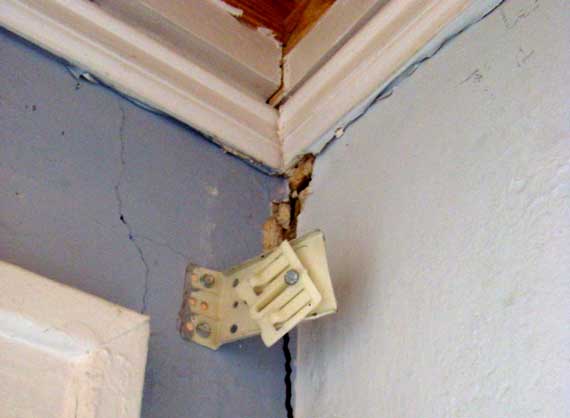
Okay, two pictures and two themes today. Above is the corner of the dining room that the tree trunk was sitting over. Being exposed to the summer heat and humidity has made it degrade a bit since the tree departed. And I don’t know what else. That’s the original plaster from when the house was built about 1921.

On a brighter note, here are some of our neighbors’ drought resistant blooms, still glorious in spite of the heat we’ve been enduring lately. I checked ’em out when I was over there “borrowing” some basil, which is right next to this bed….
Posted at 4:15 PM |
Comments Off on Two themes

Check out the pollen in the flower-center to the right of the image….
If you had asked me, I would have told you that I thought lilies always had smooth petals. And I would have been showing my ignorance.
Posted at 10:22 PM |
Comments Off on Lily close-up
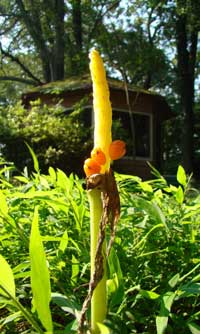
I could not have predicted that I would track this plant through its growth cycle. I’ve sure been enjoying it, though!
This is the fourth blog entry with a picture of this rogue jack-in-the-pulpit (Arisaema triphyllum) that appeared in the spring in an untended flower bed in our backyard.
Over the last week or so, the plant’s been throwing off its ripened berries, and is now down to the last three at the base of the spadix. Yes, that’s the botanical term for the “jack,” which is now left to dessicate, having done its work. The seeds are thrown out up to several feet from the plant. I say thrown out like I saw them spin away, but I haven’t; I’m just surmising.
This sets me up for next year, when I can see if any of the daughter plants germinate! Maybe I should continue to leave this bed untended….
* 1) Good title? Did you really want to check out the text?, and
2) sorry if you thought it was, but this is not a typo of a reference to James Spader (sigh).
Posted at 10:36 AM |
Comments Off on Near-naked spadix*
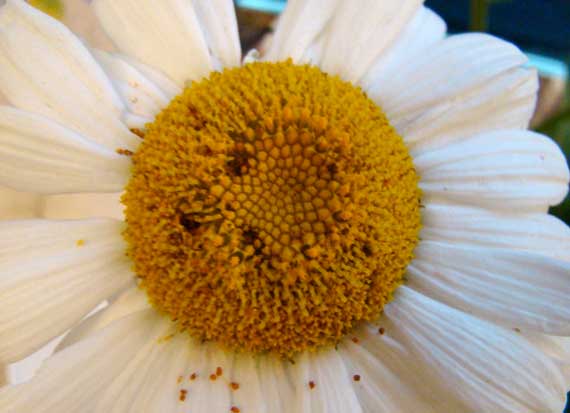
Shasta daisy, The Botanist says, which apparently has a nasty odor, but I didn’t notice that….
I’ve been thinking about these vociferous charges of flip-flopping rife in the media, finding them ill-considered, over-simplifying, and unsophisticated. Then, today, on the George [Long Name] show, I heard, of all people, Arnold Schwarzenegger say:
Flip-flopping is getting a bad rap.
He went on to say it’s “wonderful” to change your mind after getting new data or thinking things through again.
Just what I was thinking.
Posted at 8:53 PM |
1 Comment »
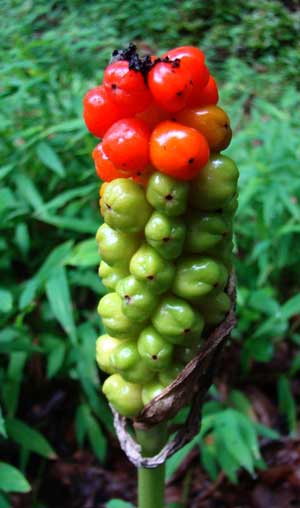
You’ve seen this jack-in-the-pulpit (Arisaema triphyllum) before.
The first picture I posted of it was when it was in bloom. That was mid-May.
By mid-June, it had transitioned to a green fruiting stage.
Now, in (almost) mid-July, as you can see, the fruiting bodies are turning a brilliant red.
I am still mystified that this plant appeared in my untended flower bed in the backyard…. Maybe it’s only there because it’s rather untended?
Shortly after I made the post yesterday bragging about how much roof has been constructed, the heavens opened and the crew got soaked getting the tarp installed. I didn’t blame them one bit for knocking off early, although the rain didn’t last that long….
BTW, judicious water withdrawls and incremental additions from summer storms mean levels of Lake Lanier, Atlanta’s main surface water source, still 15 feet below the normal (or expected? or desired?) summer levels.
Posted at 9:44 AM |
Comments Off on Fruiting pulpit
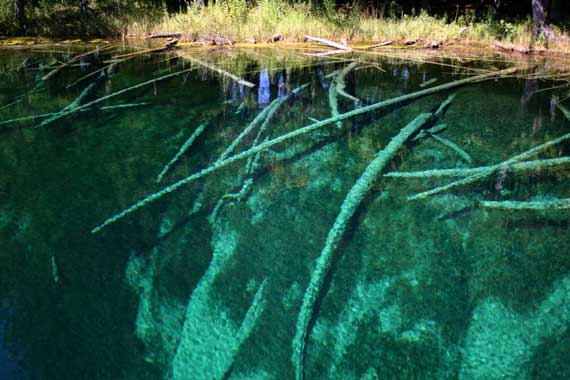
Look at the stored carbon in Kitch-iti-kipi, near Manistique, Michigan (2005 photo).
I think I have this right. Carbon levels in the air are affected by how much is emitted into the air. Reduce the amount entering the air (or reduce the amount already in the air), and we’re ahead.
So, one way to keep carbon out of the air: dead trees that don’t emit the carbon they hold. This article says by keeping dead trees emerged in water stores their carbon. Makes sense, they’re still trees, albeit waterlogged, and still holding their carbon.
What they don’t say is that if the trees are converted into building material or sculptures or whatever, it seems to me that stores carbon, too. It’s not decaying, so it’s not releasing its carbon….
Lesson? Cut more trees and keep the wood around.* Either submerged—or in your coffee table?
The difference, I guess, is that you can sell the fact that you’ve submerged the trees as carbon credits, but not that you’ve turned logs into lumber and into furniture, etc. Those you have to sell as material objects.
* Damage to the environment…priceless?
Posted at 9:21 AM |
Comments Off on Submerge that carbon